230 books match the query 'Doctrines' and 10 start with r
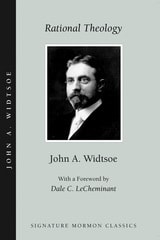
cover of Rational Theology

Rational Theology

John A. Widtsoe

Signature Books, 1998

The decades framing the turn of the twentieth century constituted a period of progressive optimism, of increasing faith in science and technology, and of character-building education—vividly illustrated in the founding of Christian Science, for example, and in the Latter-day Saint magazine, the Improvement Era.

In keeping with the times, it is not surprising that former professor of chemistry and university president John A. Widtsoe was called to the LDS Quorum of Twelve Apostles in 1921. An inheritor and promoter of “reasonable” religion, his popular book, Joseph Smith as Scientist, and his influential LDS Melchizedek priesthood manual (later released as a book), Rational Theology, underscored his and other Mormon leaders’ positivist assumptions about the world—that science was good, that Mormonism would be proven true, and, drawing from Herbert Spencer’s application of evolution to ethics, that society would be perfected.

Like Widtsoe’s secular books (published nationally and internationally by Macmillan, Webb, and J. Wiley & Sons), Rational Theology would enjoy multiple printings domestically and several foreign translations. Although his other church writings (Evidences and Reconciliations, The Gospel in the Service of Man, Guide Posts to Happiness: The Right to Personal Satisfaction, and others) proved to be influential, none so thoroughly summarized his embrace of science and Mormonism as Rational Theology.

John Andreas Widtsoe was born in Dalöe, Island of Fröyen, Norway, in 1872. He immigrated to Utah in 1883 and graduated from Brigham Young College in 1891 and from Harvard with high honors in 1894. Widtsoe married Leah Eudora Dunford, daughter of Susa Young Gates, in 1898 and had seven children. In 1899 he was awarded a Ph.D. with high honors from the University of Göttingen, Germany. He both taught at and served as president of Utah State Agricultural College and the University of Utah. He was elected to the Victoria Institute in England, an honor received by only one other Mormon scholar—James E. Talmage. Widtsoe served as editor of the Improvement Era and wrote more than thirty books, including religious, autobiographical, and professional publications. His essay on LDS temple worship has been included in the new edition of The House of the Lord: A Study of Holy Sanctuaries Ancient and Modern. He was an apostle from 1921 until his death in 1952.
[more]
cover of Religion and Economic Justice

Religion and Economic Justice

edited by Michael Zweig

Temple University Press, 1992

As Eastern European economies move to capitalism, many people there hope for a better life. But capitalism is no guarantee of prosperity. Economic deprivation, war, social marginalization, and powerlessness mark the lives of millions and spark social movements for economic justice aimed at correcting these conditions. Often these movements are based in religious communities, their activists motivated by religious commitment to human dignity and the need for personal empowerment. Although the new theology contains an economic critique, little dialogue has taken place between the religious and economic communities on matters of economic analysis. Religion and Economic Justice seeks to develop this exchange.

This book contains original essays by distinguished contributors from economics, religious ethics, and biblical studies. The authors provide a powerful critique of the individualism which underlies mainstream economic analysis and which fragments our communities, a critique that extends to the values implicit in the market system. The authors also show how social marginalization and economic deprivation are the consequences of economic organization, not simply the failings of individuals.
[more]
cover of Religion, Order, and Law

Religion, Order, and Law

David Little

University of Chicago Press, 1984
"The issue of the Protestant ethic and the spirit of capitalism has been debated endlessly, but few scholars have seriously continued Weber's own research into the Reformation sources of seventeenth-century England. David Little's study was one of the first to do so, and remains an important contribution."—Guenther Roth, University of Washington
[more]
cover of Religious Freedom after the Sexual Revolution: A Catholic Guide

Religious Freedom after the Sexual Revolution

A Catholic Guide

Helen Alvare

Catholic University of America Press, 2022
Laws mandating cooperation with the state’s new sexual orthodoxy are among the leading contemporary threats to the religious freedom of Catholic institutions in the United States. These demand that Catholic schools, health-care providers, or social services cooperate with contraception, cohabitation, abortion, same-sex marriage, or transgender identity and surgeries. But Catholic institutions’ responses seem thin and uninspiring to many. They are criticized as legalistic, authoritarian, bureaucratic, retrograde and hurtful to women and to persons who identify as LGBTQ. They are even called “un-Christian.” They invite disrespect both for Catholic sexual responsibility norms and for religious freedom generally, not only among lawmakers and judges, but also in the court of public opinion, which includes skeptical Catholics. The U.S. Constitution protects Catholic institutions’ “autonomy” – their authority over faith and doctrine, internal operations, and the personnel involved in personifying and transmitting the faith. Other constitutional and statutory provisions also safeguard religious freedom, if not always perfectly. Catholic institutions could take far better advantage of all of these existing protections if they communicated, first, how they differ from secular institutions: how their missions emerge from their faith in Jesus Christ, and their efforts both to make his presence felt in the world today, and to display the inbreaking of the Kingdom of God. Second, they need to draw out the link between their teachings on sexual responsibility and love of God and neighbor. Drawing upon Scripture, tradition, history, theology and empirical evidence, Helen Alvaré frames a more complete, inspiring and appealing response to current laws’ attempts to impose a new sexual orthodoxy upon Catholic institutions. It clarifies the “ecclesial” nature of Catholic schools, hospitals and social services. It summarizes the empirical evidence supporting the link between personnel decisions and mission, and between Catholic sexual responsibility norms and human flourishing. It grounds Catholic sexual responsibility teachings in the same love of God and neighbor that animate the existence, operations, and services of Catholic institutions.
[more]
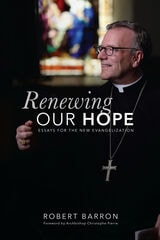
cover of Renewing Our Hope: Essays for the New Evangelization

Renewing Our Hope

Essays for the New Evangelization

Robert Barron

Catholic University of America Press, 2020
In a time of discouragement, how can the Church renew itself and its outreach to all people? Bishop Robert Barron, Auxiliary Bishop of the Archdiocese of Los Angeles, insists that a "dumbed down" Catholicism cannot succeed in today's highly educated society--instead, the Church needs to draw upon its great theological heritage in order to renew its hope in Christ. With Renewing Our Hope: Essays for the New Evangelization, Bishop Barron traces this renewal through four stages. "Renewing Our Mission" lays out the challenges that call for Catholics to become more aware of their own intellectual resources in encountering the "Nones." "Renewing Our Minds" showcases the importance of theological reflection as a font of wisdom and sanity in the Church, touching on Thomas Aquinas, Hans Urs von Balthasar, the recently canonized John Henry Newman, and Pope Francis. In "Renewing the Church," he proceeds to look at how Scripture, the family, the seminary, and Catholic college graduates can each contribute to this renewal. Finally, in "Renewing Our Culture," he returns to the judgments Catholics must make in assessing contemporary culture, specifically, family life, liberalism, relativism, and (surprisingly) the beauty of cinema. Bishop Barron, known as the host of the Catholicism PBS video series, was previously rector and professor of systematic theology at Mundelein Seminary outside Chicago, Illinois. He demonstrates again in Renewing Our Hope his ability to make the fruits of his wide reading accessible to a broad audience, while still giving his academic colleagues much to consider.
[more]
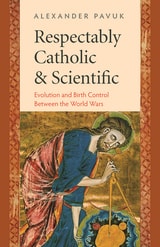
cover of Respectably Catholic and Scientific: Evolution and Birth Control Between the World Wars

Respectably Catholic and Scientific

Evolution and Birth Control Between the World Wars

Alexander Pavuk

Catholic University of America Press, 2021
Respectfully Catholic and Scientific traces the unexpected manner in which several influential liberal-progressive Catholics tried to shape how evolution and birth control were framed and debated in the public square in the era between the World Wars-- and the unintended consequences of their efforts. A small but influential cadre of Catholic priests professionally trained in social sciences, Frs. John Montgomery Cooper, John A. Ryan, and John A. O’Brien, gained a hearing from mainline public intellectuals largely by engaging in dialogue on these topics using the lingua franca of the age, science, to the near exclusion of religious argumentation. The Catholics’ approach was more than just tactical. It also derived from the subtle influence of Catholic theological Modernism, with its strong enthusiasm for science, and from an inclination toward scientism inherited from the Progressive Era’s social science milieu. All three shared a fervent desire to translate the Catholic ethos, as they understood it, into the vocabulary of the modern age while circumventing anti-Catholic attitudes in the process. However, their method resulted in a series of unintended consequences whereby their arguments were not infrequently co-opted and used against both them and the institutional church they served. Alexander Pavuk considers the complex role of both liberal religious figures and scientific elites in evolution and birth control discourse, and how each contributed in unexpected ways to the reconstruction of those topics in public culture. The reconstruction saw the topics themselves shift from matters considered largely within moral frameworks into bodies of kno
[more]
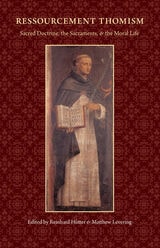
cover of Ressourcement Thomism: Sacred Doctrine, the Sacraments, and the Moral Life

Ressourcement Thomism

Sacred Doctrine, the Sacraments, and the Moral Life

Reinhard Hütter

Catholic University of America Press, 2010
The essays in this volume explore three areas in which St. Thomas Aquinas's voice has never fallen silent: sacred doctrine, the relationship of sacraments and metaphysics, and the central role of virtue in moral theology.
[more]
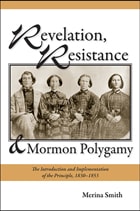
cover of Revelation, Resistance, and Mormon Polygamy: The Introduction and Implementation of the Principle, 1830–1853

Revelation, Resistance, and Mormon Polygamy

The Introduction and Implementation of the Principle, 1830–1853

Merina Smith

Utah State University Press, 2013

 In Revelation, Resistance, and Mormon Polygamy historian Merina Smith explores the introduction of polygamy in Nauvoo, a development that unfolded amid scandal and resistance. Smith considers the ideological, historical, and even psychological elements of the process and captures the emotional and cultural detail of this exciting and volatile period in Mormon history. She illuminates the mystery of early adherents' acceptance of such a radical form of marriage in light of their dedication to the accepted monogamous marriage patterns of their day.

When Joseph Smith began to reveal and teach the doctrine of plural marriage in 1841, even stalwart members like Brigham Young were shocked and confused. In this thoughtful study, Smith argues that the secret introduction of plural marriage among the leadership coincided with an evolving public theology that provided a contextualizing religious narrative that persuaded believers to accept the principle.

This fresh interpretation draws from diaries, letters, newspapers, and other primary sources and is especially effective in its use of family narratives. It will be of great interest not only to scholars and the general public interested in Mormon history but in American history, religion, gender and sexuality, and the history of marriage and families.
[more]
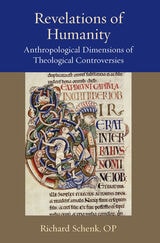
cover of Revelations of Humanity: Anthropological Dimensions of Theological Controversies

Revelations of Humanity

Anthropological Dimensions of Theological Controversies

Richard Schenk, OP

Catholic University of America Press, 2022
Revelations of Humanity brings together essays into the history and actuality of how our searches for God and for our own humanity are interwoven. They argue that the revelation of God is possible only when accompanied by a revelation of what it means to be a human being. Revelation implies that the truth is not fully evident in either case. This quest is aided in many of the essays by a recollection of the thought of Thomas Aquinas. As opposed to simple memory, recollection implies that memory has been lost or become clouded, here by the misrepresentation of Thomas’ view of humanity’s relation to God as harmonistic, at best semi-Pelagian, often even naturalistic. This difficult recovery is made possible by historical research that alone can escape the easy systematic alienation that supporters and critics of Thomas have often brought to their interpretation of his works. Thomas’s sense of a real but finite capacity of human beings for God, his grace and revelation, anticipates in more ways than is commonly known much of contemporary suspicion about human capacities, but in ways that are open to God. That programmatic insight into the historical Thomas, keenly aware of human entanglements, limits and hopes, offers on many contemporary issues a ressourcement of systematic thought. Revelations of Humanity revolves around three clusters of issues. The first asks about the reality and limits of the human capacity for truth: in metaphysical, moral and political matters and in relation to the disputed issues of analogous reason and faith. The second cluster is structured around the four involvements that the Second Vatican Council identified as the human face of genuine Christian existence: participation in the legitimate joys, hopes, sorrows and fears of the contemporary world. These are refracted in the broken light of the human proprium of risibility, the abiding uncertainty addressed by hope, the disputed question of a suffering God and the recollection of Christ’s anxiety in the face of death. The final cluster brings together anthropological dimensions of current ecumenical and interreligious disputes: the need to complement affirmation with admonition in ecumenical conversation, exemplified by the ambivalence towards sacrifice in a genuinely Catholic theology and the need to avoid the excesses of univocity, equivocity or an all too facile analogy in the determination of interreligious relationalities.
[more]
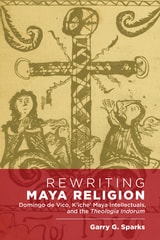
cover of Rewriting Maya Religion: Domingo de Vico, K’iche’ Maya Intellectuals, and the Theologia Indorum

Rewriting Maya Religion

Domingo de Vico, K’iche’ Maya Intellectuals, and the Theologia Indorum

Garry G. Sparks

University Press of Colorado, 2019

In Rewriting Maya Religion Garry Sparks examines the earliest religious documents composed by missionaries and native authors in the Americas, including a reconstruction of the first original, explicit Christian theology written in the Americas—the nearly 900-page Theologia Indorum (Theology for [or of] the Indians), initially written in Mayan languages by Friar Domingo de Vico by 1554. Sparks traces how the first Dominican missionaries to the Maya repurposed native religious ideas, myths, and rhetoric in their efforts to translate a Christianity and how, in this wake, K’iche’ Maya elites began to write their own religious texts, like the Popol Vuh. This ethnohistory of religion critically reexamines the role and value of indigenous authority during the early decades of first contact between a Native American people and Christian missionaries.
 
Centered on the specific work of Dominicans among the Highland Maya of Guatemala in the decades prior to the arrival of the Catholic Reformation in the late sixteenth century, the book focuses on the various understandings of religious analyses—Hispano-Catholic and Maya—and their strategic exchanges, reconfigurations, and resistance through competing efforts of religious translation. Sparks historically contextualizes Vico’s theological treatise within both the wider set of early literature in K’iche’an languages and the intellectual shifts between late medieval thought and early modernity, especially the competing theories of language, ethnography, and semiotics in the humanism of Spain and Mesoamerica at the time.
 
Thorough and original, Rewriting Maya Religion serves as an ethnohistorical frame for continued studies on Highland Maya religious symbols, discourse, practices, and logic dating back to the earliest documented evidence. It will be of great significance to scholars of religion, ethnohistory, linguistics, anthropology, and Latin American history.
 
[more]