Results by title
110 books match the query 'Education (Higher)' and 9 start with r
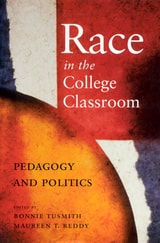
Race in the College Classroom
TuSmith, Bonnie
Rutgers University Press, 2002
Winner of the 2003 American Educational Studies Association Critics' Choice Awards
Winner of the 2003 Gustavus Myers Outstanding Book Award
Did affirmative action programs solve the problem of race on American college campuses, as several recent books would have us believe? If so, why does talking about race in anything more than a superficial way make so many students uncomfortable? Written by college instructors from many disciplines, this volume of essays takes a bold first step toward a nationwide conversation. Each of the twenty-nine contributors addresses one central question: what are the challenges facing a college professor who believes that teaching responsibly requires an honest and searching examination of race?
Professors from the humanities, social sciences, sciences, and education consider topics such as how the classroom environment is structured by race; the temptation to retreat from challenging students when faced with possible reprisals in the form of complaints or negative evaluations; the implications of using standardized evaluations in faculty tenure and promotion when the course subject is intimately connected with race; and the varying ways in which white faculty and faculty of color are impacted by teaching about race.
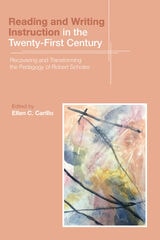
Reading and Writing Instruction in the Twenty-First Century
Recovering and Transforming the Pedagogy of Robert ScholesEllen C. Carillo
Utah State University Press, 2021
In this volume, Scholes’s scholarship is included alongside original essays, providing a resource for those considering everything from the place of the English major in the twenty-first century to best practices for helping students navigate misinformation and disinformation. Reading and Writing Instruction in the Twenty-First Century not only keeps Scholes’s legacy alive but carries it on through a commitment, in Scholes’s (1998) own words, to “offer our students . . . the cultural equipment they are going to need when they leave us.”
Contributors:
Angela Christie, Paul T. Corrigan, Lynée Lewis Gaillet, Doug Hesse, Alice S. Horning, Emily J. Isaacs, Christopher La Casse, Robert Lestón, Kelsey McNiff, Thomas P. Miller, Jessica Rivera-Mueller, Christian Smith, Kenny Smith
Reclaiming Class
Women, Poverty, And The Promiseedited by Vivyan C. Adair and Sandra L. Dahlberg
Temple University Press, 2003
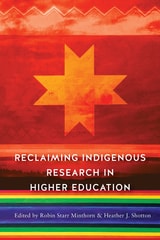
Reclaiming Indigenous Research in Higher Education
Minthorn, Robin Starr
Rutgers University Press, 2018
Recently, Native scholars have started to reclaim research through the development of their own research methodologies and paradigms that are based in tribal knowledge systems and values, and that allow inherent Indigenous knowledge and lived experiences to strengthen the research. Reclaiming Indigenous Research in Higher Education highlights the current scholarship emerging from these scholars of higher education. From understanding how Native American students make their way through school, to tracking tribal college and university transfer students, this book allows Native scholars to take center stage, and shines the light squarely on those least represented among us.
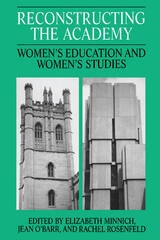
Reconstructing the Academy
Women's Education and Women's StudiesEdited by Elizabeth Minnich, Jean F. O'Barr, and Rachel A. Rosenfeld
University of Chicago Press, 1988
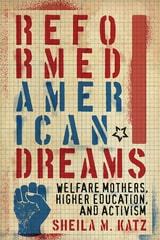
Reformed American Dreams
Welfare Mothers, Higher Education, and ActivismSheila M. Katz
Rutgers University Press, 2019
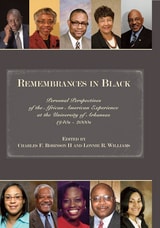
Remembrances in Black
Personal Perspectives of the African American Experience at the University of Arkansas, 1940s–2000sCharles F. Robinson II
University of Arkansas Press, 2015
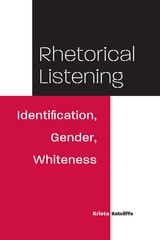
Rhetorical Listening
Identification, Gender, WhitenessKrista Ratcliffe
Southern Illinois University Press, 2005
Extending the feminist rhetorical project to define and model rhetorical listening
Long-ignored within rhetoric and composition studies, listening has returned to the disciplinary radar. Rhetorical Listening: Identification, Gender, Whiteness argues that rhetorical listening facilitates conscious identifications needed for cross-cultural communication.
Krista Ratcliffe establishes eavesdropping, listening metonymically, and listening pedagogically as approaches to rhetorical listening. She defines and models rhetorical listening, addressing identifications with gender and whiteness within public debates, scholarship, and pedagogy. Offering an approach grounded in classical rhetorical theory, Heideggerian theory, feminist theory, and critical race theory, Ratcliffe presents rhetorical listening as an invention tactic that engages spoken and written texts and supplements reading, writing, speaking, and silence as a rhetorical art.
Theorizing intersections of gender and whiteness, Rhetorical Listening examines how whiteness functions as an "invisible" racial category and provides disciplinary and cultural reasons for the displacement of listening and for the use of rhetorical listening as a code of cross-cultural conduct. Ratcliffe presents rhetorical listening in terms of cultural logics, stances, and dominant interpretive tropes. She highlights the modern identification theory of Kenneth Burke and the postmodern identification and disidentification theory of Diana Fuss and presents nonidentification as a more productive site for rhetorical listening.

Right to DREAM
Immigration Reform and America’s FutureWilliam A. Schwab
University of Arkansas Press, 2013