153 books match the query 'Egypt' and 4 start with r
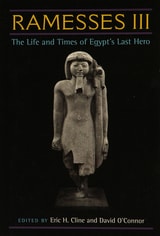
cover of Ramesses III: The Life and Times of Egypt's Last Hero

Ramesses III

The Life and Times of Egypt's Last Hero

Edited by Eric H. Cline and David O'Connor

University of Michigan Press, 2012

In the tumultuous and vivid history of New Kingdom Egypt, Ramesses III's reign was prosperous and culturally rich. He fended off attacks by the "Sea Peoples" and others who threatened the state, he built the great temple of Medinet Habu, and he left wonderfully complete documents describing contemporary social structure and the economy. Amazingly, we even have an account from a contemporary judicial document that describes events leading to Ramesses III's assassination. This edited collection presents a detailed and informative look at the life, career, and world of one of Egypt's most important pharaohs, providing insight both on his reign and its aftermath and on the study of the political and cultural history of ancient Egypt. This collection offers the best new scholarship on Ramesses III, with contributions from Christopher J. Eyre; Ogden Goelet, Jr.; Peter W. Haider; Carolyn R. Higginbotham; Kenneth A. Kitchen; Bojana Mojsov; Steven R. Snape; Emily Teeter; and James M. Weinstein, as well as from David O'Connor and Eric H. Cline. It will be of interest to those with an informed amateur's interest in Egyptology as well as to scholars of Egyptian and biblical archaeology.
[more]
cover of Reading Arab Women's Autobiographies: Shahrazad Tells Her Story

Reading Arab Women's Autobiographies

Shahrazad Tells Her Story

By Nawar Al-Hassan Golley

University of Texas Press, 2003

Authors of autobiographies are always engaged in creating a "self" to present to their readers. This process of self-creation raises a number of intriguing questions: why and how does anyone choose to present herself or himself in an autobiography? Do women and men represent themselves in different ways and, if so, why? How do differences in culture affect the writing of autobiography in various parts of the world?

This book tackles these questions through a close examination of Arab women's autobiographical writings. Nawar Al-Hassan Golley applies a variety of western critical theories, including Marxism, colonial discourse, feminism, and narrative theory, to the autobiographies of Huda Shaarawi, Fadwa Tuqan, Nawal el-Saadawi, and others to demonstrate what these critical methodologies can reveal about Arab women's writing. At the same time, she also interrogates these theories against the chosen texts to see how adequate or appropriate these models are for analyzing texts from other cultures. This two-fold investigation sheds important new light on how the writers or editors of Arab women's autobiographies have written, documented, presented, and organized their texts.
[more]
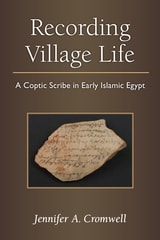
cover of Recording Village Life: A Coptic Scribe in Early Islamic Egypt

Recording Village Life

A Coptic Scribe in Early Islamic Egypt

Jennifer A. Cromwell

University of Michigan Press, 2017

Recording Village Life presents a close study of over 140 Coptic texts written between 724–756 CE by a single scribe, Aristophanes son of Johannes, of the village Djeme in western Thebes. These texts, which focus primarily on taxation and property concerns, yield a wealth of knowledge about social and economic changes happening at both the community and country-wide levels during the early years of Islamic rule in Egypt. Additionally, they offer a fascinating picture of the scribe’s role within this world, illuminating both the practical aspects of his work and the social and professional connections with clients for whom he wrote legal documents.

Papyrological analysis of Aristophanes’ documents, within the context of the textual record of the village, shows a new and divergent scribal practice that reflects broader trends among his contemporaries: Aristophanes was part of a larger, national system of administrative changes, enacted by the country’s Arab rulers in order to better control administrative practices and fiscal policies within the country. Yet Aristophanes’ dossier shows him not just as an administrator, revealing details about his life, his role in the community, and the elite networks within which he operated. This unique perspective provides new insights into both the micro-history of an individual’s experience of eighth-century Theban village life, and its reflection in the macro social, economic, and political trends in Egypt at this time.

This book will prove valuable to scholars of late antique studies, papyrology, philology, early Islamic history, social and economic history, and Egyptology.
[more]
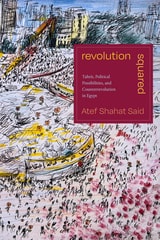
cover of Revolution Squared: Tahrir, Political Possibilities, and Counterrevolution in Egypt

Revolution Squared

Tahrir, Political Possibilities, and Counterrevolution in Egypt

Atef Shahat Said

Duke University Press, 2024

In Revolution Squared Atef Shahat Said examines the 2011 Egyptian Revolution to trace the expansive range of liberatory possibilities and containment at the heart of every revolution. Drawing on historical analysis and his own participation in the revolution, Said outlines the importance of Tahrir Square and other physical spaces as well as the role of social media and digital spaces. He develops the notion of lived contingency—the ways revolutionary actors practice and experience the revolution in terms of the actions they do or do not take—to show how Egyptians made sense of what was possible during the revolution. Said charts the lived contingencies of Egyptian revolutionaries from the decade prior to the revolution’s outbreak to its peak and the so-called transition to democracy to the 2013 military coup into the present. Contrary to retrospective accounts and counterrevolutionary thought, Said argues that the Egyptian Revolution was not doomed to defeat. Rather, he demonstrates that Egyptians did not fully grasp their immense clout and that limited reformist demands reduced the revolution’s potential for transformation.
[more]