Results by title
79 books match the query 'Election' and 2 start with r
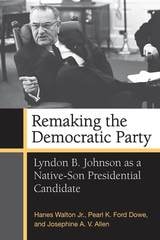
Remaking the Democratic Party
Lyndon B. Johnson as a Native-Son Presidential CandidateHanes Walton Jr., Pearl K. Ford Dowe, and Josephine A. V. Allen
University of Michigan Press, 2016
A continuation of Hanes Walton Jr.’s work on Southern Democratic presidents, Remaking the Democratic Party analyzes the congressional and presidential elections of Lyndon Baines Johnson. This study builds upon the general theory of the native-son phenomenon to demonstrate that a Southern native-son can win the presidency without the localism evident in the elections of Bill Clinton and Jimmy Carter.
Although ridiculed by contemporaries for his apparent lack of control over formal party politics and the national committee, Johnson excelled at leading the Democratic Party’s policy agenda. While a senator and as president, Johnson advocated for—and secured—liberal social welfare and civil rights legislation, forcing the party to break with its Southern tradition of elitism, conservatism, and white supremacy. In a way, Johnson set the terms for the continuing partisan battle because, by countering the Democrats’ new ideology, the Republican Party also underwent a transformation.
Although ridiculed by contemporaries for his apparent lack of control over formal party politics and the national committee, Johnson excelled at leading the Democratic Party’s policy agenda. While a senator and as president, Johnson advocated for—and secured—liberal social welfare and civil rights legislation, forcing the party to break with its Southern tradition of elitism, conservatism, and white supremacy. In a way, Johnson set the terms for the continuing partisan battle because, by countering the Democrats’ new ideology, the Republican Party also underwent a transformation.
[more]
Revolutionizing Repertoires
The Rise of Populist Mobilization in PeruRobert S. Jansen
University of Chicago Press, 2017
Politicians and political parties are for the most part limited by habit—they recycle tried-and-true strategies, draw on models from the past, and mimic others in the present. But in rare moments politicians break with routine and try something new.
Drawing on pragmatist theories of social action, Revolutionizing Repertoires sets out to examine what happens when the repertoire of practices available to political actors is dramatically reconfigured. Taking as his case study the development of a distinctively Latin American style of populist mobilization, Robert S. Jansen analyzes the Peruvian presidential election of 1931. He finds that, ultimately, populist mobilization emerged in the country at this time because newly empowered outsiders recognized the limitations of routine political practice and understood how to modify, transpose, invent, and recombine practices in a whole new way. Suggesting striking parallels to the recent populist turn in global politics, Revolutionizing Repertoires offers new insights not only to historians of Peru but also to scholars of historical sociology and comparative politics, and to anyone interested in the social and political origins of populism.
Drawing on pragmatist theories of social action, Revolutionizing Repertoires sets out to examine what happens when the repertoire of practices available to political actors is dramatically reconfigured. Taking as his case study the development of a distinctively Latin American style of populist mobilization, Robert S. Jansen analyzes the Peruvian presidential election of 1931. He finds that, ultimately, populist mobilization emerged in the country at this time because newly empowered outsiders recognized the limitations of routine political practice and understood how to modify, transpose, invent, and recombine practices in a whole new way. Suggesting striking parallels to the recent populist turn in global politics, Revolutionizing Repertoires offers new insights not only to historians of Peru but also to scholars of historical sociology and comparative politics, and to anyone interested in the social and political origins of populism.
[more]