Results by title
115 books match the query 'Elections' and 5 start with r
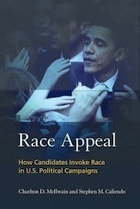
Race Appeal
How Candidates Invoke Race in U.S. Political CampaignsAuthored by Charlton D. McIlwain and Stephen M. Caliendo
Temple University Press, 2011
In our evolving American political culture, whites and blacks continue to respond very differently to race-based messages and the candidates who use them. Race Appeal examines the use and influence such appeals have on voters in elections for federal office in which one candidate is a member of a minority group.
Charlton McIlwain and Stephen Caliendo use various analysis methods to examine candidates who play the race card in political advertisements. They offer a compelling analysis of the construction of verbal and visual racial appeals and how the news media covers campaigns involving candidates of color.
Combining rigorous analyses with in-depth case studies-including an examination of race-based appeals in the historic 2008 presidential election—Race Appeal is a groundbreaking work that represents the most extensive and thorough treatment of race-based appeals in American political campaigns to date.

Race, Elections, and Power in Modern Brazil
Andrew Janusz
University of Michigan Press, 2027
While Brazil is famous for its history of racial diversity and was once revered as a “racial democracy,” its political arena is a site of separation. Elected officials in the country, which has the largest African descendant population of any country outside of Africa, are overwhelmingly white. Why are Afro-Brazilians not elected in proportion to their population size? And how does their underrepresentation affect the policymaking process?
In Race, Elections, and Power in Modern Brazil, Andrew Janusz argues that race shapes who runs for public office, who is elected, and who they represent. Drawing on surveys, interviews, and administrative election datasets, he shows that white politicians have several electoral advantages over their Afro-Brazilian competitors. Due to social stereotypes and racism, white Brazilians are more likely than Afro-Brazilians to be recruited by party elites, raise campaign funds, and be favored by voters. Using original data on legislator behavior, Janusz also finds that Brazil’s predominately white lawmakers are largely unresponsive to the needs of marginalized Afro-Brazilians and less likely than their Afro-Brazilian counterparts to advance legislation that would meaningfully enhance their quality of life. Providing compelling empirical evidence that Brazil is a racialized democracy, this book offers an accessible and eye-opening look at the central role race plays in Brazilian politics.
Realignment in American Politics
Toward a TheoryEdited by Bruce A. Campbell and Richard J. Trilling
University of Texas Press, 1980
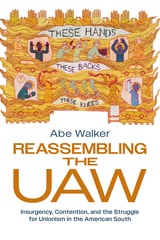
Reassembling the UAW
Insurgency, Contention, and the Struggle for Unionism in the American SouthAbe Walker
Temple University Press, 2026
Abe Walker chronicles the organizing campaign from its origin in 2014 to the union’s breakthrough victory in 2024, illustrating what went wrong—and what went right—along the way. Walker provides a systematic analysis of the strategic challenges and tactical shifts, showing the patterns that persisted across three election cycles while highlighting their differences, from global-level alliances to local labor issues.
Reassembling the UAW also demonstrates how rebel rank-and-file workers ousted the old-guard leadership and transformed the UAW into a militant union to achieve results. Ultimately, Walker offers valuable lessons for organizational strategy, the power of collective action, and the future of the labor movement.
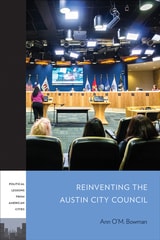
Reinventing the Austin City Council
Ann O'M. Bowman
Temple University Press, 2020
Reinventing the Austin City Council explores the puzzle that was Austin’s reluctance to alter its at-large system and establish a geographically-based, single-member district system. Ann Bowman chronicles the repeated attempts to change the system, the eventual decision to do so, and the consequences of that change. In the process, she explores the many twists and turns that occurred in Austin as it struggled to design a fair system of representation. Reinventing the Austin City Council assesses the impact of the new district system since its inception in 2014.
Austin’s experience ultimately offers a political lesson for creating institutional change.