Results by title
193 books match the query 'Empire' and 6 start with r
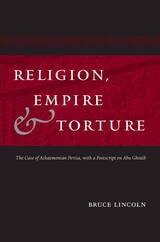
Religion, Empire, and Torture
The Case of Achaemenian Persia, with a Postscript on Abu GhraibBruce Lincoln
University of Chicago Press, 2007
Lincoln identifies three core components of an imperial theology that have transhistorical and contemporary relevance: dualistic ethics, a theory of divine election, and a sense of salvific mission. Beyond this, he asks, how did the Achaemenians understand their place in the cosmos and their moral status in relation to others? Why did they feel called to intervene in the struggle between good and evil? What was their sense of historic purpose, especially their desire to restore paradise lost? And how did this lead them to deal with enemies and critics as imperial power ran its course? Lincoln shows how these religious ideas shaped Achaemenian practice and brought the Persians unprecedented wealth, power, and territory, but also produced unmanageable contradictions, as in a gruesome case of torture discussed in the book’s final chapter. Close study of that episode leads Lincoln back to the present with a postscript that provides a searing and utterly novel perspective on the photographs from Abu Ghraib.
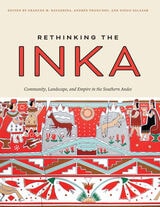
Rethinking the Inka
Community, Landscape, and Empire in the Southern AndesEdited by Frances M. Hayashida, Andrés Troncoso, and Diego Salazar
University of Texas Press, 2022
2023 Book Award, Society for American Archaeology
A dramatic reappraisal of the Inka Empire through the lens of Qullasuyu.
The Inka conquered an immense area extending across five modern nations, yet most English-language publications on the Inka focus on governance in the area of modern Peru. This volume expands the range of scholarship available in English by collecting new and notable research on Qullasuyu, the largest of the four quarters of the empire, which extended south from Cuzco into contemporary Bolivia, Argentina, and Chile.
From the study of Qullasuyu arise fresh theoretical perspectives that both complement and challenge what we think we know about the Inka. While existing scholarship emphasizes the political and economic rationales underlying state action, Rethinking the Inka turns to the conquered themselves and reassesses imperial motivations. The book’s chapters, incorporating more than two hundred photographs, explore relations between powerful local lords and their Inka rulers; the roles of nonhumans in the social and political life of the empire; local landscapes remade under Inka rule; and the appropriation and reinterpretation by locals of Inka objects, infrastructure, practices, and symbols. Written by some of South America’s leading archaeologists, Rethinking the Inka is poised to be a landmark book in the field.
Revenge Capitalism
The Ghosts of Empire, the Demons of Capital, and the Settling of Unpayable DebtsMax Haiven
Pluto Press, 2020
In Revenge Capitalism, Max Haiven argues that this economic vengeance helps us explain the culture and politics of revenge we see in society more broadly. Moving from the history of colonialism and its continuing effects today, he examines the opioid crisis in the US, the growth of 'surplus populations' worldwide and unpacks the central paradigm of unpayable debts - both as reparations owed, and as a methodology of oppression.
Revenge Capitalism offers no easy answers, but is a powerful call to the radical imagination.
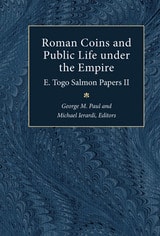
Roman Coins and Public Life under the Empire
E. Togo Salmon Papers IIGeorge M. Paul and Michael Ierardi, Editors
University of Michigan Press, 1999
Coins are a unique source of information about the Roman world. In the case of the Roman Empire they were issued by or with the approval of the ruling power. The representations and legends they show therefore present an official view of contemporary affairs. The coins themselves, minted for official purposes such as paying the army, when studied carefully can help reconstruct official policies. They can also occasionally reveal what monuments now lost may have looked like.
It is not infrequent to come across pleas that the ancient historian should make more frequent use of numismatic evidence. These essays make clear that efforts are being made both by numismatists and by historians to bring the two disciplines together. At the same time the papers reveal that the task is by no means a straightforward one. The survival of Roman coins is variable, and so attempts to reconstruct the size and distribution of issues calls for skilled and experienced analysis. This collection of papers provides evidence for the kind of deductions that the historian may make from Roman coins as well as the illustrations of the pitfalls that await the unwary.
Those interested in Roman history, amateur coin collectors, and professional numismatists will all find much here to widen their knowledge of the public context of Roman coins.
George Paul is Professor of Classics, McMaster University. Michael Ierardi is Lecturer in Classics, McMaster University.
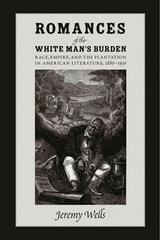
Romances of the White Man's Burden
Race, Empire, and the Plantation in American Literature, 1880-1936Jeremy Wells
Vanderbilt University Press, 2011
Romances of the White Man's Burden takes on works in American literature in which the proverbial "old plantation" is made to seem not a relic but a harbinger, a sign that the South had arrived at a multiracial modernity and harmony before the rest of the United States. Focusing on writers such as Joel Chandler Harris, Thomas Nelson Page, Henry W. Grady, Thomas Dixon, and William Faulkner, Jeremy Wells reveals their shared fixation on the figure of the white southern man as specially burdened by history. Each of these writers, in his own way, presented the plantation South as an emblem, not an aberration, of America.
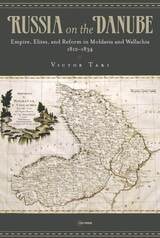
Russia on the Danube
Empire, Elites, and Reform in Moldavia and Wallachia, 1812–1834Victor Taki
Central European University Press, 2021
One of the goals of Russia’s Eastern policy was to turn Moldavia and Wallachia, the two Romanian principalities north of the Danube, from Ottoman vassals into a controllable buffer zone and a springboard for future military operations against Constantinople. Russia on the Danube describes the divergent interests and uneasy cooperation between the Russian officials and the Moldavian and Wallachian nobility in a key period between 1812 and 1834. Victor Taki’s meticulous examination of the plans and memoranda composed by Russian administrators and the Romanian elite underlines the crucial consequences of this encounter. The Moldavian and Wallachian nobility used the Russian-Ottoman rivalry in order to preserve and expand their traditional autonomy. The comprehensive institutional reforms born out of their interaction with the tsar’s officials consolidated territorial statehood on the lower Danube, providing the building blocks of a nation state.
The main conclusion of the book is that although Russian policy was driven by self-interest, and despite the Russophobia among a great part of the Romanian intellectuals, this turbulent period significantly contributed to the emergence, several decades later, of modern Romania.