Results by title
60 books match the query 'Energy' and 3 start with r
Remaking the Urban Social Contract
Health, Energy, and the EnvironmentEdited by Michael A. Pagano
University of Illinois Press, 2016
This new volume draws from provocative discussions on the urban social contract among policy makers, researchers, public intellectuals, and citizens at the 2015 UIC Urban Forum. Michael A. Pagano presents papers that emphasize political agreements, disagreements, challenges, and controversies on health, energy, and environmental policies. Authors explore the substantive and philosophical changes in the urban social contract and offer proposals for remaking it in the new century. Topics range from big-picture analyses to specifics covering areas like public services, the smart cities movement, and greening strategies.
Contributors: Alba Alexander, Megan Houston, Dennis R. Judd, Cynthia Klein-Banai, William C. Kling, Howard A. Learner, David A. McDonald, David C. Perry, Emily Stiehl, Anthony Townsend, Natalia Villamizar-Duarte, and Moira Zellner.
[more]
Risk Principles for Public Utility Regulators
Janice A. Beecher
Michigan State University Press, 2016
Risk and risk allocation have always been central issues in public utility regulation. Unfortunately, the term “risk” can easily be misrepresented and misinterpreted, especially when disconnected from long-standing principles of corporate finance.
This book provides those in the regulatory policy community with a basic theoretical and practical grounding in risk as it relates specifically to economic regulation in order to focus and elevate discourse about risk in the utility sector in the contemporary context of economic, technological, and regulatory change. This is not a “how-to” book with regard to calculating risks and returns but rather a resource that aims to improve understanding of the nature of risk. It draws from the fields of corporate finance, behavioral finance, and decision theory as well as the broader legal and economic theories that undergird institutional economics and the economic regulatory paradigm.
We exist in a world of scarce resources and abundant uncertainties, the combination of which can exacerbate and distort our sense of risk. Although there is understandable impulse to reduce risk, attempts to mitigate may be as likely to shift risk, and some measures might actually increase risk exposure. Many of the concepts explored here apply not just to financial decisions, such as those by utility investors, but also to regulatory and utility decision-making in general.
[more]
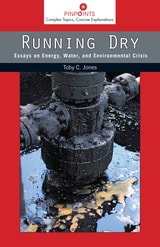
Running Dry
Essays on Energy, Water, and Environmental CrisisJones, Toby Craig
Rutgers University Press, 2015
The world’s water is under siege. A combination of corporate greed, the elite pursuit of political power, and our unrelenting reliance on carbon-based energy is accerlating a broad range of environmental and political crises. Potentially catastrophic climate change, driven primarily by the consumption of oil and gas, threatens the environment in a variety of ways, including producing unprecedented patterns of heavy weather and superstorms in some places and droughts in others. Alongside intensifying environmental dangers posed by our reliance on carbon energy, the conditions of modern life, from happiness to the possibility of democratic politics, are also being undermined.
In Running Dry, historian Toby Craig Jones explores how modern society’s unquenchable thirst for carbon-based energy is endangering the environment broadly, as well as the historical roots of this threat. This accessible book examines the history of the "energy-water nexus," the ways in which oil and gas extraction poison and dry up water resources, the role of corporate "science" in deflecting attention away from the emerging crises, and the ways in which the rush to capture more energy is also challenging America's democratic order.
[more]