201 books match the query 'English fiction' and 7 start with r
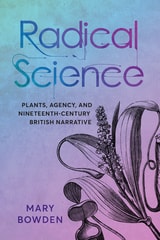
cover of Radical Science: Plants, Agency, and Nineteenth-Century British Narrative

Radical Science

Plants, Agency, and Nineteenth-Century British Narrative

Mary Bowden

The Ohio State University Press, 2026

Can plants move? Can they think? Can they act? In Radical Science, Mary Bowden shows that debates about plants’ capabilities are not new but can be traced to the nineteenth century, where they moved from scientific inquiries to popular articles and literary fiction. Examining the work of nineteenth-century physiological botanists, Bowden expands beyond Charles Darwin’s work in the field to uncover the full story of these debates and the impacts they had on literature, culture, and people. While many have interpreted the frequent comparisons between plants and people in nineteenth-century literature to be exemplary of aesthetic values or sexual symbolism, Bowden maintains that comparisons between plants and women, members of the working class, and people of color reiterate botanical debates about how to recognize agency in beings that are assumed to be passive. Studying the scientific texts of Darwin and Maria Elizabetha Jacson alongside social problem novels by Elizabeth Gaskell and Charles Kingsley and early science fiction by H. G. Wells, Radical Science foregrounds the connection between science and literature and ultimately suggests that we look to the propositions of nineteenth-century physiological botany to find more sustaining models of social and environmental relationship.
[more]
cover of Raising the Dust: The Literary Housekeeping of Mary Ward, Sarah Grand, and Charlotte Perkins Gilman

Raising the Dust

The Literary Housekeeping of Mary Ward, Sarah Grand, and Charlotte Perkins Gilman

Beth Sutton-Ramspeck

Ohio University Press, 2004

Raising the Dust identifies a heretofore-overlooked literary phenomenon that author Beth Sutton-Ramspeck calls “literary housekeeping.” The three writers she examines rejected turn-of-the-century aestheticism and modernism in favor of a literature that is practical, even ostensibly mundane, designed to “set the human household in order.”

To Mary Augusta Ward, Sarah Grand, and Charlotte Perkins Gilman, housekeeping represented public responsibilities: making the food supply safe, reforming politics, and improving the human race itself. Raising the Dust places their writing in the context of the late-Victorian era, in particular the eugenics movement, the proliferation of household conveniences, the home economics movement, and decreased reliance on servants. These changes affected relationships between the domestic sphere and the public sphere, and hence shaped the portrayal of domesticity in the era's fiction and nonfiction.

Moreover, Ward, Grand, and Gilman articulated a domestic aesthetic that swept away boundaries. Sutton-Ramspeck uncovers a new paradigm here: literature as engaging the public realm through the devices and perspectives of the domestic. Her innovative and ambitious book also connects fixations on cleaning with the discovery of germs (the first bacterium discovered was anthrax, and knowledge of its properties increased fears of dust); analyzes advertising cards for soap; and links the mental illness in Gilman's “The Yellow Wall-Paper” to fears during the period of arsenic poisoning from wallpaper.
[more]
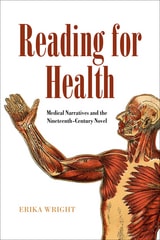
cover of Reading for Health: Medical Narratives and the Nineteenth-Century Novel

Reading for Health

Medical Narratives and the Nineteenth-Century Novel

Erika Wright

Ohio University Press, 2016

In Reading for Health: Medical Narratives and the Nineteenth-Century Novel, Erika Wright argues that the emphasis in Victorian Studies on disease as the primary source of narrative conflict that must be resolved has obscured the complex reading practices that emerge around the concept of health. By shifting attention to the ways that prevention of illness and the preservation of well-being operate in fiction, both thematically and structurally, Wright offers a new approach to reading character and voice, order and temporality, setting and metaphor. As Wright reveals, while canonical works by Austen, Brontë, Dickens, Martineau, and Gaskell register the pervasiveness of a conventional “therapeutic” form of action and mode of reading, they demonstrate as well an equally powerful investment in the achievement and maintenance of “health”—what Wright refers to as a “hygienic” narrative—both in personal and domestic conduct and in social interaction of the individual within the community.
[more]
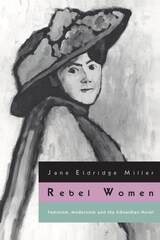
cover of Rebel Women: Feminism, Modernism and the Edwardian Novel

Rebel Women

Feminism, Modernism and the Edwardian Novel

Jane Eldridge Miller

University of Chicago Press, 1996

With the rise of women's suffrage, challenges to marriage and divorce laws, and expanding opportunities for education and employment for women, the early years of the twentieth century were a time of social revolution. Examining British novels written in 1890-1914, Jane Eldridge Miller demonstrates how these social, legal, and economic changes rendered the traditional narratives of romantic desire and marital closure inadequate, forcing Edwardian novelists to counter the limitations and ideological implications of those narratives with innovative strategies. The original and provocative novels that resulted depict the experiences of modern women with unprecedented variety, specificity, and frankness. Rebel Women is a major re-evaluation of Edwardian fiction and a significant contribution to literary history and criticism.

"Miller's is the best account we have, not only of Edwardian women novelists, but of early 20th-century women novelists; the measure of her achievement is that the distinction no longer seems workable." —David Trotter, The London Review of Books
[more]
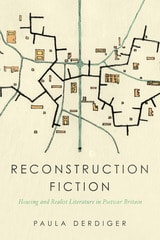
cover of Reconstruction Fiction: Housing and Realist Literature in Postwar Britain

Reconstruction Fiction

Housing and Realist Literature in Postwar Britain

Paula Derdiger

The Ohio State University Press, 2020
Reconstruction Fiction: Housing and Realist Literature in Postwar Britain by Paula Derdiger assesses the impact of World War II and the welfare state on literary fiction by focusing on one of the defining issues of the postwar period: housing. Through compelling close readings and lively historical and cultural analysis, Derdiger argues that literary realism was a necessary, generative response to the war and welfare state since they impacted the built environment and landscape. Wartime decimation of buildings and streets called for reconstruction, and reconstruction called not just for bricks and mortar, architectural drawings, town plans, preservation schemes, and new policies but also for fiction that invited particular ways of inhabiting an environment that had been irrevocably changed. Derdiger argues that fiction, like actual buildings, creates a sheltered space for the mediation between individual subjects and the social and geographical environments that they encounter. Realist fiction, specifically, insists that such mediation is possible and that it is socially valuable. Covering writers spanning various social positions and aesthetic tendencies—including Elizabeth Bowen, Graham Greene, Patrick Hamilton, Doris Lessing, Colin MacInnes, and Elizabeth Taylor—Derdiger shows how these authors responded to the war with realistic technique, investing in external conditions just as much as or more than their characters’ interior lives. In doing so, their reconstruction fiction helped to shape postwar life.
[more]
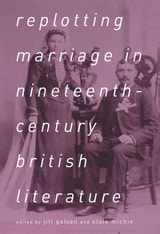
cover of Replotting Marriage in Nineteenth-Century British Literature

Replotting Marriage in Nineteenth-Century British Literature

Edited by Jill Galvan and Elsie Michie

The Ohio State University Press, 2018


In Replotting Marriage in Nineteenth-Century British Literature, Jill Galvan and Elsie Michie bring together top Victorian scholars to scrutinize nineteenth-century marriage in incisive ways. The volume puts marriage in conversation with many aspects of culture, from education and anthropology to Darwinism and crime. It aims to widen the repertoire of critical questions we ask about how fiction represents conjugal coupling, employing, among other approaches, transimperial reading, queer theory, disability studies, and philosophies of the formation of human society. By paying close attention to elements of genre and narrative, moreover, the collection analyzes the story of marriage as formally and structurally diverse, rather than as a familiar plot line. 
 
 
These essays point to nineteenth-century marriage studies as a new field of inquiry. With contributions by Ian Duncan, Elisha Cohn, Kathy Psomiades, Kelly Hager, Lauren Goodlad, Marlene Tromp, Sukanya Banerjee, Holly Furneaux, Talia Schaffer, and Helena Michie, and an afterword by Mary Jean Corbett, Replotting Marriage in Nineteenth-Century British Literature demonstrates how both established and developing fields can be brought to bear on a long-examined institution—ultimately prompting a rethinking of the nineteenth century itself.
[more]
cover of Representing the Troubles in Irish Short Fiction

Representing the Troubles in Irish Short Fiction

Michael L. Storey

Catholic University of America Press, 2004

Representing the Troubles in Irish Short Fiction offers a comprehensive examination of Irish short stories written over the last eighty years that have treated the Troubles, Ireland's intractable conflict that arose out of its relationship to England.
[more]