Results by title
166 books match the query 'Enslavement' and 6 start with r
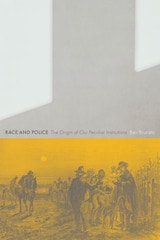
Race and Police
The Origin of Our Peculiar InstitutionsBen Brucato
Rutgers University Press, 2024
Race and Police corrects the Eurocentrism in the orthodox history of American police and in predominating critical theories of police. That orthodoxy rests on an origin story that begins with Sir Robert Peel and the London Metropolitan Police Service. Predating the Met by more than a century, America’s first police, often called slave patrols, did more than maintain order—it fabricated a racial order. Prior to their creation, all white citizens were conscripted to police all Blacks. Their participation in the coercive control of Blacks gave definition to their whiteness. Targeted as threats to the security of the economy and white society, being policed defined Blacks who, for the first time, were treated as a single racial group. The boundaries of whiteness were first established on the basis of who was required to regulate slaves, given a specific mandate to prevent Black insurrection, a mandate that remains core to the police role to this day.
Racial Blackness and Indian Ocean Slavery
Iran's Cinematic ArchiveParisa Vaziri
University of Minnesota Press, 2023
Rethinking the history of African enslavement in the western Indian Ocean through the lens of Iranian cinema
From the East African and Red Sea coasts to the Persian Gulf ports of Bushihr, Kish, and Hurmuz, sailing and caravan networks supplied Iran and the surrounding regions with African slave labor from antiquity to the nineteenth century. This book reveals how Iranian cinema preserves the legacy of this vast and yet long-overlooked history that has come to be known as Indian Ocean slavery.
How does a focus on blackness complicate traditional understandings of history and culture? Parisa Vaziri addresses this question by looking at residues of the Indian Ocean slave trade in Iranian films from the second half of the twentieth century. Revealing the politicized clash between commercial cinema (fīlmfārsī) and alternative filmmaking (the Iranian New Wave), she pays particular attention to the healing ritual zār, which is both an African slave descendent practice and a constitutive element of Iranian culture, as well as to cinematic sīyāh bāzī (Persian black play). Moving beyond other studies on Indian Ocean and trans-Saharan slavery, Vaziri highlights the crystallization of a singular mode of historicity within these cinematic examples—one of “absence” that reflects the relative dearth of archival information on the facts surrounding Indian Ocean slavery.
Bringing together cinema studies, Middle East studies, Black studies, and postcolonial theory, Racial Blackness and Indian Ocean Slavery explores African enslavement in the Indian Ocean through the revelatory and little-known history of Iranian cinema. It shows that Iranian film reveals a resistance to facticity representative of the history of African enslavement in the Indian Ocean and preserves the legacy of African slavery’s longue durée in ways that resist its overpowering erasure in the popular and historical imagination.
Retail e-book files for this title are screen-reader friendly with images accompanied by short alt text and/or extended descriptions.
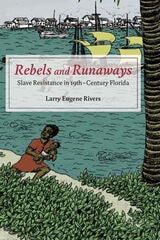
Rebels and Runaways
Slave Resistance in Nineteenth-Century FloridaLarry Eugene Rivers
University of Illinois Press, 2013
Against a smoldering backdrop of violence, this study analyzes the various degrees of slave resistance--from the perspectives of both slave and master--and how they differed in various regions of antebellum Florida. In particular, Rivers demonstrates how the Atlantic world view of some enslaved blacks successfully aided their escape to freedom, a path that did not always lead North but sometimes farther South to the Bahama Islands and Caribbean. Identifying more commonly known slave rebellions such as the Stono, Louisiana, Denmark (Telemaque) Vesey, Gabriel, and the Nat Turner insurrections, Rivers argues persuasively that the size, scope, and intensity of black resistance in the Second Seminole War makes it the largest sustained slave insurrection ever to occur in American history.
Meticulously researched, Rebels and Runaways offers a detailed account of resistance, protest, and violence as enslaved blacks fought for freedom.
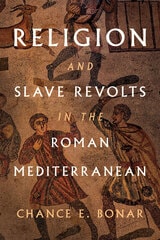
Religion and Slave Revolts in the Roman Mediterranean
Chance E. Bonar
University of Wisconsin Press, 2027
During both the republic and the empire, Romans enslaved large numbers of people, drawn from captives taken in warfare and from generations of children born to those they had enslaved. Given the imbalance in source material toward free Roman societal concerns, the lives of the enslaved are but sketchily drafted and rely heavily on descriptions written by their enslavers. Their religious beliefs and praxes are mentioned rarely, and never without bias. Similarly, despite the fame of a few revolts, the motivations and details even of the better-known rebellious leaders are often murky.
In this monograph, Chance E. Bonar demonstrates that we cannot understand slave revolts or Roman discussions of them without understanding the religious cultures of both the enslaved and their enslavers. Religious conviction could provide a catalyst for revolts as well as a means to delegitimize and suppress them. Further, elite Roman writers used religious cultures to craft their own narratives of slave revolts, sometimes decades or even centuries later. Bonar extracts the strands of religious thought among the enslaved that have been hidden by dominant accounts, recovering fuller pictures of their lives.
Rice and Slaves
Ethnicity and the Slave Trade in Colonial South CarolinaDaniel C. Littlefield
University of Illinois Press, 1991

Roman Slavery and Emotional Labor
Sarah Levin-Richardson
University of Wisconsin Press, 2027
Roman slavery was characterized by pervasive exploitation. Sarah Levin-Richardson here takes the innovative step of examining how emotions and affect functioned in this realm. Taking wetnurses, pedagogues, children, sex laborers, and mourners in turn, Levin-Richardson shows how the skills of enslaved individuals—including managing their own affective states, performing the affect required for a situation (such as grief), and inspiring the desired feelings in others—were resources that could be manipulated for slaveowners’ emotional regulation, social capital, personal pleasure, and monetary benefit. This labor catered to the emotional needs of free people from birth through death while providing enslaved individuals a means to protect family and friends, as well as a potential pathway to upward mobility or freedom. A significant contribution to ancient histories of enslavement, Roman Slavery and Emotional Labor illuminates the pervasive emotional labor performed by enslaved individuals, the reliance of enslavers on this labor, and the opportunities for enslaved people to leverage this labor even in the most extreme conditions.