85 books match the query 'Experience' and 3 start with r
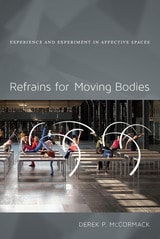
cover of Refrains for Moving Bodies: Experience and Experiment in Affective Spaces

Refrains for Moving Bodies

Experience and Experiment in Affective Spaces

Derek P. McCormack

Duke University Press, 2013
In Refrains for Moving Bodies, Derek P. McCormack explores the kinds of experiments with experience that can take place in the affective spaces generated when bodies move. Drawing out new connections between thinkers including Henri Lefebvre, William James, John Dewey, Gregory Bateson, Félix Guattari, and Gilles Deleuze, McCormack argues for a critically affirmative experimentalism responsive to the opportunities such spaces provide for rethinking and remaking maps of experience. Foregrounding the rhythmic and atmospheric qualities of these spaces, he demonstrates the particular value of Deleuze and Guattari's concept of the "refrain" for thinking and diagramming affect, bodies, and space-times together in creative ways, putting this concept to work to animate empirical encounters with practices and technologies as varied as dance therapy, choreography, radio sports commentary, and music video. What emerges are geographies of experimental participation that perform and disclose inventive ways of thinking within the myriad spaces where the affective capacities of bodies are modulated through moving.
[more]
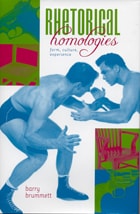
cover of Rhetorical Homologies: Form, Culture, Experience

Rhetorical Homologies

Form, Culture, Experience

Barry Brummett

University of Alabama Press, 2009

A highly developed study of the relationships between rhetoric and public culture.

One of the most widely used ideas in scholarship of the humanities and social sciences is that of homology: a formal pattern structuring different kinds of texts, ideas, and experiences. Rhetorical Homologies explores the central meaning of this form in a variety of discourses and also examines the kind of homologies that shape audience responses to personal, public, and political issues. Barry Brummett is most interested in homologies among very different orders of experience and texts: experiences on the battlefield that are homologous to those at a dining room table, for instance. What the common patterns that underlie such cases mean, why they are interesting, and why homology is rhetorical are the subjects of this study. 

Brummett focuses on a wide range of topics, from the homologies between rhetoric and weapons throughout history to the homology of ritual injuries as manifested in representations of Christian martyrs, Laurel and Hardy films, the African-American practice of playing the dozens, and televised professional wrestling. Brummett also explores the homology of the Wise Woman, using rhetorical representations of Sojourner Truth and Oprah Winfrey. In a concluding chapter, Brummett argues that the idea of homology is important in understanding how social life is organized in general and that the centrality of discourse in organizing experience makes rhetorical homologies an important perspective for general knowledge beyond the boundaries of this study.
 

[more]
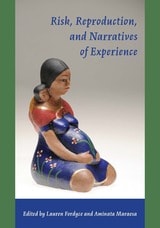
cover of Risk, Reproduction, and Narratives of Experience

Risk, Reproduction, and Narratives of Experience

Lauren Fordyce

Vanderbilt University Press, 2012

As Carole Browner explains in her foreword: "These chapters compellingly reveal that although we anthropologists tend to speak of biomedicine in hegemonic terms, in fact its penetration is quite variable and often ambivalently met. . . . Risk, Reproduction, and Narratives of Experience sheds new light on a troubling core aspect of medicalization processes, which simultaneously render pregnant women more docile subjects even as they are impelled to actively engage with biomedicalized prenatal care regimes. . . . We also see that a consummate means by which states seek to consolidate power in the reproductive realm is through expansion of the biomedical concept of risk. This critical observation emerges repeatedly in this collection."
[more]