78 books match the query 'Fascism & Totalitarianism' and 3 start with r

cover of Readings on Fascism and National Socialism

Readings on Fascism and National Socialism

University of Colorado, Dept. of Philosophy

Ohio University Press, 1952

The catastrophe and holocaust brought about by the two powerful movements of fascism and national socialism will mark human life always. Now, as we feel our hatred for them, we find it difficult to understand how they could have been so powerful, how they could have appealed so strongly to millions of people of a modern age.

To understand our own times, it is necessary to understand these movements. And to understand them, we must read the basic philosophical and political documents which show the force of the ideas which moved a world to the brink of disaster.

This collection of readings has been selected to encourage students to clarify their thinking on social philosophy. They will accordingly need to determine whether the readings contain more or less coherent body of ideas which constitutes a social philosophy. They will also need to raise the more far-reaching question of whether the ideas are acceptable. To arrive at any satisfactory answer to this latter question, they will necessarily have to compare the ideas of fascism and their practical meanings with the alternatives, real and ideal, that are the substance of live philosophical issues.

[more]
cover of Reichsrock: The International Web of White-Power and Neo-Nazi Hate Music

Reichsrock

The International Web of White-Power and Neo-Nazi Hate Music

Dyck, Kirsten

Rutgers University Press, 2016
From rap to folk to punk, music has often sought to shape its listeners’ political views, uniting them as a global community and inspiring them to take action. Yet the rallying potential of music can also be harnessed for sinister ends. As this groundbreaking new book reveals, white-power music has served as a key recruiting tool for neo-Nazi and racist hate groups worldwide. 
 
Reichsrock shines a light on the international white-power music industry, the fandoms it has spawned, and the virulently racist beliefs it perpetuates. Kirsten Dyck not only investigates how white-power bands and their fans have used the internet to spread their message globally, but also considers how distinctly local white-power scenes have emerged in Western Europe, Eastern Europe, Latin America, the United States, and many other sites. While exploring how white-power bands draw from a common well of nationalist, racist, and neo-Nazi ideologies, the book thus also illuminates how white-power musicians adapt their music to different locations, many of which have their own terms for defining whiteness and racial otherness. 
 
Closely tracking the online presence of white-power musicians and their fans, Dyck analyzes the virtual forums and media they use to articulate their hateful rhetoric. This book also demonstrates how this fandom has sparked spectacular violence in the real world, from bombings to mass shootings. Reichsrock thus sounds an urgent message about a global menace. 
 
[more]
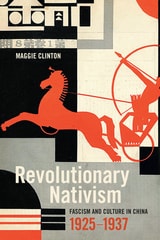
cover of Revolutionary Nativism: Fascism and Culture in China, 1925-1937

Revolutionary Nativism

Fascism and Culture in China, 1925-1937

Maggie Clinton

Duke University Press, 2017

In Revolutionary Nativism Maggie Clinton traces the history and cultural politics of fascist organizations that operated under the umbrella of the Chinese Nationalist Party (GMD) during the 1920s and 1930s. Clinton argues that fascism was not imported to China from Europe or Japan; rather it emerged from the charged social conditions that prevailed in the country's southern and coastal regions during the interwar period. These fascist groups were led by young militants who believed that reviving China's Confucian "national spirit" could foster the discipline and social cohesion necessary to defend China against imperialism and Communism and to develop formidable industrial and military capacities, thereby securing national strength in a competitive international arena. Fascists within the GMD deployed modernist aesthetics in their literature and art while justifying their anti-Communist violence with nativist discourse. Showing how the GMD's fascist factions popularized a virulently nationalist rhetoric that linked Confucianism with a specific path of industrial development, Clinton sheds new light on the complex dynamics of Chinese nationalism and modernity.
[more]