Results by title
75 books match the query 'Folk & Traditional' and 6 start with r
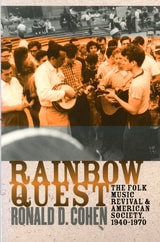
Rainbow Quest
The Folk Music Revival and American Society, 1940-1970Ronald D. Cohen
University of Massachusetts Press, 2002
For a brief period from the late 1950s to the mid-1960s, folk music captured a mass audience in the United States, as college students and others swarmed to concerts by the likes of Peter, Paul & Mary, Joan Baez, and Bob Dylan. In this comprehensive study, Ronald D. Cohen reconstructs the history of this singular cultural moment, tracing its origins to the early decades of the twentieth century. Drawing on scores of interviews and numerous manuscript collections, as well as his own extensive files, Cohen shows how a broad range of traditions—from hillbilly, gospel, blues, and sea shanties to cowboy, ethnic, and political protest music—all contributed to the genre known as folk. He documents the crucial work of John Lomax and other collectors who, with the assistance of recording companies, preserved and distributed folk music in the 1920s.
During the 1930s and 1940s, the emergence of left-wing politics and the rise of the commercial music marketplace helped to stimulate wider interest in folk music. Stars emerged, such as Woody Guthrie, Leadbelly, Pete Seeger, Burl Ives, and Josh White. With the success of the Weavers and the Kingston Trio in the 1950s, the stage was set for the full-blown “folk revival” of the early 1960s. Centered in New York's Greenwich Village and sustained by a flourishing record industry, the revival spread to college campuses and communities across the country. It included a wide array of performers and a supporting cast of journalists, club owners, record company executives, political activists, managers, and organizers. By 1965 the boom had passed its peak, as rock and roll came to dominate the marketplace, but the folk revival left an enduring musical legacy in American culture.

Red Dust and Broadsides
A Joint AutobiographyRonald D. Cohen
University of Massachusetts Press, 1999
Perhaps best known for Broadside, the influential magazine they founded in 1962, Agnes “Sis” Cunningham and Gordon Friesen have long been renowned figures on the American left. In this book, these two dedicated social activists—Sis the folk musician and Gordon the radical journalist—offer a spirited account of their personal and political odyssey. The story is illustrated with numerous photographs and drawings.
Born into poverty in rural Oklahoma, further shaped by the hardships of the “dustbowl” Depression years, Sis and Gordon were already committed to radical causes when they met and married in 1941. A short time later they moved to New York City, where they befriended Pete Seeger and Woody Guthrie. Sis joined the folk protest group the Almanac Singers, and Gordon continued his work as a journalist. Although blacklisted for their political views during the McCarthy era, Sis and Gordon persevered and eventually launched Broadside, which they continued to produce for almost twenty years. The magazine was instrumental in promoting the careers of many singer-songwriters, publishing the first works of such artists as Bob Dylan, Janis Ian, Phil Ochs, Buffy Sainte-Marie, and Tom Paxton, as well as the works of more established figures, including Malvina Reynolds and Pete Seeger. Indeed, Broadside gave birth to a musical revival that energized the country and forged a vital link between the folk music of the 1930s and 1940s and the urban folk revivalists of the 1960s and 1970s.

Red River Blues
The Blues Tradition in the SoutheastBruce Bastin
University of Illinois Press, 1986
A Classic of Blues Literature inductee into the Blues Foundation's Blues Hall of Fame
Drawing on archives and interviews with musicians, Red River Blues remains an acclaimed work of blues scholarship. Bruce Bastin traces the origins of the music to the turn of the twentieth century, when African Americans rejected slave songs, worksongs, and minstrel music in favor of a potent new vehicle for secular musical expression. Bastin looks at the blues' early emerging popularity and its spread via the Great Migration, delves into a wealth of field recordings, and looks at the careers of Brownie McGhee, Blind Boy Fuller, Curly Weaver, Sonny Terry, and many other foundational artists.

Right to the Juke Joint
A Personal History of American MusicPatrick B Mullen
University of Illinois Press, 2018
Roll Me in Your Arms
"Unprintable" Ozark Folksongs and Folklore, Volume I, Folksongs and MusicVance Randolph
University of Arkansas Press, 1992
Collected in the field from 1915 through 1955, these tales and songs were considered by the publisher at the time to be too salacious for inclusion in Vance Randolph’s Ozark Folksongs. Randolph came to doubt that they would ever appear in print, and they did not in his lifetime.
Roll Me in Your Arms, Volume I of “Unprintable” Ozark Folksongs and Folklore, includes 180 unexpurgated songs collected by Randolph with tunes transcribed from the original singers. Volume II, Blow the Candle Out, contains rhymes and songs without music as well as other unexpurgated Ozark folk materials, including children’s lore, elements in speech, graffiti, riddles, dance calls, and beliefs.
G. Legman’s painstaking and patient editing, annotating, and crossreferencing richly complement the Randolph collection. The result is a look into a previously neglected area in the study of folksong and folklore in the Ozarks and further evidence of Randolph’s preeminence in the field.
The late Vance Randolph lived in the Ozark Mountains from 1920 until his death in 1980. Although he taught folklore at the University of Arkansas in Fayetteville, he is best remembered for his many years of field research resulting in the national bestseller Pissing in the Snow & Other Ozark Folktales and more than a dozen other books on American folklore.
Roots of the Revival
American and British Folk Music in the 1950sRonald D. Cohen and Rachel Clare Donaldson
University of Illinois Press, 2014
After setting the stage with the work of music collectors in the nineteenth century, the authors explore the so-called recovery of folk music practices and performers by Alan Lomax and others, including journeys to and within the British Isles that allowed artists and folk music advocates to absorb native forms and facilitate the music's transatlantic exchange. Cohen and Donaldson place the musical and cultural connections of the twin revivals within the decade's social and musical milieu and grapple with the performers' leftist political agendas and artistic challenges, including the fierce debates over "authenticity" in practice and repertoire that erupted when artists like Harry Belafonte and the Kingston Trio carried folk into the popular music mainstream.
From work songs to skiffle, from the Weavers in Greenwich Village to Burl Ives on the BBC, Roots of the Revival offers a frank and wide-ranging consideration of a time, a movement, and a transformative period in American and British pop culture.