Results by title
107 books match the query 'Form' and 7 start with r
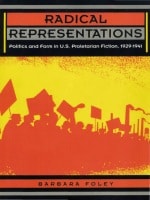
Radical Representations
Politics and Form in U.S. Proletarian Fiction, 1929–1941Barbara Foley
Duke University Press, 1994
Josephine Herbst, William Attaway, Jack Conroy, Thomas Bell and Tillie Olsen, are among the radical writers whose work Foley reexamines. Her fresh approach to the U.S. radicals' debates over experimentalism, the relation of art to propaganda, and the nature of proletarian literature recasts the relation of writers to the organized left. Her grasp of the left's positions on the "Negro question" and the "woman question" enables a nuanced analysis of the relation of class to race and gender in the proletarian novel. Moreover, examining the articulation of political doctrine in different novelistic modes, Foley develops a model for discussing the interplay between politics and literary conventions and genres.
Radical Representations recovers a literature of theoretical and artistic value meriting renewed attention form those interested in American literature, American studies, the U. S. left, and cultural studies generally.
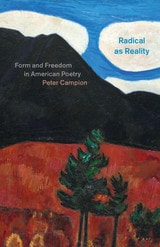
Radical as Reality
Form and Freedom in American PoetryPeter Campion
University of Chicago Press, 2019
Through close readings of the great modernists, midcentury objectivists, late twentieth-century poets, his contemporaries, and more, Campion unearths an American poetic landscape that is subtler and more varied than most critics have allowed. He discovers commonalities among poets considered opposites, dramatizes how form and history are mutually entailing, and explores how the conventions of poetry, its inheritance, and its inventions sprang from the tensions of ordinary life. At its core, this is a book about poetic making, one that reveals how the best poets not only receive but understand and adapt what comes before them, reinterpreting the history of their art to create work that is, indeed, radical as reality.
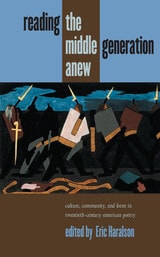
Reading the Middle Generation Anew
Culture, Community, and Form in Twentieth-Century American PoetryEric Haralson
University of Iowa Press, 2006
In addition to having worked during the broad middle of the last century, these poets constitute the center of twentieth-century American poetry in the larger sense, refuting invidious connotations of “middle” as coming after the great moderns and being superseded by a proliferating postmodern experimentation. This middle generation mediates the so-called American century and its prodigious body of poetry, even as it complicates historical and aesthetic categorizations.
Taking diverse formal and thematic angles on these poets—deconstructionist, biographical-historical, and more formalist accounts—this book re-examines their between-ness and ambivalence: their various positionings and repositionings in aesthetic, political, and personal matters. The essays study the interplay between these writers and such shifting formations as religious discourse, consumerism, militarism and war, the ideology of America as “nature’s nation,” and U.S. race relations and ethnic conflicts. Reading the Middle Generation Anew also shows the legacy of the middle generation, the ways in which their lives and writings continue to be a shaping force in American poetry. This fresh and invigorating collection will be of great interest to literary scholars and poets.
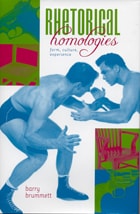
Rhetorical Homologies
Form, Culture, ExperienceBarry Brummett
University of Alabama Press, 2009
A highly developed study of the relationships between rhetoric and public culture.
One of the most widely used ideas in scholarship of the humanities and social sciences is that of homology: a formal pattern structuring different kinds of texts, ideas, and experiences. Rhetorical Homologies explores the central meaning of this form in a variety of discourses and also examines the kind of homologies that shape audience responses to personal, public, and political issues. Barry Brummett is most interested in homologies among very different orders of experience and texts: experiences on the battlefield that are homologous to those at a dining room table, for instance. What the common patterns that underlie such cases mean, why they are interesting, and why homology is rhetorical are the subjects of this study.
Brummett focuses on a wide range of topics, from the homologies between rhetoric and weapons throughout history to the homology of ritual injuries as manifested in representations of Christian martyrs, Laurel and Hardy films, the African-American practice of playing the dozens, and televised professional wrestling. Brummett also explores the homology of the Wise Woman, using rhetorical representations of Sojourner Truth and Oprah Winfrey. In a concluding chapter, Brummett argues that the idea of homology is important in understanding how social life is organized in general and that the centrality of discourse in organizing experience makes rhetorical homologies an important perspective for general knowledge beyond the boundaries of this study.
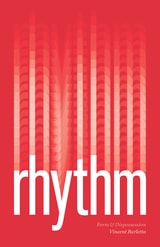
Rhythm
Form and DispossessionVincent Barletta
University of Chicago Press, 2020
Vincent Barletta explores rhythm through three historical moments, each addressing it as a phenomenon that transcends poetry, aesthetics, and even temporality. He reveals rhythm to be a power that holds us in place, dispossesses us, and shapes the foundations of our world. In these moments, Barletta encounters rhythm as a primordial and physical binding force that establishes order and form in the ancient world, as the anatomy of lived experience in early modern Europe, and as a subject of aesthetic and ethical questioning in the twentieth century.
A wide-ranging book covering a period spanning two millennia and texts from over ten languages, Rhythm will expand the conversation around this complex and powerful phenomenon.
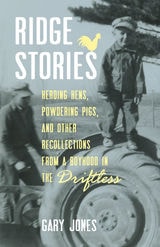
Ridge Stories
Herding Hens, Powdering Pigs, and Other Recollections from a Boyhood in the DriftlessGary Jones
Wisconsin Historical Society Press, 2019
Raised on a small dairy farm in the Driftless Area in the mid-twentieth century, Gary Jones gets real about his rural roots. In this collection of interrelated stories, Jones writes with plainspoken warmth and irreverence about farm, family, and folks on the ridge. Readers will meet Gramp Jones, whose oversized overalls saved him from losing a chunk of flesh to an irate sow; the young one-room-school teacher who helped the kids make sled jumps at recess; Charlotte, the lawn-mowing sheep who once ended up in the living room; Victor the pig-cutter, who learned his trade from folk tradition rather than vet school; and other colorful characters of the ridge. Often humorous and occasionally touching, Jones’s essays paint a vivid picture that will entertain city and country folk alike.
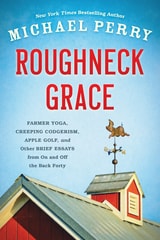
Roughneck Grace
Farmer Yoga, Creeping Codgerism, Apple Golf, and Other Brief Essays from on and off the Back FortyMichael Perry
Wisconsin Historical Society Press, 2016
New York Times bestselling author, humorist, and newspaper columnist Michael Perry returns with a new collection of bite-sized essays from his Sunday Wisconsin State Journal column, “Roughneck Grace.” Perry’s perspectives on everything from cleaning the chicken coop to sharing a New York City elevator with supermodels will have you snorting with laughter on one page, blinking back tears on the next, and--no matter your zip code--nodding in recognition throughout.