Results by title
167 books match the query 'Gardening' and 6 start with r

R. F. D.
Charles Allen SmartCharles Allen Smart
Ohio University Press, 1998
“This book,” the author tells us in his preface, “is intended to be a picture of life on a farm in Southern Ohio in the 1930s.” It is a faithful portrait of farm life as thousands of men and women experienced it from one end of the country to the other and from pioneering times to the present century.
Originally published in 1938 to enthusiastic reviews and commercial success, RFD is the story of one couple’s trials with leaving the comforts of city life for a chance to get back to the land.
From his farm near Chillicothe, Ohio, Charles Allen Smart gives a realistic rendering of what it meant to farm in the 1930s. It is part of the book’s intrinsic honesty that it could not be as good as Walden. Thoreau had worked out a philosophy that suited him and that he was ready to recommend to others. Mr. Smart had no prescription for the general ailments, beyond a belief that creating things is important and that owning, buying, and selling things are unimportant.
What he tells us throughout this unusual book is that for him life on this particular farm, in this particular house, with this particular set-up of friends, neighbors, dogs, sheep, hens, cattle, trees, corn, vegetables, grass, and weather, costs less in human values than life in New York City—or in Chillicothe.
Ohio University Press is especially pleased to reissue this midwestern classic with a new foreword by noted farm writer Gene Logsdon.

Reading Zen in the Rocks
The Japanese Dry Landscape GardenFrançois Berthier
University of Chicago Press, 2005
Berthier's guided tour of the famous garden of Ryoanji (Temple) in Kyoto leads him into an exposition of the genre, focusing on its Chinese antecedents and affiliations with Taoist ideas and Chinese landscape painting. He traces the roles of Shinto and Zen Buddhism in the evolution of the garden and also considers how manual laborers from the lowest classes in Japan had a hand in creating some of its highest examples. Parkes contributes an equally original and substantive essay which delves into the philosophical importance of rocks and their "language of stone," delineating the difference between Chinese and Japanese rock gardens and their relationship to Buddhism. Together, the two essays compose one of the most comprehensive and elegantly written studies of this haunting garden form.
Reading Zen in the Rocks is fully illustrated with photographs of all the major gardens discussed, making it a handsome addition to the library of anyone interested in gardening, Eastern philosophy, and the combination of the two that the karesansui so superbly represents.
Praise for the French edition:
"A small book of rare depth, remarkably illustrated, on one of the most celebrated and beautiful rock gardens of the monasteries of Kyoto."—L'Humanité
"Through Le Jardin de Ryoanji, Berthier teaches us to read the zen in the rocks, to discover the language offered by the garden at Ryoanji. Enigmatic, poetic, and disconcerting, an enriching journey through a work of art of surprising modernity, Le Jardin de Ryoanji is a work that will interest all the amateurs of Japanese art and Eastern philosophy."—Lien Horticole
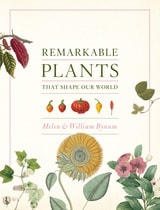
Remarkable Plants That Shape Our World
Helen Bynum and William Bynum
University of Chicago Press, 2014
Remarkable Plants celebrates the wonder and utility of the green kingdom, taking a detailed look at how plants have shaped our world. It focuses on eighty key species and richly explores their history, highlighting their importance and bringing to light surprising stories. Organized thematically into eight sections, the book starts with “Transformers” (including rice, beans, olives) and moves through sections such as “Heal and Harm” (poppy, aloe, strychnos) and “Revered and Adored” (lotus, frankincense, rose). Each species is introduced with its common and scientific names and followed by an exploration of its cultural, historical, botanical, and symbolic associations. Hundreds of botanical illustrations show full plants as well as highlight distinctive leaves, blooms, and fruits.
Rooted in one of the world’s most important and renowned temples of greenery, the Royal Botanic Gardens, Kew, Remarkable Plants is a symbiotic balance of science and art that will open readers’ eyes to the deep influence of the natural world on our modern one.
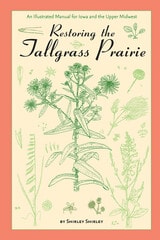
Restoring the Tallgrass Prairie
An Illustrated Manual for Iowa and the Upper MidwestShirley Shirley
University of Iowa Press, 1994
Iowa is the only state that lies entirely within the natural region of the tallgrass prairie. Early documents indicate that 95 percent of the state—close to 30 million acres—was covered by prairie vegetation at the time of Euro-American settlement. By 1930 the prairie sod had been almost totally converted to cropland; only about 30,000 acres of the original “great green sea” remained. Now, in this gracefully illustrated manual, Shirley Shirley has created a step-by-step guide to reconstructing the natural landscape of Iowa and the Upper Midwest.
Chapters on planning, obtaining and selecting plants and seeds, starting seeds indoors, preparing the site, planting, and maintenance set the stage for comprehensive species accounts. Shirley gives firsthand information on soil, moisture, sun, and pH requirements; location, size, and structure; blooming time and color; and propagation, germination, and harvesting for more than a hundred wildflowers and grasses.
Shirley's sketches—all drawn from native plants and from seedlings that she grew herself—will be valuable for even the most experienced gardener. While other books typically feature only the flowering plant, her careful drawings show the three stages of the seedlings, the flower, and the seedhead with seeds as well as the entire plant. This practical and attractive volume will help anyone dedicated to reconstructing the lost “emerald growth” of the historic tallgrass prairie.
Robert Irwin Getty Garden
Lawrence Weschler
J. Paul Getty Trust, The, 2020
Row by Row
Talking with Kentucky GardenersKatherine J. Black
Ohio University Press, 2015
For two and a half years, Katherine J. Black crisscrossed Kentucky, interviewing home vegetable gardeners from a rich variety of backgrounds. Row by Row: Talking with Kentucky Gardeners is the result, a powerful compilation of testimonies on the connections between land, people, culture, and home.
The people profiled here share a Kentucky backdrop, but their life stories, as well as their gardens, have as many colors, shapes, and tastes as heirloom tomatoes do. Black interviewed those who grow in city backyards, who carve out gardens from farmland, and who have sprawling plots in creek bottoms and former pastures. Many of the gardeners in Row by Row speak eloquently about our industrialized food system’s injuries to the land, water, and health of people. But more often they talk about what they are doing in their gardens to reverse this course.
Row by Row is as sure to appeal to historians, food studies scholars, and sustainability advocates as it is to gardeners and local food enthusiasts. These eloquent portraits, drawn from oral histories and supplemented by Deirdre Scaggs’ color photographs, form a meditation on how gardeners make sense of their lives through what they grow and how they grow it.