Results by title
130 books match the query 'Gender identity' and 2 start with r
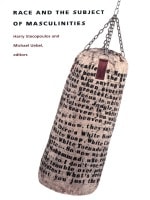
Race and the Subject of Masculinities
Harry Stecopoulos and Michael Uebel, eds.
Duke University Press, 1997
Although in recent years scholars have explored the cultural construction of masculinity, they have largely ignored the ways in which masculinity intersects with other categories of identity, particularly those of race and ethnicity. The essays in Race and the Subject of Masculinities address this concern and focus on the social construction of masculinity—black, white, ethnic, gay, and straight—in terms of the often complex and dynamic relationships among these inseparable categories.
Discussing a wide range of subjects including the inherent homoeroticism of martial-arts cinema, the relationship between working-class ideologies and Elvis impersonators, the emergence of a gay, black masculine aesthetic in the works of James Van der Zee and Robert Mapplethorpe, and the comedy of Richard Pryor, Race and the Subject of Masculinities provides a variety of opportunities for thinking about how race, sexuality, and "manhood" are reinforced and reconstituted in today’s society. Editors Harry Stecopoulos and Michael Uebel have gathered together essays that make clear how the formation of masculine identity is never as obvious as it might seem to be. Examining personas as varied as Eddie Murphy, Bruce Lee, Tarzan, Malcolm X, and Andre Gidé, these essays draw on feminist critique and queer theory to demonstrate how cross-identification through performance and spectatorship among men of different races and cultural backgrounds has served to redefine masculinity in contemporary culture. By taking seriously the role of race in the making of men, Race and the Subject of Masculinities offers an important challenge to the new studies of masculinity.
Discussing a wide range of subjects including the inherent homoeroticism of martial-arts cinema, the relationship between working-class ideologies and Elvis impersonators, the emergence of a gay, black masculine aesthetic in the works of James Van der Zee and Robert Mapplethorpe, and the comedy of Richard Pryor, Race and the Subject of Masculinities provides a variety of opportunities for thinking about how race, sexuality, and "manhood" are reinforced and reconstituted in today’s society. Editors Harry Stecopoulos and Michael Uebel have gathered together essays that make clear how the formation of masculine identity is never as obvious as it might seem to be. Examining personas as varied as Eddie Murphy, Bruce Lee, Tarzan, Malcolm X, and Andre Gidé, these essays draw on feminist critique and queer theory to demonstrate how cross-identification through performance and spectatorship among men of different races and cultural backgrounds has served to redefine masculinity in contemporary culture. By taking seriously the role of race in the making of men, Race and the Subject of Masculinities offers an important challenge to the new studies of masculinity.
Contributors. Herman Beavers, Jonathan Dollimore, Richard Dyer, Robin D. G. Kelly, Christopher Looby, Leerom Medovoi, Eric Lott, Deborah E. McDowell, José E. Muñoz, Harry Stecopoulos, Yvonne Tasker, Michael Uebel, Gayle Wald, Robyn Wiegman
[more]
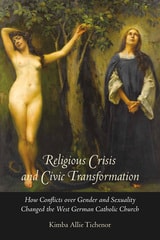
Religious Crisis and Civic Transformation
How Conflicts over Gender and Sexuality Changed the West German Catholic ChurchKimba Allie Tichenor
Brandeis University Press, 2016
This book offers a fresh interpretation of the connection between the West German Catholic Church and post-1950s political debates on women’s reproductive rights and the protection of life in West Germany. According to Tichenor, Catholic women in West Germany, influenced by the culture of consumption, the sexual revolution, Vatican II reforms, and feminism, sought to renegotiate their relationship with the Church. They demanded a more active role in Church ministries and challenged the Church’s hierarchical and gendered view of marriage and condemnation of artificial contraception. When the Church refused to compromise, women left en masse. In response, the Church slowly stitched together a new identity for a postsecular age, employing an elaborate nuptial symbolism to justify its stance on celibacy, women’s ordination, artificial contraception, abortion, and reproductive technologies. Additionally, the Church returned to a radical interventionist agenda that embraced issue-specific alliances with political parties other than the Christian parties. In her conclusion, Tichenor notes more recent setbacks to the German Catholic Church, including disappointment with the reactionary German Pope Benedict XVI and his failure in 2010 to address over 250 allegations of sexual abuse at twenty-two of Germany’s twenty-seven dioceses. How the Church will renew itself in the twenty-first century remains unclear. This closely observed case study, which bridges religious, political, legal, and women’s history, will interest scholars and students of twentieth-century European religious history, modern Germany, and the intersection of Catholic Church practice and women’s issues.
[more]