Results by title
66 books match the query 'Genealogy' and 5 start with r
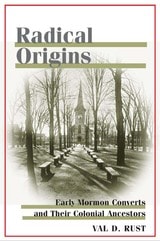
Radical Origins
Early Mormon Converts and Their Colonial AncestorsVal D. Rust
University of Illinois Press, 2004
Utilizing a unique set of meticulously compiled genealogical data, Rust uncovers the ancestors of early church members throughout what we understand as the radical segment of the Protestant Reformation. Coming from backgrounds in the Antinomians, Seekers, Anabaptists, Quakers, and the Family of Love, many colonial ancestors of the church(s early members had been ostracized from their communities. Expelled from the Massachusetts Bay Colony, some were whipped, mutilated, or even hanged for their beliefs.
Rust shows how family traditions can be passed down through the generations, and can ultimately shape the outlook of future generations. This, he argues, extends the historical role of Mormons by giving their early story significant implications for understanding the larger context of American colonial history. Featuring a provocative thesis and stunning original research, Radical Origins is a remarkable contribution to our understanding of religion in the development of American culture and the field of Mormon history.
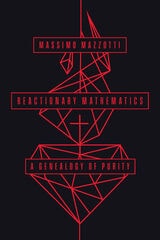
Reactionary Mathematics
A Genealogy of PurityMassimo Mazzotti
University of Chicago Press, 2023
The nineteenth century opened with a major shift in European mathematics, and in the Kingdom of Naples, this occurred earlier than elsewhere. Between 1790 and 1830 its leading scientific institutions rejected as untrustworthy the “very modern mathematics” of French analysis and in its place consolidated, legitimated, and put to work a different mathematical culture. The Neapolitan mathematical resistance was a complete reorientation of mathematical practice. Over the unrestricted manipulation and application of algebraic algorithms, Neapolitan mathematicians called for a return to Greek-style geometry and the preeminence of pure mathematics.
For all their apparent backwardness, Massimo Mazzotti explains, they were arguing for what would become crucial features of modern mathematics: its voluntary restriction through a new kind of rigor and discipline, and the complete disconnection of mathematical truth from the empirical world—in other words, its purity. The Neapolitans, Mazzotti argues, were reacting to the widespread use of mathematical analysis in social and political arguments: theirs was a reactionary mathematics that aimed to technically refute the revolutionary mathematics of the Jacobins. During the Restoration, the expert groups in the service of the modern administrative state reaffirmed the role of pure mathematics as the foundation of a newly rigorous mathematics, which was now conceived as a neutral tool for modernization. What Mazzotti’s penetrating history shows us in vivid detail is that producing mathematical knowledge was equally about producing certain forms of social, political, and economic order.
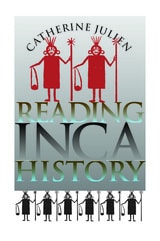
Reading Inca History
Catherine Julien
University of Iowa Press, 2002
At the heart of this book is the controversy over whether Inca history can and should be read as history. Did the Incas narrate a true reflection of their past, and did the Spaniards capture these narratives in a way that can be meaningfully reconstructed? In Reading Inca History,Catherine Julien finds that the Incas did indeed create detectable life histories.
The two historical genres that contributed most to sixteenth- and seventeenth-century Spanish narratives about the Incas were an official account of Inca dynastic genealogy and a series of life histories of Inca rulers. Rather than take for granted that there was an Inca historical consciousness, Julien begins by establishing an Inca purpose for keeping this dynastic genealogy. She then compares Spanish narratives of the Inca past to identify the structure of underlying Inca genres and establish the dependency on oral sources. Once the genealogical genre can be identified, the life histories can also be detected.
By carefully studying the composition of Spanish narratives and their underlying sources, Julien provides an informed and convincing reading of these complex texts. By disentangling the sources of their meaning, she reaches across time, language, and cultural barriers to achieve a rewarding understanding of the dynamics of Inca and colonial political history.
Representative Democracy
Principles and GenealogyNadia Urbinati
University of Chicago Press, 2006
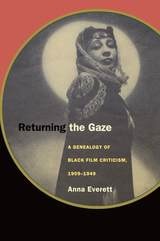
Returning the Gaze
A Genealogy of Black Film Criticism, 1909–1949Anna Everett
Duke University Press, 2001
Culling black newspapers, magazines, scholarly and political journals, and monographs, Everett has produced an unparalleled investigation of black critical writing on the early cinema during the era of racial segregation in America. Correcting the notion that black critical interest in the cinema began and ended with the well-documented press campaign against D. W. Griffith’s Birth of a Nation, she discovers that as early as 1909 black newspapers produced celebratory discourses about the cinema as a much-needed corrective to the predominance of theatrical blackface minstrelsy. She shows how, even before the Birth of a Nation controversy, the black press succeeded in drawing attention to both the callous commercial exploitation of lynching footage and the varied work of black film entrepreneurs. The book also reveals a feast of film commentaries that were produced during the “roaring twenties” and the jazz age by such writers as W.E.B. DuBois, Langston Hughes, and Zora Neale Hurston, as well as additional pieces that were written throughout the Depression and the pre– and post–war periods. Situating this wide-ranging and ideologically complex material in its myriad social, political, economic, and cultural contexts, Everett aims to resuscitate a historical tradition for contemporary black film literature and criticism.
Returning the Gaze will appeal to scholars and students of film, black and ethnic studies, American studies, cultural studies, literature, and journalism.