Results by title
73 books match the query 'German literature' and 3 start with r
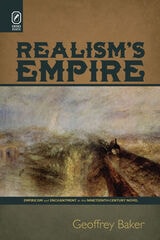
Realism's Empire
Empiricism and Enchantment in the Nineteenth-Century NovelGeoffrey Baker
The Ohio State University Press, 2009
If realist novels are the literary avatars of secular science and rational progress, then why are so many canonical realist works organized around a fear of that progress? Realism is openly indebted, at the level of form and content, to imperialist and scientific advances. However, critical emphasis on this has obscured the extent to which major novelists of the period openly worried about the fate of mystery and the dissolution of tradition that accompanied science’s shrinking of the world. Realism’s modernization is inseparable from nostalgia.
In Realism’s Empire: Empiricism and Enchantment in the Nineteenth-Century Novel, Geoffrey Baker demonstrates that realist fiction’s stance toward both progress and the foreign or supernatural is much more complex than established scholarship has assumed. The work of Honoré de Balzac, Anthony Trollope, and Theodor Fontane explicitly laments the loss of mystery in the world due to increased knowledge and exploration. To counter this loss and to generate the complications required for narrative, these three authors import peripheral, usually colonial figures into the metropolitan centers they otherwise depict as disenchanted and rationalized: Paris, London, and Berlin. Baker’s book examines the consequences of this duel for realist narrative and readers’ understandings of its historical moment. In so doing, Baker shows Balzac, Trollope, and Fontane grappling with new realities that frustrate their inherited means of representation and oversee a significant shift in the development of the novel.
[more]

Respectability and Deviance
Nineteenth-Century German Women Writers and the Ambiguity of RepresentationRuth-Ellen Boetcher Joeres
University of Chicago Press, 1998
The first major study in English of nineteenth-century German women writers, this book examines their social and cultural milieu along with the layers of interpretation and representation that inform their writing.
Studying a period of German literary history that has been largely ignored by modern readers, Ruth-Ellen Boetcher Joeres demonstrates that these writings offer intriguing opportunities to examine such critical topics as canon formation; the relationship between gender, class, and popular culture; and women, professionalism, and technology. The writers she explores range from Annette von Droste-Hülshoff, who managed to work her way into the German canon, to the popular serial novelist E. Marlitt, from liberal writers such as Louise Otto and Fanny Lewald, to the virtually unknown novelist and journalist Claire von Glümer. Through this investigation, Boetcher Joeres finds ambiguities, compromises, and subversions in these texts that offer an extensive and informative look at the exciting and transformative epoch that so much shaped our own.
Studying a period of German literary history that has been largely ignored by modern readers, Ruth-Ellen Boetcher Joeres demonstrates that these writings offer intriguing opportunities to examine such critical topics as canon formation; the relationship between gender, class, and popular culture; and women, professionalism, and technology. The writers she explores range from Annette von Droste-Hülshoff, who managed to work her way into the German canon, to the popular serial novelist E. Marlitt, from liberal writers such as Louise Otto and Fanny Lewald, to the virtually unknown novelist and journalist Claire von Glümer. Through this investigation, Boetcher Joeres finds ambiguities, compromises, and subversions in these texts that offer an extensive and informative look at the exciting and transformative epoch that so much shaped our own.
[more]
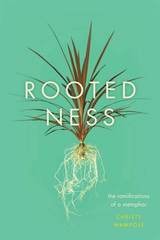
Rootedness
The Ramifications of a MetaphorChristy Wampole
University of Chicago Press, 2016
People have long imagined themselves as rooted creatures, bound to the earth—and nations—from which they came. In Rootedness, Christy Wampole looks toward philosophy, ecology, literature, history, and politics to demonstrate how the metaphor of the root—surfacing often in an unexpected variety of places, from the family tree to folk etymology to the language of exile—developed in twentieth-century Europe.
Wampole examines both the philosophical implications of this metaphor and its political evolution. From the root as home to the root as genealogical origin to the root as the past itself, rootedness has survived in part through its ability to subsume other compelling metaphors, such as the foundation, the source, and the seed. With a focus on this concept’s history in France and Germany, Wampole traces its influence in diverse areas such as the search for the mystical origins of words, land worship, and nationalist rhetoric, including the disturbing portrayal of the Jews as an unrooted, and thus unrighteous, people. Exploring the works of Martin Heidegger, Simone Weil, Jean-Paul Sartre, Paul Celan, and many more, Rootedness is a groundbreaking study of a figure of speech that has had wide-reaching—and at times dire—political and social consequences.
Wampole examines both the philosophical implications of this metaphor and its political evolution. From the root as home to the root as genealogical origin to the root as the past itself, rootedness has survived in part through its ability to subsume other compelling metaphors, such as the foundation, the source, and the seed. With a focus on this concept’s history in France and Germany, Wampole traces its influence in diverse areas such as the search for the mystical origins of words, land worship, and nationalist rhetoric, including the disturbing portrayal of the Jews as an unrooted, and thus unrighteous, people. Exploring the works of Martin Heidegger, Simone Weil, Jean-Paul Sartre, Paul Celan, and many more, Rootedness is a groundbreaking study of a figure of speech that has had wide-reaching—and at times dire—political and social consequences.
[more]