383 books match the query 'Globalization' and 16 start with r

cover of Re-Imagining the City: Art, Globalization and Urban Spaces

Re-Imagining the City

Art, Globalization and Urban Spaces

Edited by Elizabeth Grierson and Kristen Sharp

Intellect Books, 2013
Re-Imagining the City: Art, Globalization, and Urban Spaces examines how contemporary processes of globalization are transforming cultural experience and production in urban spaces. It maps how cultural productions in art, architecture, and communications media are contributing to the reimagining of place and identity through events, artifacts, and attitudes. This book recasts how we understand cities—how knowledge can be formed, framed, and transferred through cultural production and how that knowledge is mediated through the construction of aesthetic meaning and value.

[more]
cover of Reconfiguring Racial Capitalism: South Africa in the Chinese Century

Reconfiguring Racial Capitalism

South Africa in the Chinese Century

Mingwei Huang

Duke University Press, 2024

In Reconfiguring Racial Capitalism, Mingwei Huang traces the development of new forms of racial capitalism in the twenty-first century. Through fieldwork in one of the “China malls” that has emerged along Johannesburg’s former mining belt, Huang identifies everyday relations of power and difference between Chinese entrepreneurs and African migrant workers in these wholesale shops. These relations, Huang contends, replicate and perpetuate global structures of white supremacy, anti-Blackness, capitalism, and colonialism, even when whiteness is not present. Huang argues that this dynamic reflects the sedimented legacies and continued operation of white supremacy and colonialism, which have been transformed in the shift of capitalism’s center of gravity toward China and the Global South. These new forms of racial capitalism and empire layer onto and extend histories of exploitation and racialization in South Africa. Taking a palimpsestic approach, Huang offers tools for understanding this shift and decentering contemporary Western conceptions of race, empire, and racial capitalism in the Chinese Century.
[more]
cover of Redefining Japaneseness: Japanese Americans in the Ancestral Homeland

Redefining Japaneseness

Japanese Americans in the Ancestral Homeland

Yamashiro, Jane H

Rutgers University Press, 2017
There is a rich body of literature on the experience of Japanese immigrants in the United States, and there are also numerous accounts of the cultural dislocation felt by American expats in Japan. But what happens when Japanese Americans, born and raised in the United States, are the ones living abroad in Japan? 
 
Redefining Japaneseness chronicles how Japanese American migrants to Japan navigate and complicate the categories of Japanese and “foreigner.” Drawing from extensive interviews and fieldwork in the Tokyo area, Jane H. Yamashiro tracks the multiple ways these migrants strategically negotiate and interpret their daily interactions. Following a diverse group of subjects—some of only Japanese ancestry and others of mixed heritage, some fluent in Japanese and others struggling with the language, some from Hawaii and others from the US continent—her study reveals wide variations in how Japanese Americans perceive both Japaneseness and Americanness. 
 
Making an important contribution to both Asian American studies and scholarship on transnational migration, Redefining Japaneseness critically interrogates the common assumption that people of Japanese ancestry identify as members of a global diaspora. Furthermore, through its close examination of subjects who migrate from one highly-industrialized nation to another, it dramatically expands our picture of the migrant experience.  
 
[more]
cover of Religion, Secularism, and Political Belonging

Religion, Secularism, and Political Belonging

Leerom Medovoi and Elizabeth Bentley, editors

Duke University Press, 2021

Working in four scholarly teams focused on different global regions—North America, the European Union, the Middle East, and China—the contributors to Religion, Secularism, and Political Belonging examine how new political worlds intersect with locally specific articulations of religion and secularism. The chapters address many topics, including the changing relationship between Islam and politics in Tunisia after the 2010 revolution, the influence of religion on the sharp turn to the political right in Western Europe, understandings of Confucianism as a form of secularism, and the alliance between evangelical Christians and neoliberal business elites in the United States since the 1970s. This volume also provides a methodological template for how humanities scholars around the world can collaboratively engage with sweeping issues of global significance.

Contributors. Markus Balkenhol, Elizabeth Bentley, Kambiz GhaneaBassiri, David N. Gibbs, Ori Goldberg, Marcia Klotz, Zeynep Kurtulus Korkman, Leerom Medovoi, Eva Midden, Mohanad Mustafa, Mu-chou Poo, Shaul Setter, John Vignaux Smith, Pooyan Tamimi Arab, Ernst van den Hemel, Albert Welter, Francis Ching-Wah Yip, Raef Zreik
[more]
cover of Religions/Globalizations: Theories and Cases

Religions/Globalizations

Theories and Cases

Dwight N. Hopkins, Lois Ann Lorentzen, Eduardo Mendieta, and David Batstone, eds.

Duke University Press, 2001

For the majority of cultures around the world, religion permeates and informs everyday rituals of survival and hope. But religion also has served as the foundation for national differences, racial conflicts, class exploitation, and gender discrimination. Indeed, religious spirituality, having been transformed by contemporary economic and political events, remains both empowering and controversial. Religions/Globalizations examines the extent to which globalization and religion are inseparable terms, bound up with each other in a number of critical and mutually revealing ways.
As the contributors to this work suggest, a crucial component of globalization—the breakdown of familiar boundaries and power balances—may open a space in which religion can be deployed to help refabricate new communities. Examples of such deployments can be found in the workings of liberation theology in Latin America. In other cases, however, the operations of globalization have provided a space for strident religious nationalism and identity disputes to flourish. Is there in fact a dialectical tension between religion and globalization, a codependence and codeterminism? While religion can be seen as a globalizing force, it has also been transformed and even victimized by globalization.
A provocative assessment of a contemporary phenomenon with both cultural and political dimensions, Religions/Globalizations will interest not only scholars in religious studies but also those studying Latin America, the Middle East, South Asia, and Africa.

Contributors. David Batstone, Berit Bretthauer, Enrique Dussel, Dwight N. Hopkins, Mark Juergensmeyer, Lois Ann Lorentzen, Eduardo Mendieta, Vijaya Rettakudi Nagarajan, Kathryn Poethig, Lamin Sanneh, Linda E. Thomas

[more]
cover of Religious Imaginations: How Narratives of Faith are Shaping Today’s World

Religious Imaginations

How Narratives of Faith are Shaping Today’s World

Edited by James Walters

Gingko, 2018

Market globalization, technology, climate change, and postcolonial political forces are together forging a new, more modern world. However, caught up in the mix are some powerful religious narratives that are galvanizing peoples and reimagining – and sometimes stifling – the political and social order. Some are repressive, fundamentalist imaginations, such as the so-called Islamic Caliphate. Others could be described as post-religious, such as the evolution of universal human rights out of the European Christian tradition. But the question of the compatibility of these religious worldviews, particularly those that have emerged out of the Abrahamic faith traditions, is perhaps the most pressing issue in global stability today. What scope for dialogue is there between the Jewish, Muslim, and Christian ways of imagining the future? How can we engage with these multiple imaginations to create a shared and peaceful global society? Religious Imaginations is an interdisciplinary volume of both new and well-known scholars exploring how religious narratives interact with the contemporary geopolitical climate.
 
[more]
cover of Remaindered Life

Remaindered Life

Neferti X. Tadiar

Duke University Press, 2022
In Remaindered Life Neferti X. M. Tadiar offers a new conceptual vocabulary and framework for rethinking the dynamics of a global capitalism maintained through permanent imperial war. Tracking how contemporary capitalist accumulation depends on producing life-times of disposability, Tadiar focuses on what she terms remaindered life—practices of living that exceed the distinction between life worth living and life worth expending. Through this heuristic, Tadiar reinterprets the global significance and genealogy of the surplus life-making practices of migrant domestic and service workers, refugees fleeing wars and environmental disasters, criminalized communities, urban slum dwellers, and dispossessed Indigenous people. She also examines artists and filmmakers in the Global South who render forms of various living in the midst of disposability. Retelling the story of globalization from the side of those who reach beyond dominant protocols of living, Tadiar demonstrates how attending to remaindered life can open up another horizon of possibility for a radical remaking of our present global mode of life.
[more]
cover of Remaking New York: Primitive Globalization And The Politics Of Urban Community

Remaking New York

Primitive Globalization And The Politics Of Urban Community

William Sites

University of Minnesota Press, 2003

Uses New York City to discuss the ways that policy has mismanaged the effects of globalization

Inequality increases, instability grows, communities fragment: this is the fate of a city in the wake of globalization—but is globalization really the cause? Proposing a new perspective on politics, globalization, and the city, this provocative book argues that such urban problems result in part from U.S. policies that can be changed.

William Sites develops the concept of primitive globalization, identifying a pattern of reactive politics—ad hoc measures to subsidize business, displace the urban poor, and dismantle the welfare state—that uproots social actors (corporations, citizens, urban residents) and facilitates a damaging, short-term-oriented type of international integration. In light of this theory, Sites examines the transformation of New York City since the 1970s, focusing on the logic of political action at national, local, and neighborhood levels. In the process, the story of late twentieth-century New York and its Lower East Side community emerges as something different: not a tale of globalist transformation or of local resurgence but a distinctly American case, one in which urban politics and the state, in their own right, exacerbate inequality and community fragmentation within the city.
[more]
cover of Reproduction, Globalization, and the State: New Theoretical and Ethnographic Perspectives

Reproduction, Globalization, and the State

New Theoretical and Ethnographic Perspectives

Carole H. Browner and Carolyn F. Sargent, eds.

Duke University Press, 2011

Reproduction, Globalization, and the State conceptualizes and puts into practice a global anthropology of reproduction and reproductive health. Leading anthropologists offer new perspectives on how transnational migration and global flows of communications, commodities, and biotechnologies affect the reproductive lives of women and men in diverse societies throughout the world. Based on research in Africa, the Americas, Asia, and Western Europe, their fascinating ethnographies provide insight into reproduction and reproductive health broadly conceived to encompass population control, HIV/AIDS, assisted reproductive technologies, paternity tests, sex work, and humanitarian assistance. The contributors address the methodological challenges of research on globalization, including ways of combining fine-grained ethnography with analyses of large-scale political, economic, and ideological forces. Their essays reveal complex interactions among global and state population policies and politics; public health, human rights, and feminist movements; diverse medical systems; various religious practices, doctrines, and institutions; and intimate relationships and individual aspirations.

Contributors. Aditya Bharadwaj, Caroline H. Bledsoe, Carole H. Browner, Junjie Chen, Aimee R. Eden, Susan L. Erikson, Didier Fassin, Claudia Lee Williams Fonseca, Ellen Gruenbaum, Matthew Gutmann, Marcia C. Inhorn, Mark B. Padilla, Rayna Rapp, Lisa Ann Richey, Carolyn Sargent, Papa Sow, Cecilia Van Hollen, Linda Whiteford
[more]
cover of Reproductive Rights in a Global Context: South Africa, Uganda, Peru, Denmark, United States, Vietnam, Jordan

Reproductive Rights in a Global Context

South Africa, Uganda, Peru, Denmark, United States, Vietnam, Jordan

Lara M. Knudsen

Vanderbilt University Press, 2006

A Choice Outstanding Academic Book of 2006

Traveling alone when she was between 17 and 22, with no institutional affiliation and no financial assistance, the author visited five developing countries and two developed ones on five continents. Her goal was to extend her own experience in an abortion clinic in Portland, Oregon. Lara Knudsen interviewed over 90 women's rights activists, health professionals, NGO workers, and government officials, gaining a sense of both official policies and the actual delivery of services in local clinics. The book places the experiences of women within the global context of how international population control agendas have influenced women's reproductive rights in the past, and how the changing international discourse on reproductive health continues to influence those rights today.
[more]
cover of Resolana: Emerging Chicano Dialogues on Community and Globalization

Resolana

Emerging Chicano Dialogues on Community and Globalization

Miguel Montiel

University of Arizona Press, 2009

Villagers in northern New Mexico refer to the south-facing side of a wall as la resolana, meaning “the place where the sun shines.” Every culture has a resolana, a place where the resolaneros—the villagers—gather, dialogue, and reflect on society, culture, and politics. The buried knowledge that emerges from this process may be “pure gold,” or el oro del barrio, a metaphor for the culturally contextualized knowledge gathered at the resolana.

Coming from diverse backgrounds in social work, sociology, public administration, literature, history, and education, three modern resolaneros take the twin concepts of resolana and el oro del barrio on a breathtaking journey from their rural roots to their application in an urban setting and on to a holistic view of globalization. The authors offer a humane perspective on transborder cultures and all communities struggling to maintain their cultural and linguistic identities. They share an optimistic view of how ordinary people everywhere can take back control of their own destinies. This book is about uncovering subjugated knowledge—el oro del barrio—through resolana, a dynamic process of thought and action.

Resolana will inspire dialogue and creativity from those interested in sociology, political science, social work, and Chicano studies, as well as public-policy makers and the general public.
[more]
cover of Revolutions of Capitalism: The Politics of the Event

Revolutions of Capitalism

The Politics of the Event

Maurizio Lazzarato. Translated by Brian Whitener and Geo Maher.

Duke University Press, 2026
Framed by brilliant readings of Gilles Deleuze and Félix Guattari, Gabriel Tarde, and Mikhail Bakhtin, Maurizio Lazzarato’s Revolutions of Capitalism charts a new theory of contemporary capitalism and the politics against it. Originally published in French in 2004, this newly translated work sees capitalism as driven, not only by labor or value, but by the capture of cooperation and by the taming of possibles. Lazzarato theorizes how contemporary capitalism depends on noo-politics, or the “action of brains at a distance on other brains,” which seeks to control memory and attention and to trap the proliferation of possibles. Against this, Lazzarato reveals how current social movements attack established institutions and their vision of a single possible world to liberate the creation and actualization of a multiplicity of possible worlds.
[more]
cover of Reworking English in Rhetoric and Composition: Global Interrogations, Local Interventions

Reworking English in Rhetoric and Composition

Global Interrogations, Local Interventions

Edited by Bruce Horner and Karen Kopelson

Southern Illinois University Press, 2014

In Reworking English in Rhetoric and Composition, editors Bruce Horner and Karen Kopelson gather leading scholars and new voices in the field of rhetoric and composition to offer a dynamic new perspective on English as it is used today. This provocative volume explores the myriad ways in which English is constantly redefined, revised, and redirected through specific, located acts of writing, rhetoric, teaching, and learning. Contributors provide insightful contributions to the study of English from both national and international perspectives, revealing the language as a fluid and constantly changing manner of expression that challenges established notions.

In part one, “Reworking Language,” writers call into question the idea of language as a static, stable entity. In part two, “Locations and Migrations: Global/Local Interrogations,” contributors explore the impact of writing and teaching English in both in the United States and abroad, from Arkansas and Oklahoma to China, Jamaica, and Lebanon. Part three, “Pedagogical/Institutional Interventions,” addresses English in institutional settings and the implications for future pedagogical work. Each essay in this revolutionary volume substantiates two key premises for the rethinking of English: first, that languages are susceptible to constant change through the very acts of writing, teaching, and learning, and second, that this reworking occurs as it moves between various temporal and spatial locations.

Throughout the volume, the variety and flexibility of English across the globe are both advocated and revealed, rejecting dominant Anglophone perspectives and instead placing language in cross-cultural contexts. Brimming with informative and thought-provoking insights, Reworking English in Rhetoric and Composition breathes new life into the field and provides direction for scholars and teachers looking to the future of English.
[more]
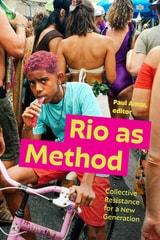
cover of Rio as Method: Collective Resistance for a New Generation

Rio as Method

Collective Resistance for a New Generation

Paul Amar, editor

Duke University Press, 2024

Rio as Method provides a new set of lenses for apprehending and transforming the world at critical junctures. Challenging trends that position Global South scholars as research informants or objects, this Rio de Janeiro-based network of scholars, activists, attorneys, and political leaders center their Brazilian megacity as a globally relevant source for transformational world-making insights. Presenting this volume as a handbook and manifesto for energizing public engagement and direct action, more than forty contributors reconceive method as a politics of knowledge production that animates new ways of being, seeing, and doing politics. They draw on lessons from the city’s intersecting religious, feminist, queer, Black, Indigenous, and urbanist movements to examine issues ranging from state violence, urban marginalization, and moral panic to anticorruption efforts, paramilitary policing, sex work, and mutual aid. Rethinking theoretical and collaborative research methods, Rio as Method models theories of decolonial analysis and concepts of collective resistance that can be taken up by scholar-activists anywhere.

Contributors. Rosiane Rodrigues de Almeida, José Claudio Souza Alves, Tamires Maria Alves, Paul Amar, Marcelo Caetano Andreoli, Beatriz Bissio, Thaddeus Gregory Blanchette, Fernando Brancoli, Thayane Brêtas, Victoria Broadus, Fatima Cecchetto, Leonard Cortana, Marcos Coutinho, Monica Cunha, Luiz Henrique Eloy Amado, Marielle Franco, Cristiane Gomes Julião, Benjamin Lessing, Roberto Kant de Lima, Amanda De Lisio, Bryan McCann, Flávia Medeiros, Ana Paula Mendes de Miranda, Sean T. Mitchell, Rodrigo Monteiro, Vitória Moreira, Jacqueline de Oliveira Muniz, Laura Rebecca Murray, Cesar Pinheiro Teixeira, Osmundo Pinho, Paulo Pinto, María Victoria Pita, João Gabriel Rabello Sodré, Luciane Rocha, Marcos Alexandre dos Santos Albuquerque, Ana Paula da Silva, Denise Ferreira da Silva, Soraya Simões, Indianare Siqueira, Antonio Carlos de Souza Lima, Leonardo Vieira Silva
[more]
cover of Rituals Of Mediation: International Politics And Social Meaning

Rituals Of Mediation

International Politics And Social Meaning

Francois Debrix

University of Minnesota Press, 2003

A timely consideration of the meaning of transnational cultural interactions today

In an era of increasing globalization, the cultural and the international have borders as permeable as most nations’s—and an understanding of one requires making sense of the other. Foregrounding the role of mediation—understood here as a site of representation, transformation, and pluralization—the authors engage two specific questions: How might we make theoretical and practical sense of transnational cultural interactions? And how are we to understand the ways in which the sites of mediation represent, transform, and remediate internationals? Accordingly, the authors consider international issues like security, development, political activism, and the war against terrorism through the lens of cultural practices such as traveling through airports, exhibiting art and photography, logging on to the Internet, and spinning news stories.

Contributors: Robin Brown, U of Leeds; David Campbell, U of Newcastle upon Tyne; Michael Dillon, U of Lancaster; Debbie Lisle, Queen’s U, Belfast; Moya Lloyd, Queen’s U, Belfast; Timothy W. Luke, Virginia Polytechnic Institute and State U; Patricia L. Price, Florida International U; Jayne Rodgers, U of Leeds; Marysia Zalewski, Queen’s U, Belfast.
[more]
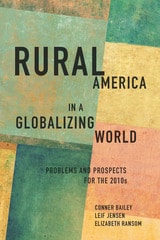
cover of Rural America in a Globalizing World: Problems and Prospects for the 2010's

Rural America in a Globalizing World

Problems and Prospects for the 2010's

Conner Bailey

West Virginia University Press, 2014

This fourth Rural Sociological Society decennial volume provides advanced policy scholarship on rural North America during the 2010’s, closely reflecting upon the increasingly global nature of social, cultural, and economic forces and the impact of neoliberal ideology upon policy, politics, and power in rural areas.

The chapters in this volume represent the expertise of an influential group of scholars in rural sociology and related social sciences. Its five sections address the changing structure of North American agriculture, natural resources and the environment, demographics, diversity, and quality of life in rural communities. 

 
[more]