Results by title
218 books match the query 'Handbooks, manuals, etc' and 12 start with r

RDA Essentials
Thomas Brenndorfer
American Library Association, 2016

Rabbi's Manual
David Polish
Central Conference of American Rabbis, 1988
Radar Essentials
A concise handbook for radar design and performance analysisG. Richard Curry
The Institution of Engineering and Technology, 2012
Reaching All Writers
A Pedagogical Guide for Evolving College Writing ClassroomsJoanne Baird Giordano
Utah State University Press, 2023
Using threshold concepts and transfer as a foundation, the authors provide an invaluable resource for multiple contexts: instructors working off the tenure track and/or at multiple institutions; two-year college programs without a writing program administrator; and writing program graduate teaching assistant training courses. Each chapter includes an overview of a threshold concept, disciplinary background readings, practical teaching strategies, assignment and learning activity ideas, assessment principles, examples from student and instructor perspectives, and questions for reflection and discussion.
Reaching All Writers describes effective teaching practices to help all college writing instructors, regardless of their institutional contexts, make changes that support equitable and inclusive learning opportunities—with a focus on teaching students whose backgrounds and learning experiences are different from those with more educational or economic privilege. Both new and experienced teachers adapting first-year college writing courses will find the book’s blend of practical strategies and disciplinary knowledge a useful companion for facilitating new classroom and program needs or designing new teaching assistant training courses.
Reading Old English
A Primer and First Reader, Revised EditionROBERT HASENFRATZ
West Virginia University Press, 2010
With the immersion method dominating contemporary language learning, the knowledge of traditional grammar is at a low ebb, creating real barriers to any student wanting to learning dead or historical languages. This revised edition of Reading Old English aims to equip readers (advanced undergraduates, graduate students, and autodidacts) with the necessary tools to read the oldest recorded forms of the English language by explaining key language features clearly and methodically, without simplifying any of the core grammatical concepts. It includes a number of helpful exercises, a variety of interesting and unusual Old English texts to translate, as well as appendices covering the basics of traditional grammar and sound changes in Old English, along with an introduction to poetic structure.
Reasons and Feelings
Writing for the Humanities NowSarah Mesle
University of Chicago Press, 2025
Humanities experts today are embattled. In a world of crises undermining higher education at every turn, what can still motivate humanists to write? Galvanizing, imaginative, and unrepentantly nerdy, Sarah Mesle’s Reasons and Feeling offers practical writing and publishing advice alongside a forcefully affirmative account of why humanities writing matters.
Mesle proposes that writing can help envision sustainable community, but only when we recognize that humanist authority comes from both our reasons and our feelings. Alongside everyday compositional advice—including strategies for addressing different audiences, pitching publications, and managing writing anxiety—readers will find an account of how such craft practices connect to both their intellectual commitments and their historical conditions. Mesle shows how university-trained writers at all levels benefit from embracing a broader range of styles and affects. Doing so helps them harness their writing’s community-building potential and makes them better able to value their own expertise, whether they write for the classroom, in public venues, or for the specialized scholarly communities that share their niche, weird, or beloved, objects of study.
Reasons and Feelings draws on Mesle’s expertise as a professor of writing and her work as an editor helping academics shift between writing for scholarly venues and journalistic ones. In a voice that’s honest, warm, accessible, and bracingly funny, Reasons and Feelings gives humanists a path toward bolder fantasies of the worlds their writing can make.
Recommended Principles to Guide Academy-Industry Relationships
American Association of University Professors
University of Illinois Press, 2014
• Preserving the integrity of research and public respect for higher education
• Eliminating and managing individual and institutional financial conflicts of interest
• Maintaining unbiased hiring and recruitment policies
• Establishing grievance procedures and due process rights for faculty, graduate students, and academic professionals
• Mastering the complications of negotiations over patents and copyright
• Assuring the ethics of research involving human subjects.
In a time of dynamic change Recommended Principles to Guide Academy-Industry Relationships offers an indispensable and authoritative guide to sustaining integrity and tradition while achieving great things in twenty-first century academia.
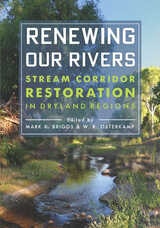
Renewing Our Rivers
Stream Corridor Restoration in Dryland RegionsEdited by Mark K. Briggs and W. R. Osterkamp
University of Arizona Press, 2020
Our rivers are in crisis and the need for river restoration has never been more urgent. Water security and biodiversity indices for all of the world’s major rivers have declined due to pollution, diversions, impoundments, fragmented flows, introduced and invasive species, and many other abuses.
Developing successful restoration responses are essential. Renewing Our Rivers addresses this need head on with examples of how to design and implement stream-corridor restoration projects. Based on the experiences of seasoned professionals, Renewing Our Rivers provides stream restoration practitioners the main steps to develop successful and viable stream restoration projects that last. Ecologists, geomorphologists, and hydrologists from dryland regions of Australia, Mexico, and the United States share case studies and key lessons learned for successful restoration and renewal of our most vital resource.
The aim of this guidebook is to offer essential restoration guidance that allows a start-to-finish overview of what it takes to bring back a damaged stream corridor. Chapters cover planning, such emerging themes as climate change and environmental flow, the nuances of implementing restoration tactics, and monitoring restoration results. Renewing Our Rivers provides community members, educators, students, natural resource practitioners, experts, and scientists broader perspectives on how to move the science of restoration to practical success.
Retention and Resistance
Writing Instruction and Students Who LeavePegeen Reichert Powell
Utah State University Press, 2014
Retention is a vital issue for institutions, but as these students’ stories show, leaving college is often the result of complex and idiosyncratic individual situations that make institutional efforts difficult and ultimately ineffective. An adjustment of institutional and pedagogical objectives is needed to refocus on educating as many students as possible, including those who might leave before graduation.
Much of the pedagogy, curricula, and methodologies of composition studies assume students are preparing for further academic study. Retention and Resistance argues for a new kairotic pedagogy that moves toward an emphasis on the present classroom experience and takes students’ varied experiences into account. Infusing the discourse of retention with three individual student voices, Powell explores the obligation of faculty to participate in designing an institution that educates all students, no matter where they are in their educational journey or how far that journey will go.
Risk and Insurance Management Manual for Libraries
American Library Association, 2005
Risk and Insurance Management Manual for Libraries, Updated
Sally Alexander
American Library Association, 2021
Running a Small Library
John A. Moorman
American Library Association, 2015