73 books match the query 'Higher Education' and 4 start with r
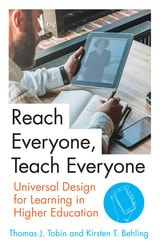
cover of Reach Everyone, Teach Everyone: Universal Design for Learning in Higher Education

Reach Everyone, Teach Everyone

Universal Design for Learning in Higher Education

Thomas J. Tobin

West Virginia University Press, 2018

Advocates for the rights of people with disabilities have worked hard to make universal design in the built environment “just part of what we do.” We no longer see curb cuts, for instance, as accommodations for people with disabilities, but perceive their usefulness every time we ride our bikes or push our strollers through crosswalks.

This is also a perfect model for Universal Design for Learning (UDL), a framework grounded in the neuroscience of why, what, and how people learn. Tobin and Behling show that, although it is often associated with students with disabilities, UDL can be profitably broadened toward a larger ease-of-use and general diversity framework. Captioned instructional videos, for example, benefit learners with hearing impairments but also the student who worries about waking her young children at night or those studying on a noisy team bus.

Reach Everyone, Teach Everyone is aimed at faculty members, faculty-service staff, disability support providers, student-service staff, campus leaders, and graduate students who want to strengthen the engagement, interaction, and performance of all college students. It includes resources for readers who want to become UDL experts and advocates: real-world case studies, active-learning techniques, UDL coaching skills, micro- and macro-level UDL-adoption guidance, and use-them-now resources.
[more]
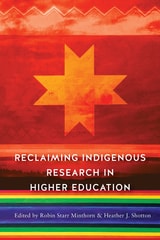
cover of Reclaiming Indigenous Research in Higher Education

Reclaiming Indigenous Research in Higher Education

Minthorn, Robin Starr

Rutgers University Press, 2018

Indigenous students remain one of the least represented populations in higher education. They continue to account for only one percent of the total post-secondary student population, and this lack of representation is felt in multiple ways beyond enrollment. Less research money is spent studying Indigenous students, and their interests are often left out of projects that otherwise purport to address diversity in higher education. 

Recently, Native scholars have started to reclaim research through the development of their own research methodologies and paradigms that are based in tribal knowledge systems and values, and that allow inherent Indigenous knowledge and lived experiences to strengthen the research. Reclaiming Indigenous Research in Higher Education highlights the current scholarship emerging from these scholars of higher education. From understanding how Native American students make their way through school, to tracking tribal college and university transfer students, this book allows Native scholars to take center stage, and shines the light squarely on those least represented among us.  

 
[more]
cover of Reformed American Dreams: Welfare Mothers, Higher Education, and Activism

Reformed American Dreams

Welfare Mothers, Higher Education, and Activism

Sheila M. Katz

Rutgers University Press, 2019

Reformed American Dreams explores the experiences of low-income single mothers who pursued higher education while on welfare after the 1996 welfare reforms. This research occurred in an area where grassroots activism by and for mothers on welfare in higher education was directly able to affect the implementation of public policy. Half of the participants in Sheila M. Katz’s research were activists with the grassroots welfare rights organization, LIFETIME, trying to change welfare policy and to advocate for better access to higher education. Reformed American Dreams takes up their struggle to raise families, attend school, and become student activists, all while trying to escape poverty. Katz highlights mothers’ experiences as they pursued higher education on welfare and became grassroots activists during the Great Recession.
[more]
cover of Resource Allocation in Higher Education

Resource Allocation in Higher Education

William F. Massy, Editor

University of Michigan Press, 1996

Resource Allocation in Higher Education describes how colleges, universities, and government agencies can use budgeting processes to improve program planning and productivity. Drawn from the contributors' direct experiences as well as research findings, it blends conceptual foundations with practical insights. Many resource allocation processes in higher education need reform, and this volume will stimulate and assist that effort. Beginning with the economic theory of nonprofits, the essays examine current budgeting systems in both theoretical and practical terms. Resource allocation systems from other domains such as health care are explored for relevant insights. Throughout, decentralization remains a major theme. Topics range from the eminently practical--how to establish a global accounting system or choose an endowment spending rate--to the more abstract--the theory of how various nonprofit enterprises balance academic values against market pressures. The volume ends by proposing value responsibility budgeting, which offers institutions a potentially better way of pursuing their academic values while remaining responsive to market pressures. Those within higher education institutions who are responsible for resource allocation, such as provosts, chief financial officers, or budget directors, will find much that speaks to them. While mostly in the domain of higher education economics, management, and planning, the essays are written for any serious reader concerned with the problem of reform in higher education. William F. Massy is Professor of Education and Business Administration at Stanford University.
[more]