Results by title
438 books match the query 'Hispanic & Latino' and 12 start with r
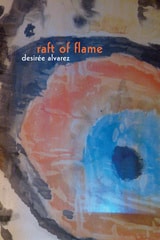
Raft of Flame
Desirée Alvarez
Omnidawn, 2019
In Raft of Flame, Alvarez constructs and fleshes out a fantastic narrative of personal and cultural history, offering glimpses into the art, history, and land that comprise her story. Her narrative explores how both nature and human populations continue to be trapped in the violence of colonialism. Vivid lyrics interrogate the complexities of mixed race, digging the dualities, upheavals, and casts of characters that underly Alvarez’s identity.
Raft of Flame won Omnidawn's 2018 Lake Merritt Prize.
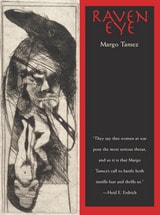
Raven Eye
Margo Tamez
University of Arizona Press, 2007
These complex and necessary themes are at the heart of award-winning poet Margo Tamez’s second book of poetry. Her poems bring forth experiences of a raced and gendered life along the border. Tamez engages the experiences of an indigenous life, refusing labels of Mexican or Native American as social constructs of a colonized people. This book is a challenging cartography of colonialism, poverty, and issues of Native identity and demonstrates these as threats to the environment, both ecological and social, in the borderlands. Each poem is crafted as if it were a minute prayer, dense with compassion and unerring optimism.
But the hope that Tamez serves is not blind. In poem after poem, she draws us into a space ruled by mythic symbolism and the ebb and flow of the landscape—a place where comfort is compromised and where we must work to relearn the nature of existence and the value of life.
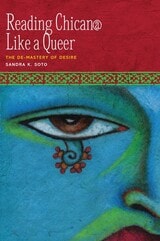
Reading Chican@ Like a Queer
The De-Mastery of DesireBy Sandra K. Soto
University of Texas Press, 2010
A race-based oppositional paradigm has informed Chicano studies since its emergence. In this work, Sandra K. Soto replaces that paradigm with a less didactic, more flexible framework geared for a queer analysis of the discursive relationship between racialization and sexuality. Through rereadings of a diverse range of widely discussed writers—from Américo Paredes to Cherríe Moraga—Soto demonstrates that representations of racialization actually depend on the sexual and that a racialized sexuality is a heretofore unrecognized organizing principle of Chican@ literature, even in the most unlikely texts. Soto gives us a broader and deeper engagement with Chican@ representations of racialization, desire, and both inter- and intracultural social relations.
While several scholars have begun to take sexuality seriously by invoking the rich terrain of contemporary Chicana feminist literature for its portrayal of culturally specific and historically laden gender and sexual frameworks, as well as for its imaginative transgressions against them, this is the first study to theorize racialized sexuality as pervasive to and enabling of the canon of Chican@ literature. Exemplifying the broad usefulness of queer theory by extending its critical tools and anti-heteronormative insights to racialization, Soto stages a crucial intervention amid a certain loss of optimism that circulates both as a fear that queer theory was a fad whose time has passed, and that queer theory is incapable of offering an incisive, politically grounded analysis in and of the current historical moment.
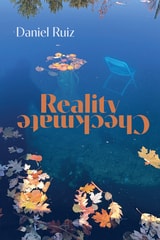
Reality Checkmate
Daniel Ruiz
Four Way Books, 2025
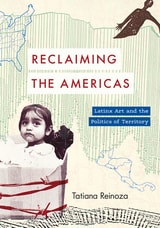
Reclaiming the Americas
Latinx Art and the Politics of TerritoryTatiana Reinoza
University of Texas Press, 2023
2023 Outstanding Book Award, National Association for Ethnic Studies
2024 Finalist, Charles Rufus Morey Book Award, College Art Association
2024 Best Arts Book, Empowering Latino Futures’ International Latino Book Awards
2025 Ewell L. Newman Book Award, American Historical Print Collectors Society
2025 Finalist, Charles C. Eldredge Prize, the Smithsonian American Art Museum
How Latinx artists around the US adopted the medium of printmaking to reclaim the lands of the Americas.
Printmakers have conspired, historically, to illustrate the maps created by European colonizers that were used to chart and claim their expanding territories. Over the last three decades, Latinx artists and print studios have reclaimed this printed art form for their own spatial discourse. This book examines the limited editions produced at four art studios around the US that span everything from sly critiques of Manifest Destiny to printed portraits of Dreamers in Texas.
Reclaiming the Americas is the visual history of Latinx printmaking in the US. Tatiana Reinoza employs a pan-ethnic comparative model for this interdisciplinary study of graphic art, drawing on art history, Latinx studies, and geography in her discussions. The book contests printmaking’s historical complicity in the logics of colonization and restores the art form and the lands it once illustrated to the Indigenous, migrant, mestiza/o, and Afro-descendant people of the Americas.

Reclaiming the Author
Figures and Fictions from Spanish AmericaLucille Kerr
Duke University Press, 1992
By focusing on works by well-known Spanish American authors—Cortazar, Donoso, Fuentes, Poniatowska, Puig, and Vargas Llosa—Kerr shows how the Spanish Americans have formed a radical poetics of the author. Her readings demonstrate how exemplary Spanish American texts, such as Rayuela, Terra nostra, and El hablador, call into question the author as a unitary or uniform, and therefore unproblematical, figure. Individually and together, Kerr's readings reclaim "the author" as a complex critical concept encompassing diverse, conflicting, even competitive roles.
Reconstructing a Chicano/a Literary Heritage
Hispanic Colonial Literature of the SouthwestEdited by María Herrera-Sobek
University of Arizona Press, 1993
Contributors:
Juan Bruce-Novoa
Ramón Gutiérrez
María Herrera-Sobek
Enrique Lamadrid
Luis Leal
Francisco A. Lomelí
Genaro Padilla
Tey Diana Rebolledo
Tino Villanueva
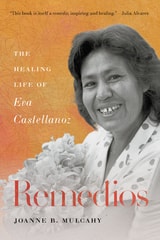
Remedios
The Healing Life of Eva Castellanoz, Updated EditionJoanne B. Mulcahy
Oregon State University Press, 2010
The result of a twenty-year friendship between Joanne Mulcahy and Eva Castellanoz, Remedios traces the transformation of an indigenous Mexican migrant worker to a curandera (healer), community activist, and winner of a National Heritage Fellowship from the National Endowment for the Arts. Blending creative nonfiction and ethnographic research, Mulcahy shares Eva’s stories, from her early years in Mexico and the Rio Grande Valley to her adult years as a wife, mother, and grandmother in Nyssa, Oregon. Her testimonios capture the hardships and resilience of her life and the lives of others in her community. As a healer, Eva combines rituals, metaphors, and herbs to attend to those who seek her help. The floral crowns she fashions for young women’s quinceañeras and other arts preserve traditions while offering life lessons. Remedios gives us an intimate glimpse into Eva’s family life, her passionate activism, and her complex identity as an indigenous, Catholic curandera.
This updated edition includes revisions throughout the text and a new afterword by the author underscoring the changes in Eva’s life and in the larger world since Remedios’s original publication. For her important work, Eva has been recognized by several organizations and programs including the Oregon Arts Commission, Arts Build Communities, and the Portland Opera. The Crown Maker, a youth opera by the Portland Opera To Go program, celebrates Eva Castellanoz’s legacy and displays how even in a time of fear and divisiveness, hope endures through people who advocate for others and inspire social change.
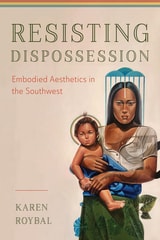
Resisting Dispossession
Embodied Aesthetics in the SouthwestKaren R. Roybal
University of Arizona Press, 2027
Illuminating the impacts of ongoing dispossession across the modern American Southwest
Resisting Dispossession examines how Native/Indigenous, Chicana/o/x, and Black communities in the American Southwest have confronted displacement and dispossession from the nineteenth century to the present. Moving beyond abstract theory, Karen R. Roybal centers cultural expression and embodied knowledge, revealing how colonialism, preservation, urban renewal, and gentrification continue to shape relationships to land, place, and belonging.
Drawing on Indigenous, Chicana feminist, and Black epistemologies, Roybal explores a diverse cultural archive of photographs, literature, musical compositions, oral histories, and storytelling practices. Through analyses of figures such as Kali Fajardo-Anstine, Raven Chacon, and Louis Carlos Bernal, alongside the stories of Chicana land grant heirs in New Mexico and southern Colorado, she demonstrates how artistic and cultural expression becomes a powerful tool for resisting erasure and reclaiming presence. Contesting representations of the Southwest made popular by figures like Ansel Adams and Georgia O’Keeffe, these works preserve alternative histories, challenge dominant narratives, and illuminate the ongoing impacts of dispossession across the region.
Interdisciplinary in scope, this work offers a fresh perspective on the intersections of aesthetics, embodiment, and power in the West and Southwest.
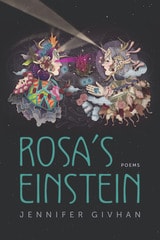
Rosa's Einstein
PoemsJennifer Givhan
University of Arizona Press, 2019
In this full-length poetry collection, the girls of Rosa’s Einstein embark on a quest to discover what is real and what is possible in the realms of imagination, spurred on by scientific curiosity and emotional resilience. Following a structural narrative arc inspired by the archetypal hero’s journey, sisters Rosa and Nieve descend into the desert borderlands of New Mexico to find resolution and healing through a bold and fearless examination of the past, meeting ghostly helpers and hinderers along the way. These metaphorical spirits take the shape of circus performers, scientists, and Lieserl, the lost daughter Albert Einstein gave away.
Poet Jennifer Givhan reimagines the life of Lieserl, weaving her search for her scientist father with Rosa and Nieve’s own search for theirs. Using details both from Einstein’s known life and from quantum physics, Givhan imagines Lieserl in a circus-like landscape of childhood trauma and survival, guided by Rosa and Nieve.
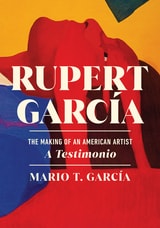
Rupert García
The Making of an American Artist, a TestimonioMario T. García
Rutgers University Press, 2026
This is the first biography of the renowned American Chicano visual artist and activist Rupert García, drawing on fifty hours of interviews conducted over thirty years and accompanied by eighty images. This in-depth oral history gives an unparalleled look at García’s life and work, tracing his evolution as an artist and the political upheavals that shaped his life and worldview.
Mario T. García’s testimonio places Rupert García’s art in historical perspective, from his beginnings as a working-class Mexican American from California’s Central Valley, his coming of age in the U.S. Air Force during the Vietnam War, his involvement in the antiwar movement during the San Francisco State student strike in 1968-69, and his participation in the Chicano Movement and beyond. Influenced by history and politics, García’s vital works of art represent a changing world through the eyes of an artist, speaking to issues of poverty, racism, capitalism, war, and the role of the artist in society.
His art—from revolutionary silkscreen posters to monumental pastels to portraits of political icons like Frida Kahlo, Che Guevara, and Dolores Huerta—serves to critique history and reassess it. It is work that will endure for generations to come.
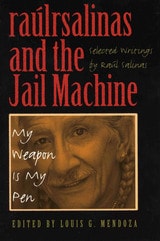
raúlrsalinas and the Jail Machine
My Weapon Is My PenSelected writings by Raúl R. Salinas
University of Texas Press, 2006
Raúl R. Salinas is regarded as one of today's most important Chicano poets and human rights activists, but his passage to this place of distinction took him through four of the most brutal prisons in the country. His singular journey from individual alienation to rage to political resistance reflected the social movements occurring inside and outside of prison, making his story both personal and universal.
This groundbreaking collection of Salinas' journalism and personal correspondence from his years of incarceration and following his release provides a unique perspective into his spiritual, intellectual, and political metamorphosis. The book also offers an insider's view of the prison rebellion movement and its relation to the civil rights and anti-war movements of the 1960s and 1970s. The numerous letters between Salinas and his family, friends, and potential allies illustrate his burgeoning political awareness of the cause and conditions of his and his comrades' incarceration and their link to the larger political and historical web of social relations between dominant and subaltern groups. These collected pieces, as well as two interviews with Salinas—one conducted upon his release from prison in 1972, the second more than two decades later—reveal to readers the transformation of Salinas from a street hipster to a man seeking to be a part of something larger than himself. Louis Mendoza has painstakingly compiled a body of work that is autobiographical, politically insurgent, and representative.