Results by title
131 books match the query 'History, Local' and 5 start with r
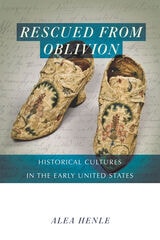
Rescued from Oblivion
Historical Cultures in the Early United StatesAlea Henle
University of Massachusetts Press, 2020
With in-depth research and an expansive scope, Rescued from Oblivion offers a vital account of the formation of historical culture and consciousness in the early United States, re-centering in the record groups long marginalized from the national memory. As Alea Henle demonstrates, these societies laid the groundwork for professional practices that are still embraced today: collection policies, distinctions between preservation of textual and nontextual artifacts, publication programs, historical rituals and commemorations, reconciliation of scholarly and popular approaches, and more. At the same time, officers of these early societies faced challenges to their historical authority from communities interested in preserving a broader range of materials and documenting more inclusive histories, including fellow members, popular historians, white women, and peoples of color.
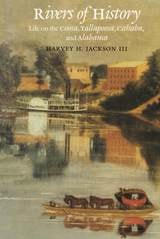
Rivers of History
Life on the Coosa, Tallapoosa, Cahaba, and AlabamaHarvey H. Jackson, III
University of Alabama Press, 1995
An illuminating study of how rivers shaped the history, culture, and environment of Alabama and the American South.
In Rivers of History, acclaimed historian Harvey H. Jackson III blends environmental history with compelling storytelling and traces the evolving relationship between people and rivers—from Indigenous communities who first depended on these waterways, to European settlers, to the development of modern towns and industries. Along the way, readers encounter stories of transportation and trade, conflict and cooperation, ecological change and conservation, all tied to the flow of these essential rivers.
Far more than a geographical study, Rivers of History demonstrates how waterways act as lifelines of human experience. Rivers shaped patterns of settlement, enabled agricultural and economic growth, and served as critical channels for communication across the American South. At the same time, they created challenges—flooding, environmental degradation, and competing demands for natural resources—that continue to influence life in the region today.
Jackson shows how the history of Alabama cannot be understood apart from its rivers. The Coosa, Tallapoosa, Cahaba, and Alabama rivers emerge not simply as physical features on a map, but as powerful forces that connect past and present, nature and society. His interdisciplinary approach—bringing together history, geography, and environmental studies—makes this work especially valuable for students, scholars, and general readers alike.
Accessible yet authoritative, Rivers of History is essential reading for anyone interested in Southern history, environmental change, or the enduring relationship between landscapes and human communities. It offers a compelling reminder that the story of a place is often written in the movement of its waters.
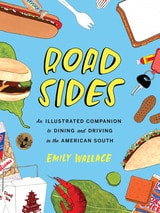
Road Sides
An Illustrated Companion to Dining and Driving in the American SouthBy Emily Wallace
University of Texas Press, 2019
An illustrated glovebox essential, Road Sides explores the fundamentals of a well-fed road trip through the American South, from A to Z. There are detours and destinations, accompanied by detailed histories and more than one hundred original illustrations that document how we get where we’re going and what to eat and do along the way.
Learn the backstory of food-shaped buildings, including the folks behind Hills of Snow, a giant snow cone stand in Smithfield, North Carolina, that resembles the icy treats it sells. Find out how kudzu was used to support a burgeoning highway system, and get to know Edith Edwards—the self-proclaimed Kudzu Queen—who turns the obnoxious vine into delicious teas and jellies. Discover the roots of kitschy roadside attractions, and have lunch with the state-employed mermaids of Weeki Wachee Springs in Florida.
Road Sides is for everyone—the driver in search of supper or superlatives (the biggest, best, and even worst), the person who cannot resist a local plaque or snack and pulls over for every historical marker and road stand, and the kid who just wants to gawk at a peach-shaped water tower.
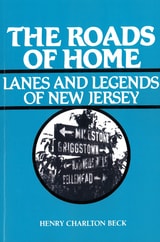
Roads of Home
Beck, Henry
Rutgers University Press, 1983
Long regarded as folklife classics, Henry Charlton Beck's books are vivid recreations of the back roads, small towns, and legends that give New Jersey its special character. Father Henry Charlton Beck, who lived in New Jersey nearly all his life, was the author of numerous books on New Jersey folklife, state editor of the Camden Courier-Post, and writer for the Newark Star-Ledger. He is considered New Jersey's first folklorist and his painstaking work has left us with a rich collection of tales.
Roman Cities
G. Michael Woloch
University of Wisconsin Press, 1984
Roman Cities provides the first comprehensive study in English of major Roman cities, including an excellent coverage of the Roman legacy which was transmitted to medieval and modern trends in architecture and urban planning..