Results by title
260 books match the query 'Holocaust' and 10 start with r
Rebuilding Jewish Life in Germany
Jay Howard Geller
Rutgers University Press, 2020
Recovered Land
Alicia Nitecki
University of Massachusetts Press, 1995
Alicia Nitecki was born in Warsaw to a Catholic family that was active in the resistance movement. Following the Nazi conquest of Poland, she and her relatives were dispersed to German prisoner-of-war, labor, and concentration camps. In this book, she revisits the places that have formed her and confronts a past that has haunted her: Warsaw during the 1944 uprising, the Black Forest village where she and the women in her family were taken as slaves in the last months of the war, and Buchenwald and Flossenbürg, the concentration camps where her grandfather was imprisoned.
Nitecki's private odyssey coincided with the collapse of communism in Poland and the reunification of Germany. These essays mark her movement from fear and rage toward fuller knowledge and reconciliation.
Refuge Denied
The St. Louis Passengers and the HolocaustSarah A. Ogilvie and Scott Miller
University of Wisconsin Press, 2006
Although the episode of the St. Louis is well known, the actual fates of the passengers, once they disembarked, slipped into historical obscurity. Prompted by a former passenger’s curiosity, Sarah Ogilvie and Scott Miller of the United States Holocaust Memorial Museum set out in 1996 to discover what happened to each of the 937 passengers. Their investigation, spanning nine years and half the globe, took them to unexpected places and produced surprising results. Refuge Denied chronicles the unraveling of the mystery, from Los Angeles to Havana and from New York to Jerusalem.
Some of the most memorable stories include the fate of a young toolmaker who survived initial selection at Auschwitz because his glasses had gone flying moments before and a Jewish child whose apprenticeship with a baker in wartime France later translated into the establishment of a successful business in the United States. Unfolding like a compelling detective thriller, Refuge Denied is a must-read for anyone interested in the Holocaust and its impact on the lives of ordinary people.
Remembering the Holocaust
Michael E. Stevens
Wisconsin Historical Society Press, 1997
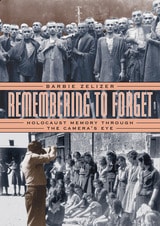
Remembering to Forget
Holocaust Memory through the Camera's EyeBarbie Zelizer
University of Chicago Press, 1998
"[A] fascinating study. . . . Here we have a completely fresh look at the emergence of photography as a major component of journalistic reporting in the course of the liberation of the camps by the Western Allies. . . . Well written and argued, superbly produced with more photographs of atrocity than most people would want to see in a lifetime, this is clearly an important book."—Omer Bartov, Times Literary Supplement
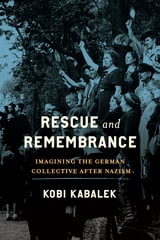
Rescue and Remembrance
Imagining the German Collective after NazismKobi Kabalek
University of Wisconsin Press, 2025
Kabalek argues that such simplistic depictions of the majority versus minority obscure the complex motivations and situations that led people in Nazi Germany to help persecuted Jews. Against the view that the rescuers were “forgotten” after the war, he shows that portrayals and interpretations of helping Jews appeared in various media and social discourses in East, West, and unified Germany and were used to actively debate questions of collective morality. Rescue and Remembrance analyzes the varied and changing depictions of rescue in the distinct German politics from the Nazi period, examining how the very notions of “majority” and “collective” were articulated and reformulated.
Rescuing the Children
A Holocaust MemoirVivette Samuel; Translated and with an introduction by Charles B. Paul; With a foreword by Elie Wiesel
University of Wisconsin Press, 2002
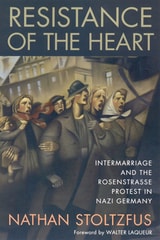
Resistance of the Heart
Intermarriage and the Rosenstrasse Protest in Nazi GermanyNathan Stoltzfus
Rutgers University Press, 2001
In February 1943 the Gestapo arrested approximately 10,000 Jews remaining in Berlin. Most died at Auschwitz. Two thousand of those Jews, however, had non-Jewish partners and were locked into a collection center on a street called Rosenstrasse. As news of the surprise arrest pulsed through the city, hundreds of Gentile spouses, mostly women, hurried to the Rosenstrasse in protest. A chant broke out: "Give us our husbands back."
Over the course of a week protesters vied with the Gestapo for control of the street. Now and again armed SS guards sent the women scrambling for cover with threats that they would shoot. After a week the Gestapo released these Jews, almost all of whom survived the war.
The Rosenstrasse Protest was the triumphant climax of ten years of resistance by intermarried couples to Nazi efforts to destroy their families. In fact, ninety-eight percent of German Jews who did not go into hiding and who survived Nazism lived in mixed marriages. Why did Hitler give in to the protesters? Using interviews with survivors and thousands of Nazi records never before examined in detail, Nathan Stoltzfus identifies the power of a special type of resistance--the determination to risk one's own life for the life of loved ones. A "resistance of the heart..."
Resonant Violence
Affect, Memory, and Activism in Post-Genocide SocietiesKerry Whigham
Rutgers University Press, 2022
Rhetorical Vectors of Memory in National and International Holocaust Trials
Marouf A. Hasian Jr.
Michigan State University Press, 2006
During the past several decades, the twentieth century Holocaust has become a defining event in many histories. This newfound respect for the Judeocide has been cathartic for both individuals and communities, in that it provides evidence that audiences around the world are rethinking the significance of the World War II narratives of bystanders, perpetrators, and victims. Given the complexities of these issues, scholars who are interested in studying Holocaust memory make choices about the questions on which they focus, the artifacts they select for analysis, and the perspectives they want to present.
Hasian reviews how national and international courts have used Holocaust trials as forums for debates about individuated justice, historical record keeping, and pedagogical memory work. He concludes that the trials involving Auschwitz, Demjanjuk, Eichmann, Finta, Nuremberg, Irving, Kastner, Keegstra, Sawoniuk, and Zündel are highly problematic. The author provides a rhetorical analysis of holocaust trials as a way of looking into the question of what role court proceedings play in the creation of Holocaust collective memories.