195 books match the query 'Homes and haunts' and 6 start with r
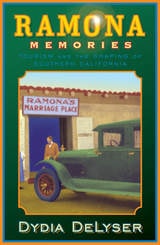
cover of Ramona Memories: Tourism and the Shaping of Southern California

Ramona Memories

Tourism and the Shaping of Southern California

Dydia DeLyser

University of Minnesota Press, 2005
The most important woman in the history of southern California never lived. The eponymous heroine of Helen Hunt Jackson's popular 1884 novel Ramona, a half-Indian beauty raised on a wealthy Mexican rancho, nonetheless left an indelible imprint on southern California's landscape. Within a year of its publication, landmarks identified with Ramona's fictional life - her birthplace, her home, the site of her wedding, and her grave - became important, even canonical parts of a visit to southern California. One could take the Ramona freeway to town, cook like Ramona, and smell like Ramona. The novel's romanticized version of California's Hispanic past also inspired films, songs, musical instruments, jewelry, clothes, beer, wine, canned goods, collectibles, and a play that still draws thirty thousand people annually. Although historians and other writers have acknowledged Ramona's importance in the shaping of southern California's regional identity, there has never been an in-depth study of the origins and evolution of the "Ramona Myth" itself - until now. In Ramona Memories, Dydia DeLyser traces the myth's emergence within the context of the late nineteenth- and early twentieth-century tourist industry. DeLyser explores the establishment of tourist attractions by fans of the novel. She details the stories of individual Ramona enthusiasts who, guided by numerous travel books and articles, wove the text of the novel and its lavishly described locations into their own lives, from pilgrimages to either of the two ranchos acclaimed as Ramona's home to Ramona-themed luncheons and hopeful honeymoon visits to the Wishing Well at her marriage place. Based on more than a decade of meticulous research, Ramona Memories reveals how a fiction - and the real places and products that it inspired - helped to make an idealized past visible, permeating southern California's social memory.
[more]
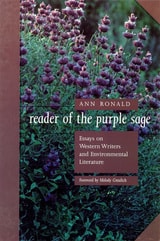
cover of Reader Of The Purple Sage: Essays On Western Writers And Environmental Literature

Reader Of The Purple Sage

Essays On Western Writers And Environmental Literature

Ann Ronald

University of Nevada Press, 2003

Literary scholar Ann Ronald gathers her most notable published essays about Nevada, environmental writing, and Western American literature in one volume. These essays reflect Ronald’s wide-ranging interests. Here are deeply informed, critical essays on writers as diverse as Zane Gray, Edward Abbey, Wallace Stegner, and Terry Tempest Williams, as well as the Tonopah Ladies—a group of literary women who found their voices in the unlikely setting of a mining boomtown—and on such varied topics as the image of Reno in nineteenth- and twentieth-century fiction. Included are several recent essays in which Ronald thoughtfully discusses the burgeoning field of environmental writing, some of its principal themes and concerns, and its best-known practitioners.
[more]
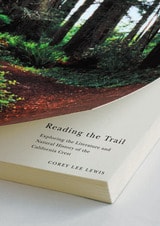
cover of Reading The Trail: Exploring The Literature And Natural History Of The California Crest

Reading The Trail

Exploring The Literature And Natural History Of The California Crest

Corey Lee Lewis

University of Nevada Press, 2005

A provocative new way to read and interpret the classic works of John Muir, Mary Austin, and Gary Snyder, and to bring their ideas into the discussion of ecological values and the current environmental crisis. Lewis combines a perceptive discussion of their work and ideas with an engaging account of his own trail experiences as hiker/backpacker and volunteer trail builder, proposing that such a field-based, interdisciplinary approach to literary study and outdoors experience can enrich our appreciation for the work of nature writers.
[more]
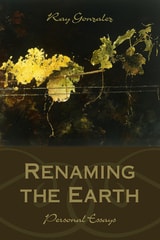
cover of Renaming the Earth: Personal Essays

Renaming the Earth

Personal Essays

Ray Gonzalez

University of Arizona Press, 2008

In his distinctive and spirited way, Ray Gonzalez, the well-known essayist, poet, fiction writer, and anthologist, reflects on the American Southwest—where he was raised and to which he still feels attached (even though he has lived much of his life elsewhere). It is a place that tugs at him, from its arid desert landscapes to its polyglot cities—part Mexican, part Anglo, part something in-between—always in the process of redefining themselves.

Nowhere does the process of redefinition hit Gonzalez quite as hard as in his native city of El Paso, Texas. There he finds the “segregated little town of my childhood” transformed into “a metropolis of fast Latino zip codes . . . a world where the cell phone, the quick beer, the rented apartment, and the low-paying job say you can be young and happy on the border.” Readers will wonder, along with the author, whether life along the “new border” is worth “the extermination of the old boundaries.”

But there is another side of the Southwest for this “son of the desert”—the world of dusty canyons, ponderosa pines, ocotillo, and mesquite. Here, he writes, “there is a shadow, and it is called ancient home—structures erased from their seed to grow elsewhere, vultured strings searching for a frame that stands atop history and renames the ground.”

Rooted in the desert sand and in the banks of the Rio Grande, the muddy river that forms the border between nations, these essays are by turns lyrical, mournful, warm to the ways of the land, and lukewarm to the ways of man.
[more]
cover of Room 306: The National Story of the Lorraine Motel

Room 306

The National Story of the Lorraine Motel

Ben Kamin

Michigan State University Press, 2012
A tragic landmark in the civil rights movement, the Lorraine Motel in Memphis is best known for what occurred there on April 4, 1968. As he stood on the balcony of Room 306, Dr. Martin Luther King Jr. was assassinated, ending a golden age of nonviolent resistance, and sparking riots in more than one hundred cities. Formerly a seedy, segregated motel, and prior to that a brothel, the motel quickly achieved the status of national shrine. The motel attracts a variety of pilgrims—white politicians seeking photo ops, aging civil rights leaders, New Age musicians, and visitors to its current incarnation, the National Civil Rights Museum. A moving and emotional account that comprises a panorama of voices, Room 306 is an important oral history unlike any other.
[more]
cover of Rooted: Seven Midwest Writers of Place

Rooted

Seven Midwest Writers of Place

David R. Pichaske

University of Iowa Press, 2006

David Pichaske has been writing and teaching about midwestern literature for three decades. In Rooted, by paying close attention to text, landscape, and biography, he examines the relationship between place and art. His focus is on seven midwestern authors who came of age toward the close of the twentieth century, their lives and their work grounded in distinct places: Dave Etter in small-town upstate Illinois; Norbert Blei in Door County, Wisconsin; William Kloefkorn in southern Kansas and Nebraska; Bill Holm in Minneota, Minnesota; Linda Hasselstrom in Hermosa, South Dakota; Jim Heynen in Sioux County, Iowa; and Jim Harrison in upper Michigan. The writers' intimate knowledge of place is reflected in their use of details of geography, language, environment, and behavior. Yet each writer reaches toward other geographies and into other dimensions of art or thought: jazz music and formalism in the case of Etter; gender issues in the case of Hasselstrom; time past and present in the case of Kloefkorn; ethnicity and the role of the artist in the case of Blei; magical realism in the case of Heynen; the landscape of literature in the case of Holm; and the curious worlds of academia, best-selling novels, and Hollywood films in the case of Harrison. The result, Pichaske notes, is the growing away from roots, the explorations and alter egos of these writers of place, and the tension between the “here” and “there” that gives each writer's art the complexity it needs to transcend provincial boundaries. Quoting generously from the writers, Pichaske employs a practical, jargon-free literary analysis fixed in the text, making Rooted interesting, readable, and especially useful in treating the literary categories of memoir and literary essay that have become important in recent decades.
[more]