Results by title
86 books match the query 'Hope' and 4 start with r

Religion Without Redemption
Social Contradictions and Awakened Dreams in Latin AmericaLuis Martinez Andrade
Pluto Press, 2015
Martínez Andrade focuses on the central role of religion in the region and how it influences people’s interaction with changes in modern economics. Capitalism in Latin America, Martínez Andrade argues, has taken on religious characteristics, with places of worship—shopping malls and department stores—as well as its own prophets. This form of cultural religion is often contradictory in surprising ways: not only does it legitimate oppression, it can also be a powerful source of rebellion, unveiling a subversive side to the status quo. Religion Without Redemption advances the ideas of liberation theory, and challenges the provincialism to which many Latin American thinkers are usually consigned.
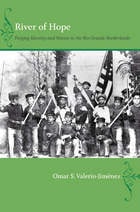
River of Hope
Forging Identity and Nation in the Rio Grande BorderlandsOmar S. Valerio-Jiménez
Duke University Press, 2012
Diverse influences transformed the borderlands as Spain, Mexico, and the United States competed for control of the region. Indian slaves joined Spanish society; Mexicans allied with Indians to defend river communities; Anglo Americans and Mexicans intermarried and collaborated; and women sued to confront spousal abuse and to secure divorces. Drawn into multiple conflicts along the border, Mexican nationals and Mexican Texans (tejanos) took advantage of their transnational social relations and ambiguous citizenship to escape criminal prosecution, secure political refuge, and obtain economic opportunities. To confront the racialization of their cultural practices and their increasing criminalization, tejanos claimed citizenship rights within the United States and, in the process, created a new identity.
Published in cooperation with the William P. Clements Center for Southwest Studies, Southern Methodist University.
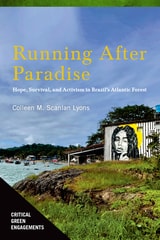
Running After Paradise
Hope, Survival, and Activism in Brazil's Atlantic ForestColleen M. Scanlan Lyons
University of Arizona Press, 2022
The pressures on this tropical forest are palpable. So are people’s responses to these pressures. What was once the state’s economic mainstay, cacao production, is only now beginning to make a comeback after a disease decimated the crops of large and small farmers alike. Tourism, another economic hope, is susceptible to economic crises and pandemics. And the threat of a massive state-led infrastructure project involving mining, a railroad, and an international port has loomed over the region for well over a decade.
Southern Bahia is at a crossroads: develop a sustainable, forest-based economy or run the risk of losing the identity and soul of this place forevermore. Through the lives of environmentalists, farmers, quilombolas, and nativos—people who are in and of this place—this book brings alive the people who are grappling with this dilemma.
Anthropologist Colleen M. Scanlan Lyons brings the eye of a storyteller to present this complex struggle, weaving in her own challenges of balancing family and fieldwork alongside the stories of the people who live in this dynamic region. Intertwined tales, friendships, and hope emerge as people both struggle to sustain their lives in a biodiversity hotspot and strive to create their paradise.
Running on Hope
Female Community Health Labor in Rajasthan, IndiaSvea Closser and Surendra Singh Shekhawat
Vanderbilt University Press, 2025
This book is freely available in an open-access edition thanks to the generous support of Johns Hopkins University.
Throughout India, Accredited Social Health Activists (ASHAs) visit households in their communities to deliver essential health services and link community members with key health benefits. Like many other female Community Health Workers across the world, ASHAs are often portrayed as virtuous, passive volunteers, selflessly providing services to their neighbors.
The reality is more complicated and much more interesting. Drawing on ethnographic work in Rajasthan, Running on Hope follows ASHAs through striking personal transformations. From their positions as rural daughters‑in‑law—a particularly low‑power position in Rajasthan—ASHAs have, over years of work, gained unprecedented autonomy for young rural women. They have also gained a deep understanding of what many argue is the exploitation involved in their low‑ranking position in the health system. ASHAs often earn less than $100 per month for extensive work, well below the legal minimum wage.
To counter this, many ASHAs have joined unions—an endeavor that has ultimately proven disappointing: union leaders’ desires for political advancement are often at odds with ASHAs’ own needs. However, ASHAs do not have connections, money, or social power to organize effectively on their own, without a political patron. In Running on Hope, authors Svea Closser and Surendra Singh Shekhawat interview women who work as ASHAs to learn about their organizing goals, their roles in their community as conduits to health education and resources, and their hopes for a better future.