Results by title
395 books match the query 'How' and 13 start with r
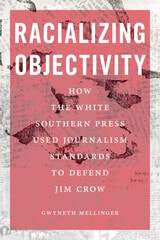
Racializing Objectivity
How the White Southern Press Used Journalism Standards to Defend Jim CrowGwyneth Mellinger
University of Massachusetts Press, 2024
Winner of the 2025 American Journalism Historians Association Book of the Year Award
Winner of the 2025 Association for Education in Journalism and Mass Communication (AEJMC)'s Tankard Book Award and the AEJMC's History Division Book Award
When the civil rights movement began to challenge Jim Crow laws, the white southern press reframed the coverage of racism and segregation as a debate over journalism standards. Many white southern editors, for instance, designated Black Americans as “Negro” in news stories, claiming it was necessary for accuracy and “objectivity,” even as white subjects went unlabeled. These news professionals disparaged media outlets that did not adhere to these norms, such as the Black press. In this way, the southern white press weaponized journalism standards—and particularly the idea of objectivity—to counter and discredit reporting that challenged white supremacy.
Through deep engagement with letters and other materials in numerous archives from editors, journalists, and leaders of newswire services, Racializing Objectivity interrogates and exposes how the white southern press used journalism standards as a professional rationalization for white supremacy and a political strategy to resist desegregation. Gwyneth Mellinger argues that white skin privilege gave these news professionals a stake in the racial status quo and was thus a conflict of interest as they defended Jim Crow. Her study includes an examination of the Southern Education Reporting Service, an objectivity project whose impartiality, she contends, instead affirmed systemic racism. In a pointed counternarrative, Mellinger highlights Black editors and academics who long criticized the supposed objectivity of the press and were consequently marginalized and often dismissed as illegitimate, fanciful, and even paranoid.
Elegant and incisive, Racializing Objectivity unequivocally demonstrates that a full telling of twentieth-century press history must reckon with the white southern press’s cooptation of objectivity and other professional standards to skew racial narratives about Black Americans, the freedom struggle, and democracy itself.

Ramparts of Resistance
Why Workers Lost Their Power, and How to Get It BackSheila Cohen
Pluto Press, 2006
Reclaiming Fair Use
How to Put Balance Back in CopyrightPatricia Aufderheide and Peter Jaszi
University of Chicago Press, 2011
Reclaiming Fair Use
How to Put Balance Back in Copyright, Second EditionPatricia Aufderheide and Peter Jaszi
University of Chicago Press, 2018
Originally published in 2011, Reclaiming Fair Use challenged the widely held notion that copyright law is obsolete in an age of digital technologies. Beginning with a survey of the contemporary landscape of copyright law, Aufderheide and Jaszi drew on their years of experience advising documentary filmmakers, English teachers, performing arts scholars, and other creative professionals to lay out in detail how the principles of fair-use can be employed to avoid copyright violation. Taking stock of the vibrant remix culture that has only burgeoned since the book’s original publication, this new edition addresses the expanded reach of fair use—tracking the Twitter hashtag #WTFU (where’s the fair use?), the maturing of the transformativeness measure in legal disputes, the ongoing fight against automatic detection software, and the progress and delays of digitization initiatives around the country.
Full of no-nonsense advice and practical examples, Reclaiming Fair Use remains essential reading for anyone interested in law, creativity, and the ever-broadening realm of new media.
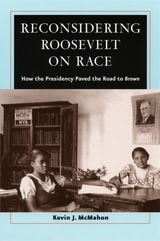
Reconsidering Roosevelt on Race
How the Presidency Paved the Road to BrownKevin J. McMahon
University of Chicago Press, 2003
McMahon shows how FDR's attempt to strengthen the presidency and undermine the power of conservative Southern Democrats dovetailed with his efforts to seek racial equality through the federal courts. By appointing a majority of rights-based liberals deferential to presidential power, Roosevelt ensured that the Supreme Court would be receptive to civil rights claims, especially when those claims had the support of the executive branch.

Red State
An Insider's Story of How the GOP Came to Dominate Texas PoliticsBy Wayne Thorburn
University of Texas Press, 2014
In November 1960, the Democratic party dominated Texas. The newly elected vice president, Lyndon Johnson, was a Texan. Democrats held all thirty statewide elective positions. The state legislature had 181 Democrats and no Republicans or anyone else. Then fast forward fifty years to November 2010. Texas has not voted for a Democratic president since 1976. Every statewide elective office is held by Republicans. Representing Texas in Washington is a congressional delegation of twenty-five Republicans and nine Democrats. Republicans control the Texas Senate by a margin of nineteen to twelve and the Texas House of Representatives by 101 to 49.
Red State explores why this transformation of Texas politics took place and what these changes imply for the future. As both a political scientist and a Republican party insider, Wayne Thorburn is especially qualified to explain how a solidly one-party Democratic state has become a Republican stronghold. He analyzes a wealth of data to show how changes in the state’s demographics—including an influx of new residents, the shift from rural to urban, and the growth of the Mexican American population—have moved Texas through three stages of party competition, from two-tiered politics, to two-party competition between Democrats and Republicans, and then to the return to one-party dominance, this time by Republicans. His findings reveal that the shift from Democratic to Republican governance has been driven not by any change in Texans’ ideological perspective or public policy orientation—even when Texans were voting Democrat, conservatives outnumbered liberals or moderates—but by the Republican party’s increasing identification with conservatism since 1960.
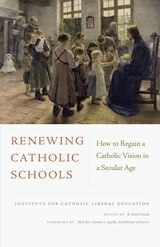
Renewing Catholic Schools
How to Regain a Catholic Vision for a Secular AgeR. Jared Staudt
Catholic University of America Press, 2020
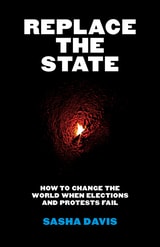
Replace the State
How to Change the World When Elections and Protests FailSasha Davis
University of Minnesota Press, 2025
A practical call to action against oppression
Across the globe, millions of people have participated in protests and marches, donated to political groups, or lobbied their representatives with the aim of creating lasting social change, overturning repressive laws, or limiting environmental destruction. Yet very little seems to improve for those affected by rapacious governments. Replace the State brings new hope for social justice movements by looking to progressive campaigns that have found success by unconventional, and more direct, means.
Sasha Davis, an activist and scholar of radical environmental advocacy, focuses on the strategies of movements, many of them Indigenous, that have occupied contested sites and demonstrated their effectiveness at managing or governing them. Including case studies of resistance to development on Indigenous lands in Hawai‘i, nuclear testing in the Nevada desert, and the U.S. military occupation of Okinawa, he offers insight and direction for activists, students, academics, and others dedicated to protecting and improving the well-being of their communities and beyond.
It would be easy to succumb to pessimism and political apathy in the face of governing institutions that are increasingly unresponsive to calls for change and repressive in response to protest, even as they violate human rights, ignore existential climate catastrophes, and concentrate power into fewer and fewer hands. Instead, Davis finds inspiration for genuine political change through social movements that are successfully “replacing the state” and taking over the day-to-day governance of threatened places. From contesting environmental abuse to reasserting Indigenous sovereignty, these social movements demonstrate how people can collectively wrest control over their communities from oppressive governments and manage them with a more egalitarian ethics of care.
Retail e-book files for this title are screen-reader friendly with images accompanied by short alt text and/or extended descriptions.

Reporting on Risk
How the Mass Media Portray Accidents, Diseases, Other HazardsEleanor Singer
Russell Sage Foundation, 1993
Rewriting
How To Do Things With TextsJoseph Harris
Utah State University Press, 2006
"Like all writers, intellectuals need to say something new and say it well. But unlike many other writers, what intellectuals have to say is bound up with the books we are reading . . . and the ideas of the people we are talking with."
What are the moves that an academic writer makes? How does writing as an intellectual change the way we work from sources? In Rewriting, a textbook for the undergraduate classroom, Joseph Harris draws the college writing student away from static ideas of thesis, support, and structure, and toward a more mature and dynamic understanding. Harris wants college writers to think of intellectual writing as an adaptive and social activity, and he offers them a clear set of strategies—a set of moves—for participating in it.

Rewriting
How to Do Things with Texts, Second EditionJoseph Harris
Utah State University Press, 2017
“Like all writers, intellectuals need to say something new and say it well. But for intellectuals, unlike many other writers, what we have to say is bound up with the books we are reading . . . and the ideas of the people we are talking with.”
What are the moves that an academic writer makes? How does writing as an intellectual change the way we work from sources? In Rewriting, Joseph Harris draws the college writing student away from static ideas of thesis, support, and structure, and toward a more mature and dynamic understanding. Harris wants college writers to think of intellectual writing as an adaptive and social activity, and he offers them a clear set of strategies—a set of moves—for participating in it. Introducing remixing as an additional signature move and updated with new attention to digital writing, the second edition both extends and rethinks the ideas of the original.
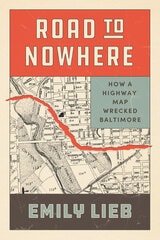
Road to Nowhere
How a Highway Map Wrecked BaltimoreEmily Lieb
University of Chicago Press, 2025
In the mid-1950s Baltimore’s Rosemont neighborhood was alive and vibrant with smart rowhouses, a sprawling park, corner grocery stores, and doctor’s offices. By 1957, a proposed expressway threatened to gut this Black, middle-class community from stem to stern.
That highway was never built, but it didn’t matter—even the failure to build it destroyed Rosemont economically, if not physically. In telling the history of the neighborhood and the notional East–West Expressway, Emily Lieb shows the interwoven tragedies caused by racism in education, housing, and transportation policy. Black families had been attracted to the neighborhood after Baltimore’s Board of School Commissioners converted several white schools into “colored” ones, which had also laid the groundwork for predatory real-estate agents who bought low from white sellers and sold high to determined Black buyers. Despite financial discrimination, Black homeowners built a thriving community before the city council formally voted to condemn some nine hundred homes in Rosemont for the expressway, leading to deflated home values and even more predatory real estate deals.
Drawing on land records, oral history, media coverage, and policy documents, Lieb demystifies blockbusting, redlining, and prejudicial lending, highlighting the national patterns at work in a single neighborhood. The result is an absorbing story about the deliberate decisions that produced racial inequalities in housing, jobs, health, and wealth—as well as a testament to the ingenuity of the residents who fought to stay in their homes, down to today.
Rural Pain, Republican Gain
How the Republican Party Is Killing Rural America and Why Democrats Are BlamedMichael E. Shepherd
University of Chicago Press, 2026
An eye-opening look at how Republican policies have affected health outcomes in rural communities and why poor, rural white voters are turning to the Republican Party—not despite this harm, but because of it.
Over the last four decades, the health of rural Americans has been in free fall. Just as opioid and gun deaths have ripped apart rural communities, hospitals have closed at alarming rates, leaving millions desperately far from care. At the same time, voters in struggling rural communities have increasingly come to vote for the Republican Party.
In Rural Pain, Republican Gain, Michael E. Shepherd demonstrates that these two trends are closely connected. At both the federal and state levels, the Republican Party has increasingly enacted policies that worsen rural health. Rural voters are not indifferent to this development (quite the contrary), but they misassign blame, in part, because the Democratic Party is more commonly associated with health-related policy initiatives and has ownership of health as an issue area. Republican politicians can reap rewards from their own destructive policies by appealing to the shared grievances of rural people.
Shepherd draws on new, wide-ranging data, including in-depth studies of the opioid epidemic, hospital closures, and COVID-19. In so doing, he quantifies the harm of Republican policymaking and its disproportionate effect on rural communities, recasting how readers understand growing Republican support among less healthy, lower-income rural white Americans.