Results by title
405 books match the query 'Human Geography' and 19 start with r
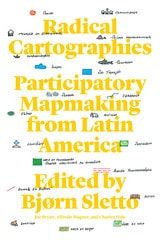
Radical Cartographies
Participatory Mapmaking from Latin AmericaEdited by Bjørn Sletto, Joe Bryan, Alfredo Wagner, and Charles Hale
University of Texas Press, 2020
Cartography has a troubled history as a technology of power. The production and distribution of maps, often understood to be ideological representations that support the interests of their developers, have served as tools of colonization, imperialism, and global development, advancing Western notions of space and place at the expense of Indigenous peoples and other marginalized communities. But over the past two decades, these marginalized populations have increasingly turned to participatory mapping practices to develop new, innovative maps that reassert local concepts of place and space, thus harnessing the power of cartography in their struggles for justice.
In twelve essays written by community leaders, activists, and scholars, Radical Cartographies critically explores the ways in which participatory mapping is being used by Indigenous, Afro-descendant, and other traditional groups in Latin America to preserve their territories and cultural identities. Through this pioneering volume, the authors fundamentally rethink the role of maps, with significant lessons for marginalized communities across the globe, and launch a unique dialogue about the radical edge of a new social cartography.
Rafts, Raccons, & Revelations
Growing Up on a Great LakePete Griffin
Parkhurst Brothers, Inc., 2021
Re-reading Cultural Geography
Edited by Kenneth E. Foote, Peter J. Hugill, Kent Mathewson, and Jonathan M. Smith
University of Texas Press, 1994
The geography of culture has held a sustained attraction for some of the most distinguished and promising geographers of the twentieth century. These notable voices have now been brought together to explore the cultural landscape in this fresh, encompassing survey of one of geography's most vital research areas.
In Re-reading Cultural Geography, a worthy successor to the original and now classic Readings in Cultural Geography (1962), the editors have gathered articles, essays, and new commentaries, as well as extensive annotated reading lists and a comprehensive bibliography, into a book that will be ideal for undergraduate and graduate courses of all levels.
Assessing an intellectual world far different from the one defined in the earlier volume, Re-reading Cultural Geography uncovers the common themes of a vibrant, often clamorous discipline. Broadly defined, these include "how the world looks"—the patternings of cultural traits and material artifacts; "how the world works"—the dynamics of human organizations in interaction with the environment; and "what the world means"—the systems of shared values and beliefs that shape communities.
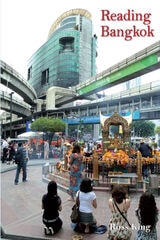
Reading Bangkok
Ross King
National University of Singapore Press, 2011
The author structures the book around external intrusions and local resistance. Geographically, this process is seen in movement from centre to periphery (Thonburi, Rattanakosin, Ratchadamnoen, Sukhumvit, Ratchadapisek, Khlong Toei, the universities). Chronologically, the city underwent various forms of colonization: incorporation of the periphery, which in turn colonized Bangkok; the economic colonization of the 19th and 20th centuries; colonization by consumption brought on in large part by globalized tourism; colonization by the "better" ideas of others (typically from the West); and finally colonization by "better" ways of thinking - notably the intrusions of the universities and of popular democracy.
This exceptionally innovative study draws on urban planning and development, history, anthropology, and political economy, and a rich body of empirical data to provide insights into the maze of power relations, inequalities and global influences that is normally hidden from view. Reading Bangkok is that rare thing, a study that genuinely changes the way its subject is seen and understood.
Real Places
An Unconventional Guide to America's Generic LandscapeGrady Clay
University of Chicago Press, 1994
"This book provides a language for the architecture of everyday life."—Ross Miller, Chicago Tribune
"Spirited observations and capsule histories."—Suzanne Stephens, New York Times Book Review
"Compelling. . . . Included here are many nuggets of insight and illumination."—Brad Knickerbocker, Christian Science Monitor
"An amusing and touching book about the reality we Americans have captured in our language."—Boston Sunday Globe
Reclaiming the Road
Mobility Justice beyond Complete StreetsDavid L Prytherch
University of Minnesota Press, 2025
Imagining equitable streets for all
For the past century, our roadways have been engineered as pipes for cars, but they offer vast potential as public spaces. From New York and Boston to Portland and Los Angeles, cities are rethinking their streets, going beyond sidewalks and bike lanes to welcome nonmotorists to share the asphalt roadway. Reclaiming the Road traces the historical evolution of America’s streets and explores contemporary movements to retake them from cars—temporarily and permanently—for diverse forms of mobility and community life. To share the street raises important questions of equity, in transportation and beyond. David L. Prytherch proposes a bold, intersectional vision of a more just street.
Reclaiming the Road connects cutting-edge theory, policy analysis, and firsthand accounts from those leading the charge in transforming our streets to advocate for changing how we think about and design roads. Prytherch features case studies of nine major cities in the United States to show how experiments in reclaiming streets accelerated during the Covid-19 pandemic to become lasting changes. Through in-depth interviews, he shares stories of how planners, transportation advocates, and community leaders have implemented innovative programs for slowing neighborhood streets, opening roads for walking and biking, and reconstructing roadways with public parklets and street plazas as social spaces for curbside conversation.
Examining movements to transform streets through the lenses of equity and justice, Reclaiming the Road tackles the conceptual challenge of defining mobility justice and the practicalities of planning a more just public street, offering a compelling vision for the future of America’s public spaces.
Retail e-book files for this title are screen-reader friendly with images accompanied by short alt text and/or extended descriptions.
Red Harvests
Agrarian Capitalism and Genocide in Democratic KampucheaJames A. Tyner
West Virginia University Press, 2021
Reassessing the Cambodian genocide through the lens of global capitalist development.
James Tyner reinterprets the place of agriculture under the Khmer Rouge, positioning it in new ways relative to Marxism, capitalism, and genocide. The Cambodian revolutionaries’ agricultural management is widely viewed by critics as irrational and dangerous, and it is invoked as part of wider efforts to discredit leftist movements. Researching the specific functioning of Cambodia’s transition from farms to agriculture within the context of the global economy, Tyner comes to a different conclusion. He finds that analysis of “actually existing political economy”—as opposed to the Marxist identification the Khmer Rouge claimed—points to overlap between Cambodian practice and agrarian capitalism.
Tyner argues that dissolution of the traditional Khmer family farm under the aegis of state capitalism is central to any understanding of the mass violence unleashed by the Khmer Rouge. Seen less as a radical outlier than as part of a global shift in farming and food politics, the Cambodian tragedy imparts new lessons to our understanding of the political economy of genocide.
Reimagining Political Ecology
Aletta Biersack and James B. Greenberg, eds.
Duke University Press, 2006
Aletta Biersack’s introduction takes stock of where political ecology has been, assesses the field’s strengths, and sets forth a bold research agenda for the future. Two essays offer wide-ranging critiques of modernist ecology, with its artificial dichotomy between nature and culture, faith in the scientific management of nature, and related tendency to dismiss local knowledge. The remaining eight essays are case studies of particular constructions and appropriations of nature and the complex politics that come into play regionally, nationally, and internationally when nature is brought within the human sphere. Written by some of the leading thinkers in environmental anthropology, these rich ethnographies are based in locales around the world: in Belize, Papua New Guinea, the Gulf of California, Iceland, Finland, the Peruvian Amazon, Malaysia, and Indonesia. Collectively, they demonstrate that political ecology speaks to concerns shared by geographers, sociologists, political scientists, historians, and anthropologists alike. And they model the kind of work that this volume identifies as the future of political ecology: place-based “ethnographies of nature” keenly attuned to the conjunctural effects of globalization.
Contributors. Eeva Berglund, Aletta Biersack, J. Peter Brosius, Michael R. Dove, James B. Greenberg, Søren Hvalkof, J. Stephen Lansing, Gísli Pálsson, Joel Robbins, Vernon L. Scarborough, John W. Schoenfelder, Richard Wilk
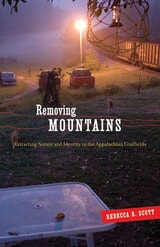
Removing Mountains
Extracting Nature and Identity in the Appalachian CoalfieldsRebecca R. Scott
University of Minnesota Press, 2010
In this rich ethnography of life in Appalachia, Scott examines mountaintop removal in light of controversy and protests from environmental groups calling for its abolishment. But Removing Mountains takes the conversation in a new direction, telling the stories of the businesspeople, miners, and families who believe they depend on the industry to survive. Scott reveals these southern Appalachian coalfields as a meaningful landscape where everyday practices and representations help shape a community's relationship to the environment.
Removing Mountains demonstrates that the paradox that faces this community-forced to destroy their land to make a wage-raises important questions related not only to the environment but also to American national identity, place, and white working-class masculinity.
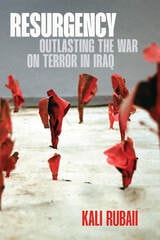
Resurgency
Outlasting the War on Terror in IraqKali Rubaii
Duke University Press, 2026
In Resurgency, Kali Rubaii offers detailed ethnographic insight into how decades of war have affected everyday life in Iraq. Drawing on fieldwork in Anbar province and Iraqi Kurdistan in 2014–15 and 2021–24, Rubaii foregrounds the practices of displaced people who stubbornly outlast their occupiers, returning to homes that feel estranging, repairing war-damaged land, and surviving into futures to which they have been disinvited. Following Anbari farmers in their struggle to counter the social and environmental fallout from toxic military waste, depleted ecosystems, and transformed political economies, Resurgency expands the temporal and descriptive categories of what war is—and what resistance looks like. By asking what actions and dispositions make sense when conditions of survival are diminished, and when today may be better than tomorrow, Rubaii offers new methods and insights to those concerned about the possibilities of life amid environmental devastation, mass displacement, and the slow violence of the forever wars.
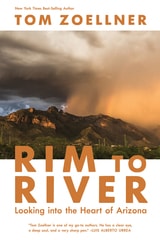
Rim to River
Looking into the Heart of ArizonaTom Zoellner
University of Arizona Press, 2023
Rim to River is the story of this extraordinary journey through redrock country, down canyons, up mesas, and across desert plains to the obscure valley in Mexico that gave the state its enigmatic name. The trek is interspersed with incisive essays that pick apart the distinctive cultural landscape of Arizona: the wine-colored pinnacles and complex spirituality of Navajoland, the mind-numbing stucco suburbs, desperate border crossings, legislative skullduggery, extreme politics, billion-dollar copper ventures, dehydrating rivers, retirement kingdoms, old-time foodways, ghosts of old wars, honky-tonk dreamers, murder mysteries, and magical Grand Canyon reveries.
In Rim to River, Zoellner does for Arizona what Larry McMurtry did for Texas in In a Narrow Grave and what Wallace Stegner did for Utah in Mormon Country: paint an enduring portrait of a misunderstood American state. An indictment, a love letter, and a homecoming story all at once.
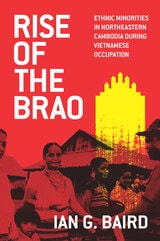
Rise of the Brao
Ethnic Minorities in Northeastern Cambodia during Vietnamese OccupationIan G. Baird
University of Wisconsin Press, 2022
Based on detailed research and interviews, Ian G. Baird documents this golden age of the Brao, including the voices of those who are too frequently omitted from official records. Rise of the Brao challenges scholars to look beyond the prevailing historical narratives to consider the nuanced perspectives of peripheral or marginal regions.
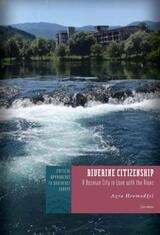
Riverine Citizenship
A Bosnian City in Love with the RiverAzra Hromadžic
Central European University Press, 2024
Water potential is a significant natural wealth of most parts of the Balkans, and it has given rise to a surge in hydropower investments unparalleled across Europe. As part of the process, a dam was planned to be built on the Una River, which runs through the Bosnian town of Bihać. This prospect alarmed the city’s residents, culminating in a protest in 2015. The book begins with this protest, and it explores how the threat of dam construction transformed the seemingly apolitical love of the river into a powerful political force around which thousands of people mobilized: riverine citizenship.
The book is based on interviews with participants, archival research, and over twenty years of ethnographic research. Azra Hromadžić focuses on the tension between ecological sustainability efforts in favor of renewable energy, on the one hand, and citizens’ historically shaped, deeply-felt, love for the river, on the other. She shows how the language and promises of green transition can mask the forces of capitalist accumulation that drive this change — whether in the form of building hydroelectric dams or promoting eco-tourism — and thus set in motion another cycle of environmental degradation, social dispossession, and economic exploitation.

Rivers on the Move
Waterways in Human Life from the Ice Age to the AnthropoceneBathesheba Demuth, Mark H. Healey, Giacomo Parrinello, and Laurence C. Smith, editors
Duke University Press, 2027
Rocky Mountain Divide
Selling and Saving the WestBy John B. Wright
University of Texas Press, 1993
The opposing forces of conservation and development have shaped and will continue to shape the natural environment and scenic beauty of the American West. Perhaps nowhere are their opposite effects more visible than in the neighboring states of Colorado and Utah, so alike in their spectacular mountain environments, yet so different in their approaches to land conservation. This study explores why Colorado has over twenty-five land trusts, while Utah has only one.
John Wright traces the success of voluntary land conservation in Colorado to the state’s history as a region of secular commerce. As environmental consciousness has grown in Colorado, people there have embraced the businesslike approach of land trusts as simply a new, more responsible way of conducting the real estate business.
In Utah, by contrast, Wright finds that Mormon millennialism and the belief that growth equals success have created a public climate opposed to the formation of land trusts. As Wright puts it, "environmentalism seems to thrive in the Centennial state within the spiritual vacuum which is filled by Mormonism in Utah." These findings remind conservationists of the power of underlying cultural values that affect their efforts to preserve private lands.
Romantic Geography
In Search of the Sublime LandscapeYi-Fu Tuan
University of Wisconsin Press, 2013
Yi-Fu Tuan established a global reputation for deepening the field of geography by examining its moral, universal, philosophical, and poetic potentials and implications. In Romantic Geography, he considers the human tendency to find salvation in geographies that cater not so much to survival needs (or even to good, comfortable living) as to the passionate and romantic aspirations of their nature.
Rubble
The Afterlife of DestructionGastón R. Gordillo
Duke University Press, 2014
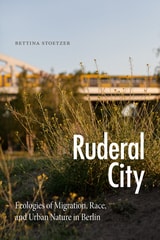
Ruderal City
Ecologies of Migration, Race, and Urban Nature in BerlinBettina Stoetzer
Duke University Press, 2022
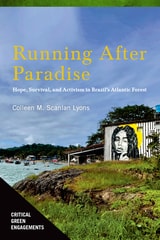
Running After Paradise
Hope, Survival, and Activism in Brazil's Atlantic ForestColleen M. Scanlan Lyons
University of Arizona Press, 2022
The pressures on this tropical forest are palpable. So are people’s responses to these pressures. What was once the state’s economic mainstay, cacao production, is only now beginning to make a comeback after a disease decimated the crops of large and small farmers alike. Tourism, another economic hope, is susceptible to economic crises and pandemics. And the threat of a massive state-led infrastructure project involving mining, a railroad, and an international port has loomed over the region for well over a decade.
Southern Bahia is at a crossroads: develop a sustainable, forest-based economy or run the risk of losing the identity and soul of this place forevermore. Through the lives of environmentalists, farmers, quilombolas, and nativos—people who are in and of this place—this book brings alive the people who are grappling with this dilemma.
Anthropologist Colleen M. Scanlan Lyons brings the eye of a storyteller to present this complex struggle, weaving in her own challenges of balancing family and fieldwork alongside the stories of the people who live in this dynamic region. Intertwined tales, friendships, and hope emerge as people both struggle to sustain their lives in a biodiversity hotspot and strive to create their paradise.