Results by title
425 books match the query 'Human rights' and 19 start with r
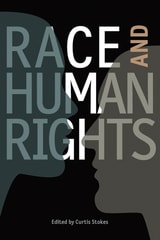
Race and Human Rights
Curtis Stokes
Michigan State University Press, 2008
The terrorist attacks against U.S. targets on September 11, 2001, and the subsequent wars in Afghanistan and Iraq, sparked an intense debate about "human rights." According to contributors to this provocative book, the discussion of human rights to date has been far too narrow. They argue that any conversation about human rights in the United States must include equal rights for all residents.
Essays examine the historical and intellectual context for the modern debate about human rights, the racial implications of the war on terrorism, the intersection of racial oppression, and the national security state. Others look at the Pinkerton detective agency as a forerunner of the Federal Bureau of Investigation, the role of Africa in post–World War II American attempts at empire-building, and the role of immigration as a human rights issue.
Re-thinking Socio-Economic Rights in an Insecure World
Nsongurua Udombana
Central European University Press, 2005
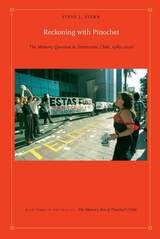
Reckoning with Pinochet
The Memory Question in Democratic Chile, 1989–2006Steve J. Stern
Duke University Press, 2010
Stern’s analysis integrates policymaking by elites, grassroots efforts by human rights victims and activists, and inside accounts of the truth commissions and courts where top-down and bottom-up initiatives met. Interpreting solemn presidential speeches, raucous street protests, interviews, journalism, humor, cinema, and other sources, he describes the slow, imperfect, but surprisingly forceful advance of efforts to revive democratic values through public memory struggles, despite the power still wielded by the military and a conservative social base including the investor class. Over time, resourceful civil-society activists and select state actors won hard-fought, if limited, gains. As a result, Chileans were able to face the unwelcome past more honestly, launch the world’s first truth commission to examine torture, ensnare high-level perpetrators in the web of criminal justice, and build a public culture of human rights. Stern provides an important conceptualization of collective memory in the wake of national trauma in this magisterial work of history.

Refugee Reception in Southern Africa
Nicholas Maple
University of London Press, 2024
While state-based reception is frequently framed as one-off moments such as registration, Refugee Reception in Southern Africa proposes a new understanding whereby reception is a process that reflects the complex dynamics of contemporary refugee arrival. By adopting this understanding, the book demonstrates how reception is a complex and ongoing process of negotiations between refugees and the state. Indeed, the relationship between the refugee and host state often remains fragile and prone to ruptures, especially when less formal reception policies allow refugees to move back and forth between refugee camps and local areas. Nevertheless, through these negotiations, Refugee Reception in Southern Africa shows how reception policies are vital in shaping a refugee’s ability to settle and engage with local communities and labor markets.
Using the cases of Zambia and South Africa, the book explores why some countries maintain encampment reception policies for refugees and others use a more liberal “free settlement” approach, whereby refugees are granted freedom of movement and permitted to settle in cities and towns. This book offers an original and unique perspective on refugee hosting in southern Africa, one that does not look upon persons who flee across a border as a homogenous group whose movement abruptly ends once they arrive in a host state or refugee camp.
Refugee Talk
Propositions on Ethics and AestheticsEva
Pluto Press, 2022
An innovative approach to the refugee crisis through a focus on language use, discourse and representation
'A wide-ranging, erudite and multi-faceted analyses of the fundamental problem of who gets to be counted as human' - Kate Evans
What does it mean to be a refugee? What political questions do they raise? Through what political rhetoric is their experiences parsed? The ongoing refugee crisis has sparked all these questions and more.
Refugee Talk uses conversation as a research method and ethical practice to approach the representation of and the discourse about and by the refugee. Though refugees who cross borders are routinely registered, filed, and detained, the individual stories they carry are just as routinely overlooked or ignored. When language itself becomes another border that excludes refugees, the need for a new vocabulary that decriminalizes and re-humanizes the refugee experience asserts itself.
The authors engage theoretically with thinkers from Hannah Arendt to Paolo Freire and Kwame A. Appiah and structure the book around conversations with academics, activists, journalists, and refugee artists and writers. The result is a comprehensive humanities approach that places ethics and aesthetics at its core.
Refugees in America
Stories of Courage, Resilience, and Hope in Their Own WordsLee T Bycel
Rutgers University Press, 2019
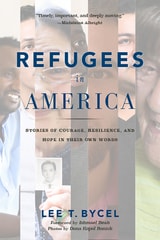
Each chapter of Refugees in America focuses on an individual from a different country, from a 93-year-old Polish grandmother who came to the United States after surviving the horrors of Auschwitz to a young undocumented immigrant from El Salvador who became an American college graduate, despite being born impoverished and blind. Some have found it easy to reinvent themselves in the United States, while others have struggled to adjust to America, with its new culture, language, prejudices, and norms.
Each of them speaks candidly about their experiences to author Lee T. Bycel, who provides illuminating background information on the refugee crises in their native countries. Their stories help reveal the real people at the center of political debates about US immigration.
Giving a voice to refugees from such far-flung locations as South Sudan, Guatemala, Syria, and Vietnam, this book weaves together a rich tapestry of human resilience, suffering, and determination.
Profits from the sale of this book will be donated to two organizations that are doing excellent refugee resettlement work and offer many opportunities to support refugees: HIAS (founded as the Hebrew Immigrant Aid Society) hias.org International Rescue Committee (IRC) rescue.org
Reluctant Interveners
America's Failed Responses to Genocide from Bosnia to DarfurEyal Mayroz
Rutgers University Press, 2020
Featured in the 2020 Association of University Presses Book, Jacket, and Journal Show
Why do we allow our governments to get away with “bystanding” to genocide? How can we, when alerted to the mass slaughter of innocents, still not take a stand? Reluctant Interveners provides the most comprehensive answers yet to these confronting questions, focusing on the complex relationships between the citizenry, the media, the political elites, and institutions in the most powerful nation in the world, the United States of America.
Eyal Mayroz offers a sobering account of the interactions between the governing and the governed, and the dynamics which transformed moral concerns for the lives of faraway “others” into cold political calculations. Exposed are the processes that turned the promise of “never again” to a recurring reality of ever again, the role of the office of the presidency in their advancement, and the resultant image of America as seen by the rest of the world. In a time of ubiquitous social media and populist revival, a greater role for the U.S. citizenry in decision-making on responses to genocide may be in the cards. The question is, in which directions will these trends take American foreign policy?
Remaking Rwanda
State Building and Human Rights after Mass ViolenceScott Straus
University of Wisconsin Press, 2011
Remembering the Fragmented
War, Memory, and Repair in ColombiaPilar Riaño-Alcalá
University of Wisconsin Press, 2027
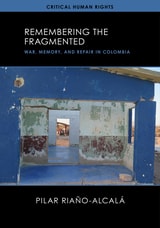
The South American nation of Colombia has experienced decades of violence involving state, guerrilla, and paramilitary actors, resulting in profound and enduring consequences. Scholars have examined both the violent events and the subsequent truth and reconciliation initiatives addressing this complex history. Pilar Riaño-Alcalá introduces a novel perspective by integrating Black, Indigenous, and memory studies in her analysis of two significant sites of mass violence: Bahia Portete, a Wayuu Indigenous territory in Upper Guajira, and Bojayá, a Black and Embera Indigenous territory in Chocó. By recognizing nonhuman and nonliving community members as actants and foregrounding Indigenous and Black ontologies in collective remembrance, Riaño-Alcalá reveals the processes through which these communities engage in social repair. She demonstrates how they interpret, restore, sustain, and reimagine their identities amid ongoing challenges posed by war and racial capitalism. This work advances scholarship in human rights studies, memory studies, Indigenous studies, Latin American studies, and the anthropology of social repair, offering significant new insights into a well-examined historical context.
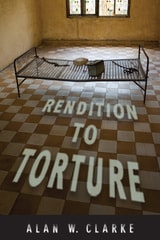
Rendition to Torture
Clarke, Alan W
Rutgers University Press, 2012
In Rendition to Torture, Alan W. Clarke explains how the United States adopted torture as a matter of official policy; how and why it turned to extraordinary rendition as a way to outsource more extreme, mutilating forms of torture; and outlines the steps the United States took to hide its abuses. Many adverse consequences attended American use of torture. False information gleaned from torture was used to justify the Iraq war, adding potency to the charge that the war was illegal under international law. Moreover, European nations and Canada aided, abetted, and became thoroughly enmeshed in U.S.-led torture and renditions, thereby spreading both the problem and the blame for this practice. Clarke offers an extended critique of these activities, placing them in historical and legal context as well as in transnational and comparative perspective.
Reparations and the Human
David L. Eng
Duke University Press, 2025
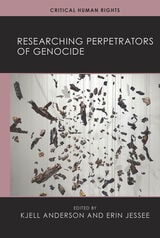
Researching Perpetrators of Genocide
Edited by Kjell Anderson and Erin Jessee
University of Wisconsin Press, 2021
This collection of case studies by scholars from a range of disciplinary backgrounds turns a critical and reflective eye toward qualitative fieldwork on the topic. Framed by an introduction that sets out key issues in perpetrator research and a conclusion that proposes and outlines a code of best practice, the volume provides an essential starting point for future research while advancing genocide studies, transitional justice, and related fields. This original, important, and welcome contribution will be of value to historians, political scientists, criminologists, anthropologists, lawyers, and legal scholars.
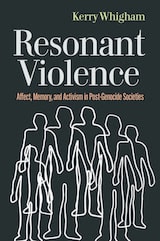
Resonant Violence
Affect, Memory, and Activism in Post-Genocide SocietiesKerry Whigham
Rutgers University Press, 2022
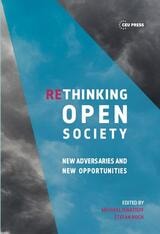
Rethinking Open Society
CONTRIBUTORS: Anne Applebaum • Erica Benner• Dorothee Bohle • Thomas Christiano • Tim Crane • Niall Ferguson • Timothy Garton Ash • Béla Greskovits • Michael Ignatieff • Robert D. Kaplan • János Kis • Ivan Krastev • Mark Lilla • Margaret MacMillan • Jan-Werner Müller • Alina Mungiu-Pippidi • Stefan Roch • Pierre Rosanvallon • Jacques Rupnik • András Sajó • Daniela Schwarzer • Sir Roger Scruton • Stephen M. Walt
Central European University Press, 2018
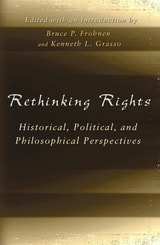
Rethinking Rights
Historical, Political, and Philosophical PerspectivesEdited by Bruce P. Frohnen and Kenneth L. Grasso
University of Missouri Press, 2008
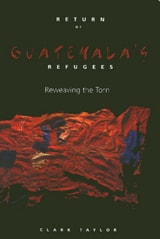
Return Of Guatemala'S Refugees
Clark Taylor
Temple University Press, 1998
Twelve years later, utilizing terms of refugee agreements reached in 1982, villagers from Santa Maria who had fled to Mexico returned to their homes and lands to re-create their community with those who had stayed in Guatemala. Return of Guatemala's Refugees tells the story of that process. In this moving and provocative book, Clark Taylor describes the experiences of the survivors -- both those who stayed behind in conditions of savage repression and those who fled to Mexico where they learned to organize and defend their rights. Their struggle to rebuild is set in the wider drama of efforts by grassroots groups to pressure the government, economic elites, and army to fulfill peace accords signed in December of 1996.
Focusing on the village of Santa Maria Tzeja, Taylor defines the challenges that faced returning refugees and their community. How did the opposing subcultures of fear (generated among those who stayed in Guatemala) and of education and human rights (experienced by those who took refuge in Mexico) coexist? Would the flood of international money sent to settle the refugees and fulfill the peace accords serve to promote participatory development or new forms of social control? How did survivors expand the space for democracy firmly grounded in human rights? How did they get beyond the grief and trauma that remained from the terror of the early eighties? Finally, the ultimate challenge, how did they work within conditions of extreme poverty to create a grassroots democracy in a militarized society?
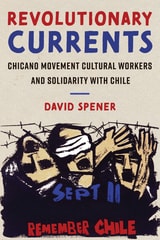
Revolutionary Currents
Chicano Movement Cultural Workers and Solidarity with ChileDavid Spener
University of Arizona Press, 2027
On September 11, 1973, General Augusto Pinochet led a bloody military coup in Chile that overthrew Salvador Allende’s democratically elected socialist government. The coup ushered in a cruelly repressive dictatorship that would govern the country for the next seventeen years, constituting a watershed moment in Cold War history.
This book recounts the untold story of how Chicano Movement poets, artists, musicians, and theater groups in the United States used their work to express solidarity with the international campaign to restore democracy in Chile. Such expressions of solidarity were especially prominent in the San Francisco Bay Area, where hundreds of Chilean exiles settled following the coup. Upon arrival, they joined a diverse Latinx population that was home to a Chicanx arts community whose members’ political orientations primed them to lend their talents to anti-imperialist causes. These Chicanxs were also drawn to the campaign against the dictatorship through friendship and acquaintance with members of the Chilean exile community.
David Spener shows how the Bay Area’s unique cosmopolitan social context offered Chicanxs and Chileans meaningful opportunities for dialogue and collaboration with each other as well as with Latinxs of other national origins. Chicanxs often adopted a pan-ethnic raza identity that they could share with Chilean, Nicaraguan, Puerto Rican, Salvadoran, and other Latinx activists. This did not mean, however, that they abandoned the political identities that they had gained from the Chicano Movement. Instead, many came to see themselves as uniting with other Latinxs, first Chileans and then Nicaraguans and Salvadorans, in a struggle against U.S. imperialism throughout the Americas.
Rights Enabled
The Disability Revolution, from the US, to Germany and Japan, to the United NationsKatharina Heyer
University of Michigan Press, 2015
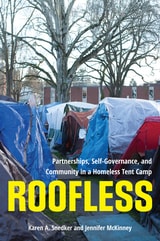
Roofless
Partnerships, Self-Governance, and Community in a Homeless Tent CampKaren A. Snedker
Rutgers University Press, 2027
Roofless critically examines homelessness and responses to it in the United States through the growing practice of forming tent camps. Karen A. Snedker and Jennifer McKinney position Seattle's "Tent City 3," (the US city with the third-largest homeless population), as an organizational model for other local governments to consider implementing in addressing their homelessness crises. Snedker and McKinney document this tent city's development through a census they conducted from 2019 to 2020, though the efforts behind Tent City 3 have a history dating back two decades. Through such an examination, the authors reveal surprising points of view and outcomes, including grassroots partnerships between city agencies, nonprofits, religious organizations, and educational institutions. In the context of rising homelessness in the US, understanding and having insight into the residents' experience of sanctioned unsheltered homelessness, compared to instances of unsanctioned encampments, allows readers to acquire a complete, nuanced picture of tent-based homelessness. As such, Roofless provides valuable insight to audiences ranging from scholars of sociology and social work, policymakers, homelessness advocates, and politicians.