Results by title
78 books match the query 'Humanism' and 3 start with r
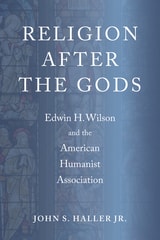
Religion After the Gods
Edwin H. Wilson and the American Humanist AssociationJohn S. Haller Jr.
University of Illinois Press, 2026
Sometimes called America’s fourth religion, religious humanism emerged in the Midwest as a product of Enlightenment rationality, the Social Gospel, and the philosophy of pragmatism. John S. Haller Jr. examines religious humanism’s first fifty years alongside Edwin H. Wilson’s pivotal role in the American Humanist Association (AHA).
Started by a group of Unitarian faculty and students, religious humanism applied the rituals of the theocentric universe of Judeo-Christianity to the non-theistic, anthropocentric universe of agnostics, altruists, humanitarians, and meliorists. Their beliefs found expression in the AHA, founded in 1941 with Wilson as the secretary and editor of its magazine. Wilson’s actions in these and other roles weighed heavily on the organization’s reputation, influence, successes, and failures. At the same time, his multifaceted work reflected the relationship between power and the possibilities inherent in the pluralistic and democratic heritage he pursued.
Rigorous and astute, Religion After the Gods reveals how the tensions between individual aspirations and bureaucratic constraints culminated in hopeful humanist practices.
Rereading the Renaissance
Petrarch, Augustine, and the Language of HumanismCarol Everhart Quillen
University of Michigan Press, 1998
Carol Quillen argues that the essential role of Augustine's words and authority in the expression of Petrarch's humanism is best grasped through a study of the complex textual practices exemplified in the writings of both men. Petrarch's reliance on Augustine is most evident in his ways of reading and in his strategies of argument. Secondly, she maintains that Petrarch's appropriation of Augustine's words is only intelligible in light of his struggle to legitimate his cultural ideals in the face of compelling opposition. Finally, Quillen shows how Petrarch's uses of Augustine can simultaneously uphold his humanist ideals and challenge the legitimacy of the assumptions on which those ideals were founded.
Interdisciplinary in scope and method, this volume speaks to important debates that span the humanities. Scholars of literary and historical studies, as well as those in the fields of classical studies, patristics, and comparative literature, will find in Rereading the Renaissance a solid contribution to their interests.
Carol Everhart Quillen is Associate Professor of History, Rice University.
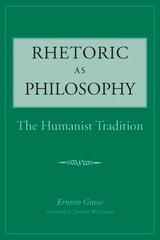
Rhetoric as Philosophy
The Humanist TraditionErnesto Grassi. Foreword by Timothy W. Crusius
Southern Illinois University Press, 2001
Originally published in English in 1980, Rhetoric as Philosophy has been out of print for some time. The reviews of that English edition attest to the importance of Ernesto Grassi’s work.
By going back to the Italian humanist tradition and aspects of earlier Greek and Latin thought, Ernesto Grassi develops a conception of rhetoric as the basis of philosophy. Grassi explores the sense in which the first principles of rational thought come from the metaphorical power of the word. He finds the basis for his conception in the last great thinker of the Italian humanist tradition, Giambattista Vico (1668–1744). He concentrates on Vico’s understanding of imagination and the sense of human ingenuity contained in metaphor. For Grassi, rhetorical activity is the essence and inner life of thought when connected to the metaphorical power of the word.