95 books match the query 'Ideology' and 3 start with r

cover of Radical Tragedy: Religion, Ideology and Power in the Drama of Shakespeare and His Contemporaries

Radical Tragedy

Religion, Ideology and Power in the Drama of Shakespeare and His Contemporaries

Jonathan Dollimore

Duke University Press, 2004
When it was first published, Radical Tragedy was hailed as a groundbreaking reassessment of the drama of Shakespeare and his contemporaries. An engaged reading of the past with compelling contemporary significance, Radical Tragedy remains a landmark study of Renaissance drama. The third edition of this critically acclaimed work includes a new foreword by Terry Eagleton and an extensive new introduction by the author.
[more]
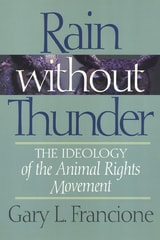
cover of Rain Without Thunder: The Ideology of the Animal Rights Movement

Rain Without Thunder

The Ideology of the Animal Rights Movement

Gary L. Francione

Temple University Press, 1996

Are "animal welfare" supporters indistinguishable from the animal exploiters they oppose? Do reformist measures reaffirm the underlying principles that make animal exploitation possible in the first place? In this provocative book, Gary L. Francione argues that the modern animal rights movement has become indistinguishable from a century-old concern with the welfare of animals that in no way prevents them from being exploited.

Francione maintains that advocating humane treatment of animals retains a sense of them as instrumental to human ends. When they are considered dispensable property, he says, they are left fundamentally without "rights." Until the seventies, Francione claims, this was the paradigm within which the Animal Rights Movement operated, as demonstrated by laws such as the Federal Humane Slaughter Act of 1958.

In this wide-ranging book, Francione takes the reader through the philosophical and intellectual debates surrounding animal welfare to make clear the difference between animal rights and animal welfare. Through case studies such as campaigns against animal shelters, animal laboratories, and the wearing of fur, Francione demonstrates the selectiveness and confusion inherent in reformist programs that target fur, for example, but leave wool and leather alone.

The solution to this dilemma, Francione argues, is not in a liberal position that espouses the humane treatment of animals, but in a more radical acceptance of the fundamental inalienability of animal rights.
[more]
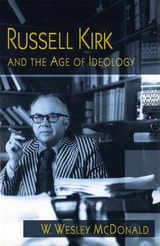
cover of Russell Kirk and the Age of Ideology

Russell Kirk and the Age of Ideology

W. Wesley McDonald

University of Missouri Press, 2004

Russell Kirk, author of The Conservative Mind and A Program for Conservatives, has been regarded as one of the foremost figures of the post–World War II revival in conservative thought. While numerous commentators on contemporary political thought have acknowledged his considerable influence on the substance and direction of American conservatism, no analysis of his social and political writing has dealt extensively with the philosophical foundations of his work.
            In this provocative study, W. Wesley McDonald examines those foundations and demonstrates their impact on the conservative intellectual movement that emerged in the 1950s and 1960s. Kirk played a pivotal role in drawing conservatism away from the laissez-faireprinciplesoflibertarianism and toward those of a traditional community grounded in a renewed appreciation of man’s social and spiritual nature and the moral prerequisites of genuine liberty. In a humane social order, a community of spirit is fostered in which generations are bound together. According to Kirk, this link is achieved through moral and social norms that transcend the particularities of time and place and, because they form the basis of genuine civilized existence, can only be neglected at great peril. These norms, reflected in religious dogmas, traditions, humane letters, social habit and custom, and prescriptive institutions, create the sources of the true community that is the final end of politics.
            Although this study does not challenge Kirk’s debts to a predominantly Catholic and Anglo-Catholic tradition of natural law, its focus is on his appeal to historical experience as the test of sound institutions. This aspect of his thought was essential to Kirk’s understanding of moral, cultural, and aesthetic norms and can be seen in his responses to American humanists Paul Elmer More and Irving Babbitt and to English and American romantic literature.
Russell Kirk and the Age of Ideology is particularly relevant because of the growing interest in Kirk’s legacy and the current debate over the meaning of conservatism. McDonald addresses both of those developments in the context of examining Kirk’s thought, attempting to correct some of the inadequacies contained in earlier studies that assess Kirk as a political thinker. This book will serve as a significant contribution to the commentary on this fascinating figure.
[more]