Results by title
221 books match the query 'Imperialism' and 5 start with r
Racial Blackness and the Discontinuity of Western Modernity
Edited by Justin A. Joyce, Dwight A. McBride, and John Carlos Rowe
University of Illinois Press, 2013
Rational Empires
Institutional Incentives and Imperial ExpansionLeo J. Blanken
University of Chicago Press, 2012
The nineteenth century marked the high point of imperialism, when tsarist Russia expanded to the Pacific and the sun was said never to set on the British Empire. Imperialism remains a perennial issue in international relations today, and nowhere is this more evident than in the intensifying competition for global resources.
Leo J. Blanken explains imperialism through an analysis of the institutions of both the expanding state and its targets of conquest. While democratic states favoring free trade generally resort to imperialism only to preempt aggressive rivals—or when they have reason to believe another state’s political institutions will not hold up when making bargains—authoritarian states tend toward imperialism because they don’t stand to benefit from free trade. The result is three distinct strategies toward imperialism: actors fighting over territory, actors peaceably dividing territory among themselves, and actors refraining from seizing territory altogether. Blanken examines these dynamics through three case studies: the scramble for Africa, the unequal treaties imposed on Qing Dynasty China, and the evolution of Britain’s imperial policy in India. By separating out the different types of imperialism, Blanken provides insight into its sources, as well as the potential implications of increased competition in the current international arena.

Remaindered Life
Neferti X. Tadiar
Duke University Press, 2022
Rereading the Black Legend
The Discourses of Religious and Racial Difference in the Renaissance EmpiresEdited by Margaret R. Greer, Walter D. Mignolo, and Maureen Quilligan
University of Chicago Press, 2008
A distinguished group of contributors here examine early modern imperialisms including the Ottomans in Eastern Europe, the Portuguese in East India, and the cases of Mughal India and China, to historicize the charge of unique Spanish brutality in encounters with indigenous peoples during the Age of Exploration. The geographic reach and linguistic breadth of this ambitious collection will make it a valuable resource for any discussion of race, national identity, and religious belief in the European Renaissance.
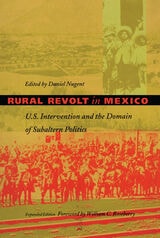
Rural Revolt in Mexico
U.S. Intervention and the Domain of Subaltern PoliticsDaniel Nugent, ed.
Duke University Press, 1998
Through their studies of social movements and popular mobilization in the Mexican countryside, the contributors argue for understanding rural revolts in terms of the specific historical contexts of particular regions and peoples, as well as the broader context of unequal cultural, political, and economic relations between Mexico and the United States. Exploring the connections between external and internal factors in social movements, these essays reveal the wide range of organized efforts through which peasants and Indians have struggled to shape their own destiny while confronted by the influence of U.S. capital and military might. Originally published as a limited edition in 1988 by the Center for U. S.–Mexican Studies, this volume presents a pioneering effort by Latin Americanist scholars to sympathetically embrace and enrich work begun in Subaltern Studies between 1982 and 1987 by projecting it onto a different region of historical experience. This revised and expanded edition includes a new introduction by Daniel Nugent and an extensive essay by Adolfo Gilly on the recent Chiapas uprising.