Results by title
456 books match the query 'India' and 21 start with r

R. K. Narayan
A Critical AppreciationWilliam Walsh
University of Chicago Press, 1982
This lucid and often eloquent study provides both new and devoted Narayan readers with an introduction to his life and work. William Walsh, who makes generous and apt use of quotations from Narayan's work, traces Narayan's artistic development and brings into clear relief the qualities that characterize his fiction: gentle irony, humor, and a tolerance of human foibles. Both a criticism and an appreciation, this work will prove valuable to those already acquainted with this delightful and important novelist and will lead others to his work for the first time.
R. K. Narayan
Contemporary Critical EssaysGeoffrey Kain
Michigan State University Press, 1993
Radiant Infrastructures
Media, Environment, and Cultures of UncertaintyRahul Mukherjee
Duke University Press, 2020
Rational Empires
Institutional Incentives and Imperial ExpansionLeo J. Blanken
University of Chicago Press, 2012
The nineteenth century marked the high point of imperialism, when tsarist Russia expanded to the Pacific and the sun was said never to set on the British Empire. Imperialism remains a perennial issue in international relations today, and nowhere is this more evident than in the intensifying competition for global resources.
Leo J. Blanken explains imperialism through an analysis of the institutions of both the expanding state and its targets of conquest. While democratic states favoring free trade generally resort to imperialism only to preempt aggressive rivals—or when they have reason to believe another state’s political institutions will not hold up when making bargains—authoritarian states tend toward imperialism because they don’t stand to benefit from free trade. The result is three distinct strategies toward imperialism: actors fighting over territory, actors peaceably dividing territory among themselves, and actors refraining from seizing territory altogether. Blanken examines these dynamics through three case studies: the scramble for Africa, the unequal treaties imposed on Qing Dynasty China, and the evolution of Britain’s imperial policy in India. By separating out the different types of imperialism, Blanken provides insight into its sources, as well as the potential implications of increased competition in the current international arena.
Reading India Now
Contemporary Formations in Literature and Popular CultureUlka Anjaria
Temple University Press, 2019
In an age of social media and reality television, reading and consumption habits in India now demand homegrown pulp fictions. Ulka Anjaria categorizes post-2000 Indian literature and popular culture as constituting “the contemporary,” a movement defined by new and experimental forms—where high- and low-brow meet, and genres break down.
Reading India Now studies the implications of this developing trend as both the right-wing resurges and marginalized voices find expression. Anjaria explores the fiction of Chetan Bhagat and Anuja Chauhan as well as Aamir Khan’s television talk show, Satyamev Jayate, plus the work of documentarian Paromita Vohra, to argue how different kinds of texts are involved in imagining new political futures for an India in transition. Contemporary literature and popular culture in India might seem artless and capitalistic, but it is precisely its openness to the world outside that allows these new works to offer significant insight into the experiences and sensibilities of contemporary India.
Reading Medieval Latin with the Legend of Barlaam and Josaphat
Donka D. Markus
University of Michigan Press, 2018
In Reading Medieval Latin with the Legend of Barlaam and Josaphat, Donka D. Markus offers comprehensive commentary on the 13th-century Dominican theologian Jacobus de Voragine’s retelling of the ancient story of the life of the Buddha that will resonate with contemporary students of Latin.
Jacobus’s version of the legend serves as a compelling, original Latin text. Vividly conveyed through parables, fables, and anecdotes, it naturally lends itself to a critical consideration of ethical principles and philosophical truths commonly shared across many cultures. With its rich stylistic devices and authentic classical Latin word order, it provides superb training for reading rhetorical prose before advancing to the works of more complex classical prose authors. At the same time, the text offers a unique opportunity for systematically learning the special features of Late and Medieval Latin. Included in this volume are two presentations of Jacobus’s text: one maintaining the original orthography reflecting Latin as it appears in medieval manuscripts, and one in which the orthography follows Classical Latin norms.
This textbook is designed for intermediate-level learners of Classical or Medieval Latin, whether in college, high school, or by self-directed study. The 5,000-word narrative text lends itself to a semester-long experience of reading one continuous work of prose. Each of the legend’s embedded stories can also be read as an independent selection with the help of the ample commentary, vocabulary, and grammar guidance. The extensive introduction provides the necessary background to contextualize the legend in its Latin iteration and sufficient historical information to make the reading meaningful for those without prior knowledge of Buddhism or medieval history. Additionally, this work makes Latin attractive to students of diverse backgrounds, as it highlights the language’s important role in disseminating the universally shared cultural legacy of humanity.
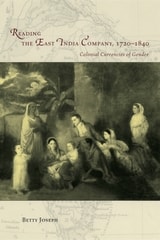
Reading the East India Company 1720-1840
Colonial Currencies of GenderBetty Joseph
University of Chicago Press, 2003
Drawing on the British East India Company's records as well as novels, memoirs, portraiture and guidebooks, Joseph shows how the company's economic and archival practices intersected to produce colonial "fictions" or "truth-effects" that strictly governed class and gender roles—in effect creating a "grammar of power" that kept the far-flung empire intact. And while women were often excluded from this archive, Joseph finds that we can still hear their voices at certain key historical junctures. Attending to these voices, Joseph illustrates how the writing of history belongs not only to the colonial project set forth by British men, but also to the agendas and mechanisms of agency—of colonized Indian, as well as European women. In the process, she makes a valuable and lasting contribution to gender studies, postcolonial theory, and the history of South Asia.
Recasting Women
Essays in Indian Colonial HistorySangari, Kumkum
Rutgers University Press, 1990
The political and social life of India in the last decade has given rise to a variety of questions concerning the nature and resilience of patriarchal systems in a transitional and post-colonial society. The contributors to this interdisciplinary volume recognize that every aspect of reality is gendered, and that such a recognition involves a dismantling of the ideological presuppositions of the so-called gender neutral ideologies, as well as the boundaries of individual disciplines.
The first set of essays seeks to analyze the patriarchal discourses of a colonial society and includes an analysis of the shaping of Hindu-Aryan identity, the parameters of the discourse on widow-immolation, the "defeminization" of popular culture in nineteenth-century urban Calcutta, the nature of the reforms proposed by early women's journals in Hindi, and the implications of the nationalist movement and of Indo-Anglian leterature on middle-class patriarchal norms.
The second set of articles relates to women of the productive classes--the reconstitution of patriarchies in the agrarian transition in Haryana, in the Oudh peasant movement, in the armed peasant struggle in Telangana, and among the working class in Bengal. The contributors explore the interrelation of patriarchies with political economy, law, religion, and culture, and suggest a different history of "reform" movements, and of class and gender relations.
Recasting Women
Essays in Indian Colonial HistorySangari, Kumkum
Rutgers University Press, 1990
The political and social life of India in the last decade has given rise to a variety of questions concerning the nature and resilience of patriarchal systems in a transitional and post-colonial society. The contributors to this interdisciplinary volume recognize that every aspect of reality is gendered, and that such a recognition involves a dismantling of the ideological presuppositions of the so-called gender neutral ideologies, as well as the boundaries of individual disciplines.
The first set of essays seeks to analyze the patriarchal discourses of a colonial society and includes an analysis of the shaping of Hindu-Aryan identity, the parameters of the discourse on widow-immolation, the "defeminization" of popular culture in nineteenth-century urban Calcutta, the nature of the reforms proposed by early women's journals in Hindi, and the implications of the nationalist movement and of Indo-Anglian leterature on middle-class patriarchal norms.
The second set of articles relates to women of the productive classes--the reconstitution of patriarchies in the agrarian transition in Haryana, in the Oudh peasant movement, in the armed peasant struggle in Telangana, and among the working class in Bengal. The contributors explore the interrelation of patriarchies with political economy, law, religion, and culture, and suggest a different history of "reform" movements, and of class and gender relations.

Recovering Subversion
Feminist Politics beyond the LawNivedita Menon
University of Illinois Press, 2004
Is the language of rights enough to foster real social and political change? Nivedita Menon explores the relationship between law and feminist politics by examining the contemporary Indian women's movement with comparisons to France and the United States. She argues that the intersection of feminist politics, law, and the state often paradoxically and severely distorts important ethical and emancipatory impulses of feminism.
Menon reviews historical challenges to the liberal notion of rights from Marxist, feminist, postcolonial, and critical legal scholars, and analyzes current Indian debates on topics including abortion, sexual violence, and Parliamentary quotas for women. Far from being a call to withdraw from the arena of law, Recovering Subversion instead urges feminists everywhere to recognize the limits of "rights discourse" and pleads for a politics that goes beyond its boundaries.
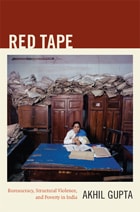
Red Tape
Bureaucracy, Structural Violence, and Poverty in IndiaAkhil Gupta
Duke University Press, 2012
Gupta conducted ethnographic research among officials charged with coordinating development programs in rural Uttar Pradesh. Drawing on that research, he offers insightful analyses of corruption; the significance of writing and written records; and governmentality, or the expansion of bureaucracies. Those analyses underlie his argument that care is arbitrary in its consequences, and that arbitrariness is systematically produced by the very mechanisms that are meant to ameliorate social suffering. What must be explained is not only why government programs aimed at providing nutrition, employment, housing, healthcare, and education to poor people do not succeed in their objectives, but also why, when they do succeed, they do so unevenly and erratically.
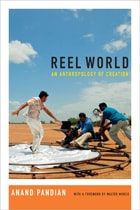
Reel World
An Anthropology of CreationAnand Pandian
Duke University Press, 2015
Reimagining Indian Secularism
Rajeev Bhargava
Seagull Books, 2023
What is unique about Indian secularism? In this book, Rajeev Bhargava argues that secularism in India, as opposed to in the West, did not arise in a society that had already been religiously homogenized, where the need of the hour was to break the political nexus between church and state. In India, secularism does not demand that the state is against or indifferent to religion, but rather that it combat institutionalized religious domination, both between and within religions. Apathy or antipathy to religion, Bhargava points out, would foment inter-religious rivalries that intensify anti-reformist tendencies, fueling further division.
As secularism receives daily ridicule in India, Bhargava provides an account of how this “principled distance” from religion has been a victim of misunderstandings by its proponents, abuse by its practitioners, and deliberate distortion by its opponents. Reimagining Indian Secularism offers a proposal of how we might one day be able to rehabilitate secularism.
Remaking the Citizen for New Times
History, Pedagogy and the Amar Chitra KathaDeepa Sreenivas
Seagull Books, 2024
How does orthodoxy maintain its power over culture? In Remaking the Citizen for New Times, Deepa Sreenivas explores how the Amar Chitra Katha, a widely read comic series started in 1967 in India, influenced the historical and national consciousness of young readers in a conservative direction. Tacitly blaming Nehruvian welfarism of the time for the moral decline of the nation, the Amar Chitra Katha emerged as a literary articulation of the Indian right’s Hindu-nationalist ideology in a modern, bourgeois guise. To renew Hindutva hegemony, the comic series gave orthodox ideas a new sheen, both in its form and content, merging Western comic styles with Indian visual storytelling traditions on the one hand, and combining mythological characters with political figureheads into harmonious narratives on the other—making it difficult to sift history from myths and legends. Sreenivas deftly argues that these mythological-political tales emphasized the instructive rather than the informative potential of history, encouraging neoliberal values such as merit and hard work while ignoring caste or class as systemic issues.
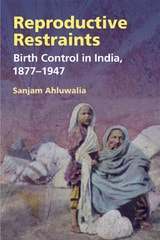
Reproductive Restraints
Birth Control in India, 1877-1947Sanjam Ahluwalia
University of Illinois Press, 2007
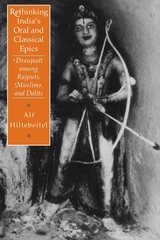
Rethinking India's Oral and Classical Epics
Draupadi among Rajputs, Muslims, and DalitsAlf Hiltebeitel
University of Chicago Press, 1999
Using his own fieldwork as a starting point, Alf Hiltebeitel analyzes how the oral tradition of the south Indian cult of the goddess Draupadi and five regional martial oral epics compare with one another and tie in with the Sanskrit epics. Drawing on literary theory and cultural studies, he reveals the shared subtexts of the Draupadi cult Mahabharata and the five oral epics, and shows how the traditional plots are twisted and classical characters reshaped to reflect local history and religion. In doing so, Hiltebeitel sheds new light on the intertwining oral traditions of medieval Rajput military culture, Dalits ("former Untouchables"), and Muslims.
Breathtaking in scope, this work is indispensable for those seeking a deeper understanding of South Asia's Hindu and Muslim traditions.
This work is the third volume in Hiltebeitel's study of the Draupadi cult. Other volumes include Mythologies: From Gingee to Kuruksetra (Volume One), On Hindu Ritual and the Goddess (Volume Two), and Rethinking the Mahabharata (Volume Four).
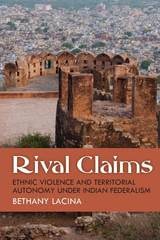
Rival Claims
Ethnic Violence and Territorial Autonomy under Indian FederalismBethany Lacina
University of Michigan Press, 2017
Using new data on ethnicity and sub-national discrimination in India, national and state archives, parliamentary records, cross-national analysis and her original fieldwork, Lacina explains ethnoterritorial politics as a three-sided interaction of the center and rival interests in the periphery. Ethnic entrepreneurs use militancy to create national political pressure in favor of their goals when the prime minister lacks clear electoral reasons to court one regional group over another. Second, ethnic groups rarely win autonomy or mobilize for violence in regions home to electorally influential anti-autonomy interests. Third, when a regional ethnic majority is politically important to the prime minister, its leaders can deter autonomy demands within their borders, while actively discriminating against minorities.
Rival Claims challenges the conventional beliefs that territorial autonomy demands are a reaction to centralized power and that governments resist autonomy to preserve central prerogatives. The center has allegiances in regional politics, and ethnoterritorial violence reflects the center’s entanglement with rival interests in the periphery.
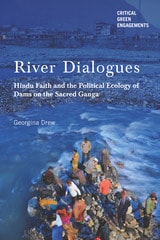
River Dialogues
Hindu Faith and the Political Ecology of Dams on the Sacred GangaGeorgina Drew
University of Arizona Press, 2017
India’s sacred Ganga River is arguably one of the most iconic sites for worship, with a continuity of rituals for the living and the dead that span over two millennia. Along the river, from high in the Himalaya to the vast plains below, people gather daily to worship the Ganga through prayer and song. But large government-sponsored dams threaten to upend these practices.
In River Dialogues, Georgina Drew offers a detailed ethnographic engagement with the social movements contesting hydroelectric development on the Ganga. The book examines the complexity of the cultural politics that, on the one hand, succeeded in influencing an unprecedented reversal of government plans for three contested hydroelectric projects, and how, on the other hand, this decision sparked ripples of discontent after being paired with the declaration of a conservation zone where the projects were situated.
The book follows the work of women who were initially involved in efforts to stop the disputed projects. After looking to their discourses and actions, Drew argues for the use of a political ecology analysis that incorporates the everyday practice and everyday religious connections that animated the cultural politics of development. Drew offers a nuanced understanding of the struggles that communities enact to assert their ways of knowing and caring for resources that serves as an example for others critically engaging with the growing global advocacy of the “green economy” model for environmental stewardship.
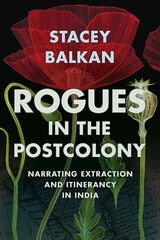
Rogues in the Postcolony
Narrating Extraction and Itinerancy in IndiaStacey Balkan
West Virginia University Press, 2022
Rogues in the Postcolony is a study of Anglophone Indian picaresque novels that dramatize the impacts of extractive capitalism and colonial occupation on local communities in several Indian states. In this materialist history of development on the subcontinent, Stacey Balkan considers works by Amitav Ghosh, Indra Sinha, and Aravind Adiga that critique violent campaigns of enclosure and dispossession at the hands of corporate entities like the English East India Company and its many legatees. By foregrounding the intersections among landscape ideology, agricultural improvement, extractive capitalism, and aesthetic expression, Rogues in the Postcolony also attends to the complicity of popular aesthetic forms with political and economic policy, as well as the colonial and extractivist logics that often frame discussions around the so-called Anthropocene epoch.
Bringing together questions about settler-colonial practices and environmental injustice, Rogues in the Postcolony concludes with an investigation of new extractivist frontiers, including solar capitalism, and considers the possibility of imagining life after extraction on the Indian subcontinent and beyond.
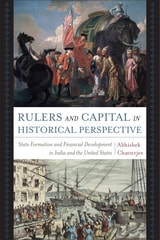
Rulers and Capital in Historical Perspective
State Formation and Financial Development in India and the United StatesAbhishek Chatterjee
Temple University Press, 2017
Rulers and Capital in Historical Perspective explains why modern banking and credit systems emerged in the nineteenth century only in certain countries that then subsequently industrialized and became developed.
Tracing the contemporaneous cases of India and the United States over time, Abhishek Chatterjee identifies the factors that were crucial to the development and regulation of a modern banking and credit system in the United States during the first third of the nineteenth century. He contrasts this situation with India’s, where the state never formally incorporated a sophisticated private credit system, and thus relegated it to the sphere of the informal economy.
Chatterjee identifies certain features in both societies, often—though not always—associated with colonialism, that tended to restrict the formation of modern institutionalized money and credit markets. Rulers and Capital in Historical Perspective demonstrates thatnotwithstanding the many other differences between the North American colonies (prior to independence), and India, the same facets of their relationships with Great Britain prevented the emergence of a modern banking system in the two respective societies.
Running on Hope
Female Community Health Labor in Rajasthan, IndiaSvea Closser and Surendra Singh Shekhawat
Vanderbilt University Press, 2025
This book is freely available in an open-access edition thanks to the generous support of Johns Hopkins University.
Throughout India, Accredited Social Health Activists (ASHAs) visit households in their communities to deliver essential health services and link community members with key health benefits. Like many other female Community Health Workers across the world, ASHAs are often portrayed as virtuous, passive volunteers, selflessly providing services to their neighbors.
The reality is more complicated and much more interesting. Drawing on ethnographic work in Rajasthan, Running on Hope follows ASHAs through striking personal transformations. From their positions as rural daughters‑in‑law—a particularly low‑power position in Rajasthan—ASHAs have, over years of work, gained unprecedented autonomy for young rural women. They have also gained a deep understanding of what many argue is the exploitation involved in their low‑ranking position in the health system. ASHAs often earn less than $100 per month for extensive work, well below the legal minimum wage.
To counter this, many ASHAs have joined unions—an endeavor that has ultimately proven disappointing: union leaders’ desires for political advancement are often at odds with ASHAs’ own needs. However, ASHAs do not have connections, money, or social power to organize effectively on their own, without a political patron. In Running on Hope, authors Svea Closser and Surendra Singh Shekhawat interview women who work as ASHAs to learn about their organizing goals, their roles in their community as conduits to health education and resources, and their hopes for a better future.