Results by title
200 books match the query 'Indians of Mexico' and 10 start with r
Racial Alterity, Wixarika Youth Activism, and the Right to the Mexican City
Diana Negrín
University of Arizona Press, 2019
This book examines the legacy of the racial imaginary in Mexico with a focus on the Wixarika (Huichol) Indigenous peoples of the western Sierra Madre from the colonial period to the present. Through an examination of the politics of identity, space, and activism among Wixarika university students living and working in the western Mexican cities of Tepic and Guadalajara, geographer Diana Negrín analyzes the production of racialized urban geographies and reveals how Wixarika youth are making claims to a more heterogeneous citizenship that challenges these deep-seated discourses and practices. Through the weaving together of historical material, critical interdisciplinary scholarship, and rich ethnography, this book sheds light on the racialized history, urban transformation, and contemporary Indigenous activism of a region of Mexico that has remained at the margins of scholarship.
Reassessing the Aztatlán World
Ethnogenesis and Cultural Continuity in Northwest MesoamericaEdited by Michael D. Mathiowetz and John M. D. Pohl
University of Utah Press, 2024
Volume contributors show how those responsible for the Aztatlán tradition were direct ancestors of diverse Indigenous peoples such as the Náayeri (Cora), Wixárika (Huichol), O’dam (Tepehuan), Caz’ Ahmo (Caxcan), Yoeme (Yaqui), Yoreme (Mayo), and others who continue to reside across the former Aztatlán region and its frontiers. The prosperity of the Aztatlán tradition was achieved through long-distance networks that fostered the development of new ritual economies and integrated peoples in Greater Mesoamerica with those in the U.S. Southwest/Mexican Northwest.
Red Medicine
Traditional Indigenous Rites of Birthing and HealingPatrisia Gonzales
University of Arizona Press, 2012
Patrisia Gonzales addresses "Red Medicine" as a system of healing that includes birthing practices, dreaming, and purification rites to re-establish personal and social equilibrium. The book explores Indigenous medicine across North America, with a special emphasis on how Indigenous knowledge has endured and persisted among peoples with a legacy to Mexico. Gonzales combines her lived experience in Red Medicine as an herbalist and traditional birth attendant with in-depth research into oral traditions, storytelling, and the meanings of symbols to uncover how Indigenous knowledge endures over time. And she shows how this knowledge is now being reclaimed by Chicanos, Mexican Americans and Mexican Indigenous peoples.
For Gonzales, a central guiding force in Red Medicine is the principal of regeneration as it is manifested in Spiderwoman. Dating to Pre-Columbian times, the Mesoamerican Weaver/Spiderwoman—the guardian of birth, medicine, and purification rites such as the Nahua sweat bath—exemplifies the interconnected process of rebalancing that transpires throughout life in mental, spiritual and physical manifestations. Gonzales also explains how dreaming is a form of diagnosing in traditional Indigenous medicine and how Indigenous concepts of the body provide insight into healing various kinds of trauma.
Gonzales links pre-Columbian thought to contemporary healing practices by examining ancient symbols and their relation to current curative knowledges among Indigenous peoples. Red Medicine suggests that Indigenous healing systems can usefully point contemporary people back to ancestral teachings and help them reconnect to the dynamics of the natural world.
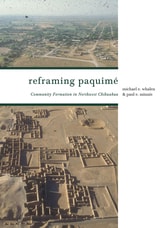
Reframing Paquimé
Community Formation in Northwest ChihuahuaMichael E. Whalen and Paul E. Minnis
University of Arizona Press, 2025
Reframing Paquimé: Community Formation in Northwest Chihuahua is a groundbreaking reinterpretation of the Casas Grandes region by scholars Michael E. Whalen and Paul E. Minnis. This final installment in their comprehensive study challenges the dominant view of Paquimé as a hierarchical society founded by outsiders, presenting instead a compelling case for a largely locally organized society with Mesoamerican and Puebloan characteristics. Drawing on twenty-five years of extensive survey and excavation data, the authors offer a fresh perspective that reframes our understanding of this remarkable archaeological site.
Whalen and Minnis bring forth significant new data that illuminates the cultural and ecological history of Paquimé and its neighboring communities. The book features more than fifty new radiocarbon dates, hundreds of analyzed archaeobotanical and faunal samples, plus tens of thousands of other artifacts. The data reveal a network of settlements characterized by corporate and ritual-based authority, challenging traditional models of the center’s rise, collapse, and subsequent regional abandonment and arguing that aspects of the Paquimé culture continued to exist up to the Spanish Colonial period.
Reframing Paquimé is poised to become an essential reference for archaeologists interested in Northwest Mexico and the U.S. Southwest. By addressing the complex dynamics of community formation and dissolution, Whalen and Minnis provide invaluable insights that will ignite scholarly debate and inspire future research. This meticulously researched volume, authored by leading experts with decades of fieldwork experience, is a vital addition to any collection on the archaeology and ethnobotany of ancient North American societies.
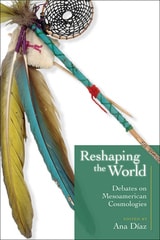
Reshaping the World
Debates on Mesoamerican CosmologiesAna Díaz
University Press of Colorado, 2019
By reanalyzing and recontextualizing both indigenous and colonial texts and imagery in nine case studies examining Maya, Zapotec, Nahua, and Huichol cultures, the contributors discuss and challenge the commonly accepted notion that the cosmos was a static structure of superimposed levels unrelated to and unaffected by historical events and human actions. Instead, Mesoamerican cosmology consisted of a multitude of cosmographic repertoires that operated simultaneously as a result of historical circumstances and regional variations. These spaces were, and are, dynamic elements shaped, defined, and redefined throughout the course of human history. Indigenous cosmographies could be subdivided and organized in complex and diverse arrangements—as components in a dynamic interplay, which cannot be adequately understood if the cosmological discourse is reduced to a superposition of nine and thirteen levels.
Unlike previous studies, which focus on the reconstruction of a pan-Mesoamerican cosmological model, Reshaping the World shows how the movement of people, ideas, and objects in New Spain and neighboring regions produced a deep reconfiguration of Prehispanic cosmological and social structures, enriching them with new conceptions of space and time. The volume exposes the reciprocal influences of Mesoamerican and European theologies during the colonial era, offering expansive new ways of understanding Mesoamerican models of the cosmos.
Contributors:
Sergio Botta, Ana Díaz, Kerry Hull, Katarzyna Mikulska, Johannes Neurath, Jesper Nielsen, Toke Sellner Reunert†, David Tavárez, Alexander Tokovinine, Gabrielle Vail
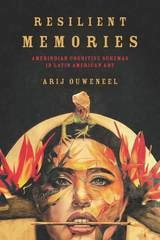
Resilient Memories
Amerindian Cognitive Schemas in Latin American ArtArij Ouweneel
The Ohio State University Press, 2018
Exploring works ranging in popularity, from Alfonso Cuarón’s Y Tu Mamá También to the paintings of Peruvian artists Claudia Coca and Jorge Miyagui, and from Mexican Zapatistas to hip-hop, Ouweneel details the ways in which artists interact with the embodied memory of the community but also assert their own place within it as crucial, furthering their audiences’ understanding of and interaction with existing cultural schemas. In this way, Ouweneel shows that memories must serve the present or they will be forgotten.
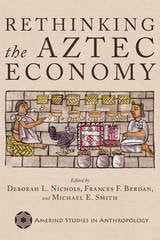
Rethinking the Aztec Economy
Edited by Deborah L. Nichols, Frances F. Berdan, and Michael E. Smith
University of Arizona Press, 2017
With its rich archaeological and historical record, the Aztec empire provides an intriguing opportunity to understand the dynamics and structure of early states and empires. Rethinking the Aztec Economy brings together leading scholars from multiple disciplines to thoroughly synthesize and examine the nature of goods and their movements across rural and urban landscapes in Mesoamerica. In so doing, they provide a new way of understanding society and economy in the Aztec empire.
The volume is divided into three parts. Part 1 synthesizes our current understanding of the Aztec economy and singles out the topics of urbanism and provincial merchant activity for more detailed analysis. Part 2 brings new data and a new conceptual approach that applies insights from behavioral economics to Nahua and Aztec rituals and social objects. Contributors also discuss how high-value luxury goods, such as feather art, provide insights about both economic and sacred concepts of value in Aztec society. Part 3 reexamines the economy at the Aztec periphery. The volume concludes with a synthesis on the scale, integration, and nature of change in the Aztec imperial economy.
Rethinking the Aztec Economy illustrates how superficially different kinds of social contexts were in fact integrated into a single society through the processes of a single economy. Using the world of goods as a crucial entry point, this volume advances scholarly understanding of life in the Aztec world.
Contributors:
Frances F. Berdan
Laura Filloy Nadal
Janine Gasco
Colin Hirth
Kenneth G. Hirth
Sarah Imfeld
María Olvido Moreno Guzmán
Deborah L. Nichols
Alan R. Sandstrom
Pamela Effrein Sandstrom
Michael E. Smith
Barbara L. Stark
Emily Umberger
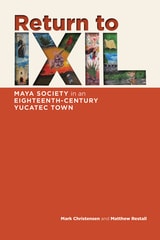
Return to Ixil
Maya Society in an Eighteenth-Century Yucatec TownMark Z. Christensen
University Press of Colorado, 2019
Supplemented with additional archival research, the wills provide new and detailed descriptions of various aspects of life in eighteenth-century Ixil. In each chapter, authors Mark Christensen and Matthew Restall examine a different dimension of Ixil’s colonial history, including the role of notaries, Maya participation in a coastal militia, economy and modes of production, religious life and records, and the structures and patterns of familial relationships. These details offer insight into the complex network of societies in colonial Yucatan, colonial Mesoamerica, and colonial Latin America.
Including an appendix presenting the original Maya texts as well as translations by Christensen and Restall, Return to Ixil not only analyzes the largest body of substantive wills in any Mayan language known today but also provides a rare closeup view of the inner workings of a colonial Maya town and the communal and familial affairs that made up a large part of the Maya colonial experience. It will be of great interest to Mayanists as well as to students and scholars of history, anthropology, ethnohistory, linguistics, and social history.
The publication of this book is supported in part byBrigham Young University and Penn State University.
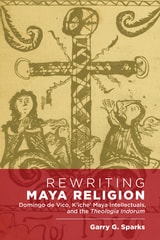
Rewriting Maya Religion
Domingo de Vico, K’iche’ Maya Intellectuals, and the Theologia IndorumGarry G. Sparks
University Press of Colorado, 2019
Centered on the specific work of Dominicans among the Highland Maya of Guatemala in the decades prior to the arrival of the Catholic Reformation in the late sixteenth century, the book focuses on the various understandings of religious analyses—Hispano-Catholic and Maya—and their strategic exchanges, reconfigurations, and resistance through competing efforts of religious translation. Sparks historically contextualizes Vico’s theological treatise within both the wider set of early literature in K’iche’an languages and the intellectual shifts between late medieval thought and early modernity, especially the competing theories of language, ethnography, and semiotics in the humanism of Spain and Mesoamerica at the time.
Thorough and original, Rewriting Maya Religion serves as an ethnohistorical frame for continued studies on Highland Maya religious symbols, discourse, practices, and logic dating back to the earliest documented evidence. It will be of great significance to scholars of religion, ethnohistory, linguistics, anthropology, and Latin American history.
Rudo Ensayo
A Description of Sonora and Arizona in 1764Juan Nentvig; Translated, Clarified, and Annotated by Alberto Francisco Pradeau and Robert R. Rasmussen
University of Arizona Press, 1980