Results by title
55 books match the query 'Individual Architects & Firms' and 3 start with r
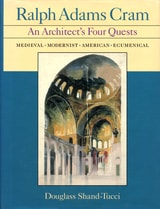
Ralph Adams Cram
An Architect's Four QuestsDouglass Shand-Tucci
University of Massachusetts Press, 2005
With his partner Bertram Goodhue, Cram won a number of important commissions, beginning with the West Point competition in 1903. Although an increasingly bitter rivalry with Goodhue would lead to the dissolution of their partnership in 1912, Cram had already begun to strike out on his own. Supervising architect at Princeton, consulting architect at Wellesley, and head of the MIT School of Architecture, he would also design most of New York's Cathedral of St. John the Divine and the campus of Rice University, as well as important church and collegiate structures throughout the country. By the 1920s Cram had become a household name, even appearing on the cover of Time magazine.
A complex man, Cram was a leading figure in what Shand-Tucci calls "a full-fledged homosexual monastery" in England, while at the same time married to Elizabeth Read. Their relationship was a complicated one, the effect of which on his children and his career is explored fully in this book. So too is his work as a religious leader and social theorist.
Shand-Tucci traces the influence on Cram of such disparate figures as Franklin Delano Roosevelt, Phillips Brooks, Henry Adams, and Ayn Rand. He divides Cram's career into four lifelong "quests": medieval, modernist, American, and ecumenical. Some quests may have failed, but in each he left a considerable legacy, ultimately transforming the visual image of American Christianity in the twentieth century.
Handsomely illustrated with over 130 photographs and drawings and eight pages of color plates, Ralph Adams Cram can be read on its own or in conjunction with Boston Bohemia, 1881–1900. Together, the two volumes complete what the Christian Century has described as a "superbly researched and captivating biography."
Rethinking the Pavilion
Shared Experience at the Vajrasana Buddhist Retreat CentreCindy Walters
University College London, 2026
A London-based architect offers a self-reflexive account of a communal building they designed in rural Britain.
Rethinking the Pavilion comprehensively investigates one unique project by Walters & Cohen Architects, the Vajrasana Buddhist Retreat Centre in rural Suffolk, completed in 2018. The book describes how shared experience defines a new way of working towards an architecture that rediscovers and enriches its communal purpose. In addition to setting out a theoretical framework that examines the architectural history and theory of pavilions, the book provides a complex discussion of the details and meanings of the design research process itself.

Robert de Cotte and the Perfection of Architecture in Eighteenth-Century France
Robert Neuman
University of Chicago Press, 1994
After describing de Cotte's training and the professional context in which he worked, Neuman offers a thorough survey of de Cotte's output. For each commission, he recreates the actual design process, showing how de Cotte manipulated an accepted vocabulary of architectural forms to meet the patron's specific requirements. De Cotte's own drawings, many reproduced here for the first time, and quotations from a wide variety of contemporary writings vividly supplement the case histories. Beautifully illustrated, Neuman's much-needed book reveals de Cotte as an innovative and strikingly modern architect.