Results by title
220 books match the query 'Individual Artists' and 10 start with r
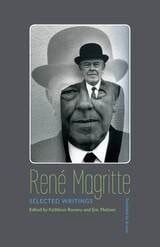
René Magritte
Selected WritingsRené Magritte
University of Minnesota Press, 2016
Available for the first time in an English translation, this selection of René Magritte’s writings gives non-Francophone readers the chance to encounter the many incarnations of the renowned Belgian painter—the artist, the man, the aspiring noirist, the fire-breathing theorist—in his own words. Through whimsical personal letters, biting apologia, appreciations of fellow artists, pugnacious interviews, farcical film scripts, prose poems, manifestos, and much more, a new Magritte emerges: part Surrealist, part literalist, part celebrity, part rascal.While this book is sure to appeal to admirers of Magritte’s art and those who are curious about his personal life, there is also much to delight readers interested in the history and theory of art, philosophy and politics, as well as lovers of creativity and the inner workings of a probing, inquisitive mind unrestricted by genre, medium, or fashion.
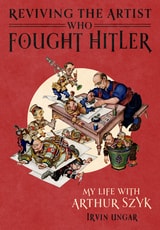
Reviving the Artist Who Fought Hitler
My Life with Arthur SzykIrvin Ungar
University of Texas Press, 2026
The intertwining story of a noted anti-Nazi artist and the former rabbi who revived his reputation.
During World War II, the Polish-Jewish immigrant Arthur Szyk became America’s leading anti-Nazi artist. His art was so effective that Adolf Hitler reportedly put a bounty on his head while the US military declared him a “citizen-soldier” of the free world. Szyk steadfastly fought for the rescue of European Jewry during the Holocaust, creating artworks like De Profundis, which imagines Jesus sharing the suffering of countless lifeless Jews. His civil rights art challenged segregation and his illuminated Declaration of Independence resides in the Library of Congress. Szyk’s masterwork, an illustrated Passover Haggadah, is considered by many to be one of the most beautiful books ever produced by human hands.
Once world-famous, Arthur Szyk was all but forgotten after his death in 1951. Reviving the Artist Who Fought Hitler recounts Irvin Ungar's decades-long journey to restore Szyk to public consciousness, and become the principal collector, dealer, scholar, and promoter of Szyk’s art in the United States, Europe, and Israel. Richly illustrated and full of forgotten history, this memoir is an inspiring story of artistic passion and an invitation to commune with a heroic advocate for all humanity.
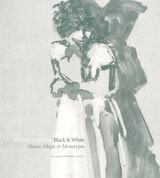
Richard Segalman Black & White
Muses, Magic & MonotypesRichard Segalman
The Artist Book Foundation, 2015
For many, the name Richard Segalman conjures up a vision of light-infused paintings of women gathered on a beach, gazing out the window of a New York City brownstone, or dressed in vcostumes from another era. But just as Edgar Degas, approaching his 60th year, surprised gallery goers with an exhibition not of ballerinas or race horses, but of highly atmospheric monotype landscapes, so too does Segalman surprise us with this exceptional collection of monotypes he began to produce in 1993, at nearly 60. "I reached a sort of plateau and needed a new direction," says the artist. "I came across a monotype... took a course... made one and I was hooked."
The significance of Segalman's shift into this medium is most powerfully conveyed through his arresting black-and-white prints that range from anonymous crowds on Coney Island beaches or New York City streets to a solitary figure in private contemplation. This monochromatic focus makes perfect sense: Segalman's first gallery appearance in New York—a sold-out show that gave him the courage to embrace the life of an artist—consisted entirely of black-and-white charcoal drawings, several stunning examples of which open this book.
Author Susan F. Castle's essay about the artist and his muses—the people, places, and things for which Richard Segalman has an abiding love—illuminates the exceptional work collected for this monograph. She combines excerpts from interviews with the artist and the three master printmakers with whom he has worked in Woodstock and Brooklyn, New York, and in Santa Fe, New Mexico. In addition, Anthony Kirk's insightful introudction provides an essential historical perspective on the artist and his printmaking process.
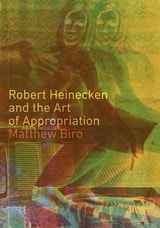
Robert Heinecken and the Art of Appropriation
Matthew Biro
University of Minnesota Press, 2022
The first comprehensive study of the artist Robert Heinecken and his critical views on the culture of mass media
This is the first book-length study dedicated to the artist Robert Heinecken, whose innovative photographic practices sought to interrogate how mass media imagery facilitated the construction of individual and collective identities. Appropriating, rephotographing, and layering pictures culled from newspapers, advertisements, pornography, and television, Heinecken recombined and transformed the ubiquitous images of mass culture to encourage viewers to critically reflect on their sense of self.
From the 1960s through the late 1990s, Heinecken’s controversial art continually challenged inherited ideas around consumerism, the facticity of reportage, and visual culture’s relationship to gender and identity politics. Embodying the evolution of contemporary art toward increasingly hybrid and conceptual approaches, his oeuvre includes examples of painting, sculpture, photomontage, performance, installation, time-based media, and artist’s books, all of which collectively exploit photography’s reproducibility to subvert society’s dominant ideologies and stereotypical modes of representation.
Author Matthew Biro presents an exhaustive look at Heinecken’s life and art, locating him within a lineage that encompasses the activities of the early twentieth-century avant-gardes and the postmodern strategies of the Pictures Generation artists. Assessing his career within the specific political and historical contexts from which he gleaned his material, and illustrated throughout with vibrant full-color reproductions of his art, this in-depth examination demonstrates Robert Heinecken’s significance as a key figure of twentieth-century art and an incisive commentator on modern life in America.
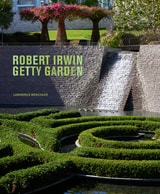
Robert Irwin Getty Garden
Lawrence Weschler
J. Paul Getty Trust, The, 2020
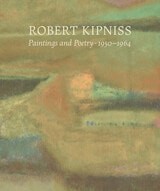
Robert Kipniss
Paintings and Poetry, 1950–1964Robert Kipniss
The Artist Book Foundation, 2013
A comprehensive look at a memorable period in the celebrated painter and printmaker's life and career, Robert Kipniss: Paintings and Poetry, 1950–1964 is the result of his many arduous months revisiting his more-than-half-a-century-ago writings and peoms that were stashed away and essentially forgotten. "Some of the poems are straightforward, some are infused with surreal irony, and some are angry," says Kipniss in his candid and honest preface. Thoughtful and articulate from conception to completion, his never-before-published poems are choreographed with his early paintings in this monograph's contemplation of these influential and foundational fourteen years. "When I stopped writing [in 1961] my vision was no longer divided between word-thinking and picture-thinking: these approaches had merged and in expressing myself I was more whole," reflects Kipniss in his retrospective musings.
This written and visual account of previously unpublished poems and critically acclaimed early paintings includes two astute and illustrative essays that further engage the reader in the evolution of the artist's prolific oeuvre. His prints, drawings, and paintings are remarkable for their eloquence and refinement, earning him international recognition for his expansive landscapes and small town vistas, as well as quiet interors and intimate still lifes.
Readers of this seminal volume are all the richer for catching a glimpse of an intensely personal segment of this accomplished artist's private history. In an unambiguous assessment, Kipniss elaborates, "The most significant insight that arose in this undertaking...came when I began to collate reproductions of my paintings of the 1950s. I could clearly see that my work in the two mediums were from very differing parts of my psyche, and that while they were both in themselves completely engaged, they were not in any way together."
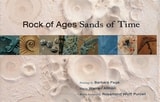
Rock of Ages, Sands of Time
Paintings by Barbara Page, Text by Warren AllmonBarbara Page and Warren D. Allmon
University of Chicago Press, 2001
These are just a few scenes from the magnificent drama that unfolds in glorious full color and three-dimensional texture in Rock of Ages, Sands of Time. Each of Barbara Page's 544 contiguous painted panels represents a million years of the history of life on earth, with fossil plants and animals depicted at the same scale and in association with each other just as they might be found by a paleontologist in the field. A muted rainbow of background colors evoke the rocks in which the fossils were found—the Texas Red Beds, for instance, or the yellow Solnhofen limestone—and keystone events are shown metaphorically, with fat rolls of paint marking major extinctions or continental drift.
To fully experience the awesome impact of an eon's worth of time spread across 500 feet of bas-relief panels, you'd have to visit the Museum of the Earth in Ithaca, New York, where Page's specially commissioned work will be installed when the museum opens in 2002. But this book is the next best thing. Not only does it contain crisp color reproductions of each painting, but it also includes an accessible essay from paleontologist Warren Allmon giving the scientific context behind the art.
For fossil lovers of all ages, and anyone interested in the merging of art and science, Rock of Ages, Sands of Time will be the find of a lifetime.
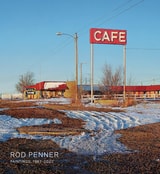
Rod Penner
Paintings, 1987–2022Rod Penner
The Artist Book Foundation, 2022
Rod Penner infuses his photorealistic paintings of the American southwest with a cinematic quality in the first major monograph on this contemporary realist artist.
The abandoned and forgotten landscapes of rural southwestern towns are the favored subjects of Rod Penner's paintings. His deft use of contrasts in his images—despondency and hope, isolation and nostalgia—evokes memories of The Last Picture Show and elicits complex responses from viewers. "I'm interested in the look of things and the quality of being there," he says. "A moment that is completely frozen with all the variety of textures; rust on poles, crumbling asphalt, light hitting the grass."
Penner's works are based on his photographs, digital video stills, and his experience of the rural landscapes of Texas and New Mexico. He depicts desolate, often deserted locations, the character of old houses and abandoned buildings, weather, and unique geography. His chosen scenes are infused with a cinematic quality that is the result of the exquisite light that he captures with his meticulous process. "The finished paintings should evoke contrasting responses of melancholy and warmth, desolation and serenity," he says.
Penner's hyperrealistic technique meticulously records both the iconic imagery and the beauty in the ashes of these once-prosperous streets and nighborhoods that still endure. The incredible poignant scenes evoke a universalism, a collective experience seen through the lens of Americana. "You won't find any hidden or overt socio-political meaning in my work and at the same time I hope that by utilizing what I find in the American landscape I'm able to connect to viewers on a deeper psychological level."
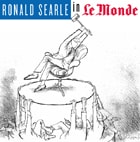
Ronald Searle in Le Monde
Ronald Searle
University of Chicago Press, 2002
Since 1995, Searle has plied his sardonic trade on the coveted op-ed pages of the French daily newspaper Le Monde. This book presents more than a hundred of the best of these cartoons, ranging across politics, the new Europe, the nature of the contemporary economy, social games, and various "angels," both benign and mischievous. Whether skewering the greed of the rich with images of men in suits padding each other's pockets with cash or conducting business under the table, or making a poignant comment about how much harder peace has to work than war to stay in the same place, Searle displays the same pungent, incisive, yet infinitely humane wit. The deceptive simplicity of his lines and shadings combine with meticulously observed details of dress, background, and facial expression to produce arresting images that convey his messages powerfully and beautifully.
By turns delightful, amusing, and disturbing, but always deeply thought provoking, Searle's work reaches well beyond the specific occasion that inspired a given cartoon to illuminate key aspects of public life in the West at the end of the millennium. This book contains twenty-five illustrations not found in the French edition, together with a new preface for English-speaking readers written by Searle himself.
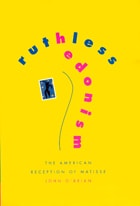
Ruthless Hedonism
The American Reception of MatisseJohn O'Brian
University of Chicago Press, 1999
In this ambitious study, John O'Brian argues that Matisse's sober presentations of himself were calculated to fit with the social constraints and ideological demands of the times. Matisse's strategy included cooperating with museums, cultivating private collectors, playing off dealers one against another, and reassuring the media that, whatever his reputation as an avant-gardist, the conduct of his life was solidly bourgeois.
Moving from the late 1920s, when Matisse's output was shedding its outlaw reputation, to the early 1950s, when his work was canonized, O'Brian shows how the way Matisse's work was viewed changed as attention shifted away from the seductiveness of his subject matter to the seductiveness of his paint. The art's resolute rejection of political concerns, its deployment of decorative design for visual satisfaction, and its representations of pleasure encouraged American audiences, who in the 1930s deemed the art disreputable, to celebrate its gratifications by the early years of the Cold War.
This intriguing, wide-ranging investigation of Matisse's self-promotion, America's uneasy embrace of modernism, and America's consumer culture and politics provides a rich context to Clement Greenberg's words published in the Nation in 1947: "Matisse's cold hedonism and ruthless exclusion of everything but the concrete, immediate sensation will in the future, once we are away from the present Zeitgeist, be better understood as the most profound mood of the first half of the twentieth century."