Results by title
50 books match the query 'Industrial Management' and 2 start with r
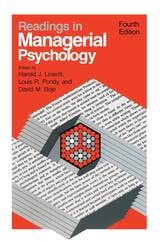
Readings in Managerial Psychology
Edited by Harold J. Leavitt, Louis R. Pondy, and David M. Boje
University of Chicago Press, 1988
With more than half the papers new to this book, the fourth edition of Readings in Managerial Psychology represents a substantial revision of this popular text. This edition focuses more than ever on the managing process, both within and between organizations, and such "soft" issues as managing creativity and imagination, managers' values and beliefs, and organizational culture play a larger role than they have before.
Readings in Managerial Psychology is designed for managers in business and industry, students of management, public and university administrators, and executives in other organizations. The collection can be used independently or as a companion volume to Harold J. Leavitt and Homa Bahrami's Managerial Psychology: Managing Behavior in Organizations (5th edition, 1988), also published by the University of Chicago Press.
Readings in Managerial Psychology is designed for managers in business and industry, students of management, public and university administrators, and executives in other organizations. The collection can be used independently or as a companion volume to Harold J. Leavitt and Homa Bahrami's Managerial Psychology: Managing Behavior in Organizations (5th edition, 1988), also published by the University of Chicago Press.
[more]
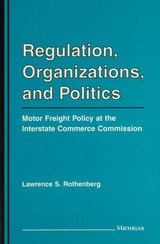
Regulation, Organizations, and Politics
Motor Freight Policy at the Interstate Commerce CommissionLawrence S. Rothenberg
University of Michigan Press, 1994
Regulation, Organizations, and Politics examines the evolution of regulation at the Interstate Commerce Commission (ICC). The ICC has probably had the most profound impact on any federal agency on the way social scientists view politics. From a perspective based in modern political economy, the author develops an analysis that improves our understanding of the determinants of bureaucratic performance and clarifies the conditions under which organizations are likely to have a substantial influence. Employing a variety of techniques, Regulation, Organizations, and Politics explains how motor carriers, particularly the larger truckers who controlled the American Trucking Association, were unable to control public policy once the chief executive decided to expand substantial political resources on reforming the motor carrier system. The author shows that this failure was rooted in the carriers' inability to offer the requisite rewards and sanctions required to influence those with power over the outcome. This work thus demonstrates that an integrated approach to the intersections of rational, if often incompletely informed, actors can help us to understand phenomena that seem puzzling at first consideration.
[more]