Results by title
124 books match the query 'Information technology' and 6 start with r
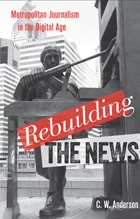
Rebuilding the News
Metropolitan Journalism in the Digital AgeC. W. Anderson
Temple University Press, 2013
Breaking down the walls of the traditional newsroom, Rebuilding the News traces the evolution of news reporting as it moves from print to online. As the business models of newspapers have collapsed, author C. W. Anderson chronicles how bloggers, citizen journalists, and social networks are implicated in the massive changes confronting journalism.
Through a combination of local newsroom fieldwork, social-network analysis, and online archival research, Rebuilding the News places the current shifts in news production in socio-historical context. Focusing on the Philadelphia Inquirer, the Philadelphia Daily News, Anderson presents a gripping case study of how these papers have struggled to adapt to emerging economic, social, and technological realities.
As he explores the organizational, networked culture of journalism, Anderson lays bare questions about the future of news-oriented media and its evolving relationship with “the public” in the digital age.

Reframing Failure in Digital Scholarship
Edited by Anna-Maria Sichani and Michael Donnay
University of London Press, 2025
Failure is ordinary. From technological failures and computational obsolescence to rejected applications and challenging collaborations, failure is an unavoidable part of any scholarly endeavor. This is especially true for digital scholarship, as the everyday risk of failure is compounded by the challenges of interdisciplinary research and the fragility of digital technology.
Reframing Failure in Digital Scholarship brings together a diverse, interdisciplinary, and international group of scholars and practitioners who each offer short personal and professional reflections on the failed, broken, or challenging aspects of scholarly practice. It provides a critical perspective on the ways institutional and material conditions are intractably linked to approaches to digital research and how those conditions differ within and across national contexts.
In creating a critical, constructive, and compassionate vocabulary for failure, this book normalizes failure as an object of inquiry, asking what value exists in failure in digital scholarship and how we can create the space to fail better.

Reinventing Reference
How Public, Academic, and School Libraries Deliver Value in the Age of GoogleVibiana Bowman Cvetkovic
American Library Association, 2014
Remembering and Forgetting in the Age of Technology
Teaching, Learning, and the Science of Memory in a Wired WorldMichelle D Miller
West Virginia University Press, 2022
Human minds are made of memories, and today those memories have competition. Biological memory capacities are being supplanted, or at least supplemented, by digital ones, as we rely on recording—phone cameras, digital video, speech-to-text—to capture information we’ll need in the future and then rely on those stored recordings to know what happened in the past. Search engines have taken over not only traditional reference materials but also the knowledge base that used to be encoded in our own brains. Google remembers, so we don’t have to. And when we don’t have to, we no longer can. Or can we?
Remembering and Forgetting in the Age of Technology offers concise, nontechnical explanations of major principles of memory and attention—concepts that all teachers should know and that can inform how technology is used in their classes. Teachers will come away with a new appreciation of the importance of memory for learning, useful ideas for handling and discussing technology with their students, and an understanding of how memory is changing in our technology-saturated world.
Responding to Rapid Change in Libraries
A User Experience ApproachLauren Stara and Callan Bignoli
American Library Association, 2020
In the face of rapid change and an ever-widening constellation of challenges, it’s crucial for library leaders to pull back to the question of “why?” Plotting a sustainable way forward depends upon recommitting ourselves to our underlying values, such as customer service and community-building, while fostering the improvements that change makes possible. With passion, patience, and fortitude, libraries can stride confidently into the future. In this book, noted speakers and consultants Bignoli and Stara speak directly to library directors, managers, administrators, and technology staff, offering concrete guidance on setting or resetting strategic priorities. Taking an interconnected and specific approach to planning for and strengthening the library environment as a whole, their book
- discusses why libraries should embrace change as a fundamental part of library life;
- explores how to harness rapid change to provide more responsive, user-centered library service;
- addresses the ways in which libraries straddle the physical and the digital, in areas such as service provision and collections, illuminating how they overlap and can be improved using similar philosophies;
- presents both a comprehensive overview of library technologies as well as related team and change management advice, all grounded in user experience principles;
- shows how the concepts of sustainability and flexibility apply to physical space planning and design, from furniture selection and arrangement to infrastructure; and
- provides sound guidance on project management, problem solving, preparing for future challenges, personal reflection and self-care, and other leadership topics.
Risky Business
Taking and Managing Risks in Library Services for TeensLinda W. American Library Association
American Library Association, 2010