Results by title
54 books match the query 'Islamic Studies' and 3 start with r
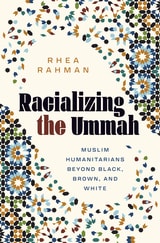
Racializing the Ummah
Muslim Humanitarians beyond Black, Brown, and WhiteRhea Rahman
University of Minnesota Press, 2026
A robust ethnography of Islamic Relief explores difficult questions about the extensive reach of white supremacy
An ethnography of Islamic Relief (IR), the largest Islamic NGO based in the West, Racializing the Ummah explores how a Muslim organization can do good in a world that defines Muslimness as less than human. Rooted in more than a decade of international research, Rhea Rahman’s study on the organization’s projects, methods, and limitations reveals how racial capitalism permeates all aspects of humanitarianism.
Beginning with a counterhistory of Muslims in the United Kingdom following World War II, Rahman analyzes IR’s mission and transnational activities in and across places including the UK, South Africa, and Mali in the broader context of global white supremacy. She shows how IR’s approaches often effectively secularize Islam to evade anti-Muslim racism and Islamophobia, implicating concepts such as the “good” Muslim aid worker, who complies with War on Terror surveillance while attending to victims of Western colonialism. Meanwhile, Rahman theorizes the tactics of aid workers on the ground, who creatively draw on an Islamic Black radical tradition to drive real change.
Through her engagement with IR and other organizations, Rahman paints a frank, nuanced portrait of the constraints Islamic aid entities face in the effort to disentangle themselves from neocolonialism and Western hegemony. Yet she also locates the possibility of escape from the all-encompassing dictates of racial capitalism in alternative visions of doing good—ones that are grounded in Islam as the foundation of a revolutionary praxis.
Retail e-book files for this title are screen-reader friendly.
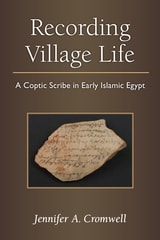
Recording Village Life
A Coptic Scribe in Early Islamic EgyptJennifer A. Cromwell
University of Michigan Press, 2017
Papyrological analysis of Aristophanes’ documents, within the context of the textual record of the village, shows a new and divergent scribal practice that reflects broader trends among his contemporaries: Aristophanes was part of a larger, national system of administrative changes, enacted by the country’s Arab rulers in order to better control administrative practices and fiscal policies within the country. Yet Aristophanes’ dossier shows him not just as an administrator, revealing details about his life, his role in the community, and the elite networks within which he operated. This unique perspective provides new insights into both the micro-history of an individual’s experience of eighth-century Theban village life, and its reflection in the macro social, economic, and political trends in Egypt at this time.
This book will prove valuable to scholars of late antique studies, papyrology, philology, early Islamic history, social and economic history, and Egyptology.
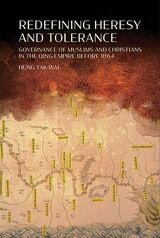
Redefining Heresy and Tolerance
Governance of Muslims and Christians in the Qing Empire before 1864Tak Wai Hung
Hong Kong University Press, 2024
Redefining Heresy and Tolerance demonstrates how the political philosophies of toleration developed in the context of late Imperial China were different from the theories that emerged in the West during their time. Focusing on religious policy in the Qing Empire, Hung attempts to clarify the Qing toleration policies and the reasoning behind them. He also demonstrates how the Qing government prevented Confucian bureaucrats from interfering in the religious life of Christians and Muslims, and how the Confucians’ understanding of “religion” was reshaped in the period.