82 books match the query 'Japanese Americans' and 4 start with r
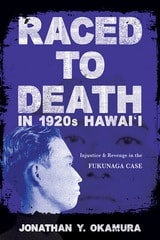
cover of Raced to Death in 1920s Hawai i: Injustice and Revenge in the Fukunaga Case

Raced to Death in 1920s Hawai i

Injustice and Revenge in the Fukunaga Case

Jonathan Y. Okamura

University of Illinois Press, 2019

On September 18, 1928, Myles Yutaka Fukunaga kidnapped and brutally murdered ten-year-old George Gill Jamieson in Waikîkî. Fukunaga, a nineteen-year-old nisei, or second-generation Japanese American, confessed to the crime. Within three weeks, authorities had convicted him and sentenced him to hang, despite questions about Fukunaga's sanity and a deeply flawed defense by his court-appointed attorneys. Jonathan Y. Okamura argues that officials "raced" Fukunaga to death—first viewing the accused only as Japanese despite the law supposedly being colorblind, and then hurrying to satisfy the Haole (white) community's demand for revenge. Okamura sets the case against an analysis of the racial hierarchy that undergirded Hawai‘ian society, which was dominated by Haoles who saw themselves most threatened by the islands' sizable Japanese American community. The Fukunaga case and others like it in the 1920s reinforced Haole supremacy and maintained the racial boundary that separated Haoles from non-Haoles, particularly through racial injustice. As Okamura challenges the representation of Hawai i as a racial paradise, he reveals the ways Haoles usurped the criminal justice system and reevaluates the tense history of anti-Japanese racism in Hawai i.
[more]
cover of Reading the Room: A Bookseller's Tale

Reading the Room

A Bookseller's Tale

Paul Yamazaki

Prickly Paradigm Press, 2024

Reading the Room is Paul Yamazaki's love letter to the work of bookselling and an engaged life of the mind.

Over twenty-four hours, Paul Yamazaki leads us through the stacks of storied City Lights Booksellers in San Francisco; the care and prowess of his approach to book buying; his upbringing in a Japanese American family in Southern California and moving to San Francisco at the height of revolutionary foment; working with legendary figures in the book publishing industry like Lawrence Ferlinghetti, Sonny Mehta, and others; and his vision for the future of bookselling. Navigating building trust with readers and nurturing relationships across the literary industry, Yamazaki testifies to the value of generosity, sharing knowledge, and dialogue in a life devoted to books.
[more]
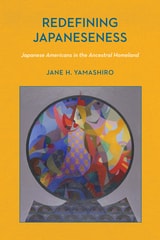
cover of Redefining Japaneseness: Japanese Americans in the Ancestral Homeland

Redefining Japaneseness

Japanese Americans in the Ancestral Homeland

Yamashiro, Jane H

Rutgers University Press, 2017
There is a rich body of literature on the experience of Japanese immigrants in the United States, and there are also numerous accounts of the cultural dislocation felt by American expats in Japan. But what happens when Japanese Americans, born and raised in the United States, are the ones living abroad in Japan? 
 
Redefining Japaneseness chronicles how Japanese American migrants to Japan navigate and complicate the categories of Japanese and “foreigner.” Drawing from extensive interviews and fieldwork in the Tokyo area, Jane H. Yamashiro tracks the multiple ways these migrants strategically negotiate and interpret their daily interactions. Following a diverse group of subjects—some of only Japanese ancestry and others of mixed heritage, some fluent in Japanese and others struggling with the language, some from Hawaii and others from the US continent—her study reveals wide variations in how Japanese Americans perceive both Japaneseness and Americanness. 
 
Making an important contribution to both Asian American studies and scholarship on transnational migration, Redefining Japaneseness critically interrogates the common assumption that people of Japanese ancestry identify as members of a global diaspora. Furthermore, through its close examination of subjects who migrate from one highly-industrialized nation to another, it dramatically expands our picture of the migrant experience.  
 
[more]
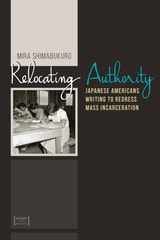
cover of Relocating Authority: Japanese Americans Writing to Redress Mass Incarceration

Relocating Authority

Japanese Americans Writing to Redress Mass Incarceration

Mira Shimabukuro

University Press of Colorado, 2015

Relocating Authority examines the ways Japanese Americans have continually used writing to respond to the circumstances of their community’s mass imprisonment during World War II. Using both Nikkei cultural frameworks and community-specific history for methodological inspiration and guidance, Mira Shimabukuro shows how writing was used privately and publicly to individually survive and collectively resist the conditions of incarceration.

Examining a wide range of diverse texts and literacy practices such as diary entries, note-taking, manifestos, and multiple drafts of single documents, Relocating Authority draws upon community archives, visual histories, and Asian American history and theory to reveal the ways writing has served as a critical tool for incarcerees and their descendants. Incarcerees not only used writing to redress the “internment” in the moment but also created pieces of text that enabled and inspired further redress long after the camps had closed.

Relocating Authority highlights literacy’s enduring potential to participate in social change and assist an imprisoned people in relocating authority away from their captors and back to their community and themselves. It will be of great interest to students and scholars of ethnic and Asian American rhetorics, American studies, and anyone interested in the relationship between literacy and social justice.

[more]