Results by title
59 books match the query 'Jewish women' and 3 start with r
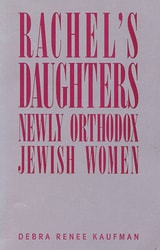
Rachel's Daughters
Newly Orthodox Jewish WomenKaufman, Debra Renee
Rutgers University Press, 1991
Debra Kaufman writes about ba'alot teshuva women who have returned to Orthodox Judaism, a form of Judaism often assumed to be oppressive to women. She addresses many of the most challenging issues of family, feminism, and gender. Why, she asks, have these women chosen an Orthodox lifestyle? What attracts young, relatively affluent, well-educated, and highly assimilated women to the most traditional, right-wing, patriarchal, and fundamentalist branch of Judaism? The answers she discovers lead her beyond an analysis of religious renewal to those issues all women and men confront in public and private life.
Kaufman interviewed and observed 150 ba'alot teshuva. She uses their own stories, in their own words, to show us how they make sense of the choices they have made. Lamenting their past pursuit of individual freedom over social responsibility, they speak of searching for shared meaning and order, and finding it in orthodoxy.
The laws and customs of Orthodox Judaism have been formulated by men, and it is men who enforce those laws and control the Orthodox community. The leadership is dominated by men. But the women do not experience theologically-imposed subordination as we might expect. Although most ba'alot teshuva reject feminism or what they perceive as feminism, they maintain a gender consciousness that incorporates aspects of feminist ideology, and often use feminist rhetoric to explain their lives.
Kaufman does not idealize the ba'alot teshuva world. Their culture does not accommodate the non-Orthodox, the homosexual, the unmarried, the divorced. Nor do the women have the mechanisms or political power to reject what is still oppressive to them. They must live within the authority of a rabbinic tradition and social structure set by males. Like other religious right women, their choices reinforce authoritarian trends current in today's society. Rachel's Daughters provides a fascinating picture of how newly orthodox women perceive their role in society as more liberating than oppressive.
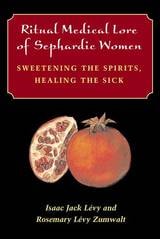
Ritual Medical Lore of Sephardic Women
Sweetening the Spirits, Healing the SickIsaac Jack Lévy and Rosemary Lévy Zumwalt
University of Illinois Press, 2002
Winner of the Ellii Kongas-Maranda Prize from the Women's Section of the American Folklore Society, 2003.
Ritual Medical Lore of Sephardic Women preserves the precious remnants of a rich culture on the verge of extinction while affirming women's pivotal role in the health of their communities. Centered around extensive interviews with elders of the Sephardic communities of the former Ottoman Empire, this volume illuminates a fascinating complex of preventive and curative rituals conducted by women at home--rituals that ensured the physical and spiritual well-being of the community and functioned as a vital counterpart to the public rites conducted by men in the synagogues.
Isaac Jack Lévy and Rosemary Lévy Zumwalt take us into the homes and families of Sephardim in Turkey, Israel, Greece, the former Yugoslavia, and the United States to unravel the ancient practices of domestic healing: the network of blessings and curses tailored to every occasion of daily life; the beliefs and customs surrounding mal ojo (evil eye), espanto (fright), and echizo (witchcraft); and cures involving everything from herbs, oil, and sugar to the powerful mumia (mummy) made from dried bones of corpses.
For the Sephardim, curing an illness required discovering its spiritual cause, which might be unintentional thought or speech, accident, or magical incantation. The healing rituals of domesticated medicine provided a way of making sense of illness and a way of shaping behavior to fit the narrow constraints of a tightly structured community. Tapping a rich and irreplaceable vein of oral testimony, Ritual Medical Lore of Sephardic Women offers fascinating insight into a culture where profound spirituality permeated every aspect of daily life.
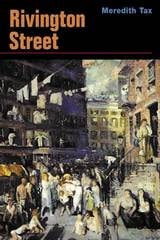
Rivington Street
A NOVELMeredith Tax
University of Illinois Press, 1982
An absorbing, epic novel, Rivington Street is also suitable for use as a classroom text.