Results by title
92 books match the query 'Judges' and 2 start with r
Reading Gender in Judges
An Intertextual ApproachShelley L. Birdsong
SBL Press, 2023
Much of the content of Judges can be understood only when read together with other parts of the Hebrew Bible. Narratives in Judges comment, criticize, and reinterpret other texts from across what became the canon, often by troubling gender, disrupting stereotypical binaries, and creating a kind of gender chaos. This volume brings together gender criticism and intertextuality, methods that logically align with intersectional lenses, to draw attention to how race, ethnicity, class, religion, ability, sex, and sexuality all play a role in how one is gendered in the book of Judges. Contributors Elizabeth H. P. Backfish, Shelley L. Birdsong, Zev Farber, Serge Frolov, Susanne Gillmayr-Bucher, Susan E. Haddox, Hyun Chul Paul Kim, Richard D. Nelson, Pamela J. W. Nourse, Tammi J. Schneider, Joy A. Schroeder, Soo Kim Sweeney, Rannfrid I. Lasine Thelle, J. Cornelis de Vos, Jennifer J. Williams, and Gregory T. K. Wong provide substantial new and significant contributions to the study of gender, the book of Judges, and biblical hermeneutics in general. This volume illustrates why biblical scholars and students need to take the intersectional identities of characters and their intertextual environments seriously.
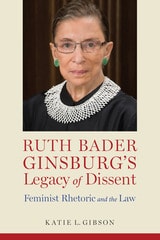
Ruth Bader Ginsburg’s Legacy of Dissent
Feminist Rhetoric and the LawKatie L. Gibson
University of Alabama Press, 2018
A rhetorical analysis of Justice Ruth Bader Ginsburg’s feminist jurisprudence.
Ruth Bader Ginsburg’s lifelong effort to reshape the language of American law has had profound consequences: she has shifted the rhetorical boundaries of jurisprudence on a wide range of fundamental issues from equal protection to reproductive rights. Beginning in the early 1970s, Ginsburg led a consequential attack on sexist law in the United States. By directly confronting the patriarchal voice of the law, she pointedly challenged an entrenched genre of legal language that silenced the voices and experiences of American women and undermined their status as equal citizens. On the United States Supreme Court, Justice Ginsburg continues to challenge the traditional scripts of legal discourse to insist on a progressive vision of the Constitution and to demand a more inclusive and democratic body of law.
This illuminating work examines Justice Ruth Bader Ginsburg’s contributions in reshaping the rhetoric of the law (specifically through the lens of watershed cases in women’s rights) and describes her rhetorical contributions—beginning with her work in the 1970s as a lawyer and an advocate for the ACLU’s Women’s Rights Project through her tenure as a Supreme Court justice. Katie L. Gibson examines Ginsburg’s rhetoric to argue that she has dramatically shifted the boundaries of legal language. Gibson draws from rhetorical theory, critical legal theory, and feminist theory to describe the law as a rhetorical genre, arguing that Ginsburg’s jurisprudence can appropriately be understood as a direct challenge to the traditional rhetoric of the law.
Ruth Bader Ginsburg stands as an incredibly important figure in late twentieth- and early twenty-first-century feminism. While a growing number of admirers celebrate Justice Ginsburg’s voice of dissent today, Ginsburg’s rhetorical legacy reveals that she has long articulated a sharp and strategic voice of judicial dissent. This study contributes to a more complete understanding of her feminist legacy by detailing the unique contributions of her legal rhetoric.