Results by title
56 books match the query 'Jurisprudence' and 3 start with r
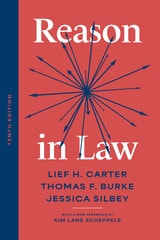
Reason in Law, Tenth Edition
Lief H. Carter, Thomas F. Burke and Jessica Silbey
University of Chicago Press, 2026
An indispensable introduction to legal reasoning, updated for today’s political and legal environment.
Since it was first published nearly five decades ago, Reason in Law has become the starting point for understanding legal reasoning, a critical component of the rule of law. The editors show how judges can integrate all the elements of a case to persuasively explain their rulings—and, even more importantly, why they sometimes fail to do so. Drawing on cases old and new, Reason in Law enables readers to become sophisticated “judges of judging.”
Now in its tenth edition, Reason in Law includes a new chapter on the increasingly contentious and politically consequential field of administrative law and addresses recent developments in the American legal landscape, including growing conservatism in the federal judiciary and the flood of lawsuits brought against the second Trump administration. It also analyzes new cases on the First Amendment rights of high schoolers, transgender civil rights, the responsibilities universities have for student safety, Donald Trump’s sweeping claims of executive power, and historic Supreme Court decisions expanding the rights of gun owners and allowing states to criminalize abortion. As always, Reason in Law connects legal theory with empirical research on the American judicial system, showing how trustworthy legal reasoning helps preserve social peace and the rule of law.
Rhetorical Knowledge in Legal Practice and Critical Legal Theory
Francis J. Mootz III
University of Alabama Press, 2006
A clear summary of contemporary rhetorical philosophy and its intersections with hermeneutics and critical theory
This book describes the significance of rhetorical knowledge for law through detailed discussions of some of the most difficult legal issues facing courts today, including affirmative action, gay rights, and assisted suicide.
Francis J. Mootz responds to both extremes, those who argue that law is merely a rhetorical mask for the exercise of power and those who demonstrate an ideological faith in law’s autonomy, and he breaks new ground by returning to modern classics in the fields of rhetoric and hermeneutics. Drawing from Chaim Perelman's "new rhetoric" and Hans-Georg Gadamer's "philosophical hermeneutics," Mootz argues that justice is a product of rhetorical knowledge. Drawing from Nietzsche, Mootz’s conception of rhetorical knowledge opens up the dynamic possibilities of critical legal theory.
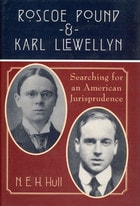
Roscoe Pound and Karl Llewellyn
Searching for an American JurisprudenceN. E. H. Hull
University of Chicago Press, 1997
Through meticulous archival research, Hull shows how the intellectual battles of the day took place against a network of private and public relationships and demonstrates how Pound's and Llewellyn's ideas of jurisprudence sprang from a kind of intellectual bricolage, the pragmatic assemblage of parts rather than the development of a unified whole, that is peculiarly American. Humorous, engaging, and provocative, Roscoe Pound and Karl Llewellyn uncovers the roots of American jurisprudence in the lives of two of its most compelling figures.