72 books match the query 'Korea (South)' and 6 start with r
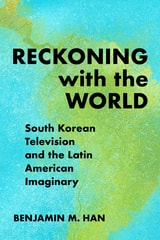
cover of Reckoning with the World: South Korean Television and the Latin American Imaginary

Reckoning with the World

South Korean Television and the Latin American Imaginary

Benjamin M. Han

Temple University Press, 2026

For many Koreans, Latin America is foreign and unfamiliar, but popular television shows have generated considerable interest in this region of the Global South. In Reckoning with the World, Benjamin Han explores this phenomenon by providing a close reading of Korean TV programs that take place, are shot in, or depict Latin America. These dramas, reality shows, and travel documentaries present South Koreans with an understanding of themselves by projecting an illusion of difference that underscores themes of identity, race, and modernity.

Historical dramas like The Land of Humans, about Korean migrants in Mexico, consider diasporic identity and nationalism, while the fantasy series Secret Garden explores issues of modernity. In addition, the TV drama Encounter and the entertainment show Traveler contrast the cultures of global Korea with Cuba. As these programs create appealing storytelling, characters, and aesthetics, they inspire and resonate with audiences and fans across the globe. However, Korean television’s imaginary of Latin America is not about its investment in fostering greater interculturality with Latin American nations and their cultures but instead projects a façade of progressive racial and cultural politics shaping Korea’s reckoning with the world.
[more]
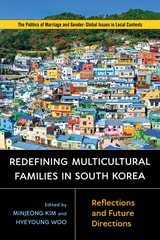
cover of Redefining Multicultural Families in South Korea: Reflections and Future Directions

Redefining Multicultural Families in South Korea

Reflections and Future Directions

Minjeong Kim

Rutgers University Press, 2022
Redefining Multicultural Families in South Korea provides an in-depth look at the lives of families in Korea that include immigrants. Ten original chapters in this volume, written by scholars in multiple social science disciplines and covering different methodological approaches, aim to reinvigorate contemporary discussions about these multicultural families. Specially, the volume expands the scope of “multicultural families” by examining the diverse configurations of families with immigrants who crossed the Korean border during and after the 1990s, such as the families of undocumented migrant workers, divorced marriage immigrants, and the families of Korean women with Muslim immigrant husbands. Second, instead of looking at immigrants as newcomers, the volume takes a discursive turn, viewing them as settlers or first-generation immigrants in Korea whose post-migration lives have evolved and whose membership in Korean society has matured, by examining immigrants’ identities, need for political representation, their fights through the court system, and the aspirations of second-generation immigrants.
[more]
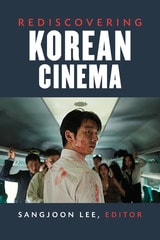
cover of Rediscovering Korean Cinema

Rediscovering Korean Cinema

Sangjoon Lee, Editor

University of Michigan Press, 2019

South Korean cinema is a striking example of non-Western contemporary cinematic success. Thanks to the increasing numbers of moviegoers and domestic films produced, South Korea has become one of the world’s major film markets. In 2001, the South Korean film industry became the first in recent history to reclaim its domestic market from Hollywood and continues to maintain around a 50 percent market share today. High-quality South Korean films are increasingly entering global film markets and connecting with international audiences in commercial cinemas and art theatres, and at major international film festivals. Despite this growing recognition of the films themselves, Korean cinema’s rich heritage has not heretofore received significant scholarly attention in English-language publications.
 
This groundbreaking collection of thirty-five essays by a wide range of academic specialists situates current scholarship on Korean cinema within the ongoing theoretical debates in contemporary global film studies. Chapters explore key films of Korean cinema, from Sweet Dream, Madame Freedom, The Housemaid, and The March of Fools to Oldboy, The Host, and Train to Busan, as well as major directors such as Shin Sang-ok, Kim Ki-young, Im Kwon-taek, Bong Joon-ho, Hong Sang-soo, Park Chan-wook, and Lee Chang-dong. While the chapters provide in-depth analyses of particular films, together they cohere into a detailed and multidimensional presentation of Korean cinema’s cumulative history and broader significance.
 
With its historical and critical scope, abundance of new research, and detailed discussion of important individual films, Rediscovering Korean Cinema is at once an accessible classroom text and a deeply informative compendium for scholars of Korean and East Asian studies, cinema and media studies, and communications. It will also be an essential resource for film industry professionals and anyone interested in international cinema.
 
[more]
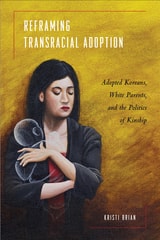
cover of Reframing Transracial Adoption: Adopted Koreans, White Parents, and the Politics of Kinship

Reframing Transracial Adoption

Adopted Koreans, White Parents, and the Politics of Kinship

Kristi Brian

Temple University Press, 2012

Until the late twentieth century, the majority of foreign-born children adopted in the United States came from Korea. In the absorbing book Reframing Transracial Adoption, Kristi Brian investigates the power dynamics at work between the white families, the Korean adoptees, and the unknown birth mothers. Brian conducts interviews with adult adopted Koreans, adoptive parents, and adoption agency facilitators in the United States to explore the conflicting interpretations of race, culture, multiculturalism, and family.

Brian argues for broad changes as she critiques the so-called "colorblind" adoption policy in the United States. Analyzing the process of kinship formation, the racial aspects of these adoptions, and the experience of adoptees, she reveals the stifling impact of dominant nuclear-family ideologies and the crowded intersections of competing racial discourses.

Brian finds a resolution in the efforts of adult adoptees to form coherent identities and launch powerful adoption reform movements.
[more]
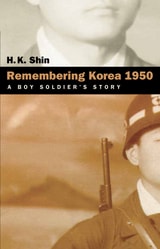
cover of Remembering Korea 1950: A Boy Soldier's Story

Remembering Korea 1950

A Boy Soldier's Story

H. K. Shin

University of Nevada Press, 2001
Hyung K. Shin was sixteen years old when the North Korean army invaded South Korea in June 1950. Fleeing his home, Shin soon found himself alone in Pusan, a refugee without resources or any means of support. To save himself from destitution, he lied about his age and volunteered for service in the South Korean army. Shin’s account of the months that followed is a moving record of the Korean War from the perspective of an ordinary ROK soldier. He recounts his hasty training and subsequent experiences as a battlefield soldier in North Korea, as a guard in a prisoner-of-war camp, and as a refugee again in the massive flight of civilians and ROK military personnel retreating before the onslaught of the Chinese invasion. Through it all, Shin struggles to retain his humanity and pursue his education. In the process, the naïve schoolboy becomes a man. Today, Hyung K. Shin is an internationally respected chemist, but in the pages of this memoir he carries us back to Korea during a pivotal moment in that country’s history. This is the first account in English that describes the war from the perspective of a Korean who lived through and fought in it. Shin’s detailed and lively narrative is a stirring monument to the survival of human decency and kindness in the midst of terror, cruelty, despair, and the destruction of a proud nation.
[more]
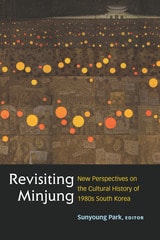
cover of Revisiting Minjung: New Perspectives on the Cultural History of 1980s South Korea

Revisiting Minjung

New Perspectives on the Cultural History of 1980s South Korea

Sunyoung Park, Editor

University of Michigan Press, 2019

An epoch-marking alliance of laborers, students, dissident intellectuals, and ordinary citizens was at the heart of South Korea’s transformation from a dictatorship into a vibrant democracy during the 1980s. Collectively known as the minjung (“the people”), these agents of Korean democratization historically carved out an expanded role for civil society in the country’s politics. In Revisiting Minjung, some of the foremost experts in 1980s Korean history, literature, film, art, and music provide new insights into one of the most crucial decades in South Korean history. Drawing from the theoretical perspectives of transnationalism, post-Marxist studies, intersectional feminism, popular culture studies, and more, the volume demonstrates how an era that is often associated with radical politics was, in effect, the catalyst for the subsequent flourishing of democratic and liberal values in South Korea.
 
Revisiting Minjung brings new themes, new subjectivities, and new theoretical perspectives to the study of the rich ecosystem of 1980s Korean culture. Treated here is a wide array of topics, including the origins of minjung ideology, its critique by the right wing, minjung art and music, workers’ literary culture, women writers and the resurgence of feminism, erotic cinema, science fiction, transnational political travels, and the representations of race and queerness in 1980s popular culture. The book thus details the origins and development of some of the movements that shape cultural life in South Korea today, and it does so through analyses that engage some of the most pressing debates in current scholarship in Korea and abroad.
[more]