Results by title
151 books match the query 'Liberalism' and 7 start with r
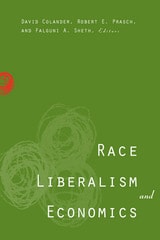
Race, Liberalism, and Economics
David Colander, Robert E. Prasch, and Falguni A. Sheth, Editors
University of Michigan Press, 2009
Noneconomists often think that economists' approach to race is almost exclusively one of laissez-faire. Racism, Liberalism, and Economics argues that economists' ideas are more complicated. The book considers economists' support of markets in relation to the challenge of race and race relations and argues that their support of laissez-faire has traditionally been based upon a broader philosophical foundation of liberalism and history: what markets have and have not achieved in the past, and how that past relates to the future. The book discusses the concepts of liberalism and racism, the history and use of these terms, and how that history relates to policy issues. It argues that liberalism is consistent with a wide variety of policies and that the broader philosophical issues are central in choosing policies.
The contributors show how the evolution of racist ideas has been a subtle process that is woven into larger movements in the development of scientific thought; economic thinking is embedded in a larger social milieu. Previous discussions of policies toward race have been constrained by that social milieu, and, since World War II, have largely focused on ending legislated and state-sanctioned discrimination. In the past decade, the broader policy debate has moved on to questions about the existence and relative importance of intangible sources of inequality, including market structure, information asymmetries, cumulative processes, and cultural and/or social capital. This book is a product of, and a contribution to, this modern discussion. It is uniquely transdisciplinary, with contributions by and discussions among economists, philosophers, anthropologists, and literature scholars.
The volume first examines the early history of work on race by economists and social scientists more generally. It continues by surveying American economists on race and featuring contributions that embody more modern approaches to race within economics. Finally it explores several important policy issues that follow from the discussion.
". . . adds new insights that contribute significantly to the debate on racial economic inequality in the U.S. The differing opinions of the contributors provide the broad perspective needed to examine this extremely complex issue."
--James Peoples, University of Wisconsin-Milwaukee
"There is an immense economic literature on racial discrimination, employing a variety of models and decomposition methods. This volume makes a unique contribution by focusing on the philosophical assumptions at the root of this analysis and by presenting many sides of the very vigorous debate surrounding these controversial issues."
--Thomas Maloney, University of Utah
"By focusing upon the progress of analytical technique, historians of economic thought have grossly neglected the symbiotic relation of economics to public policy and ideology. This collection of essays offers a most welcome breach of disciplinary apartheid. Seizing upon recent research in the almost forgotten writings about race of Classical economists and their contemporaries, it relates nineteenth-century ideas to current debates about economic discrimination and other manifestations of racism. As the writing is both learned and lively, the book should appeal both to the generally educated reader and to teachers of courses in multiculturalism."
--Melvin Reder, Isidore Brown and Gladys J. Brown Professor Emeritus of Urban and Labor Economics, University of Chicago
[more]
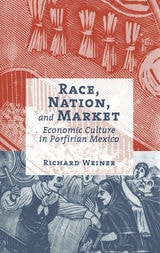
Race, Nation, and Market
Economic Culture in Porfirian MexicoRichard Weiner
University of Arizona Press, 2004
Prior to the Revolution of 1910, economic ideals were a dominant mode of political and social discourse in Mexico. Scholars have focused considerable attention on the expansion of the market economy during this period—particularly its political, economic, and social importance. Richard Weiner now enhances our understanding of the emergence of modern Mexico by exploring the market's immense symbolic significance. Race, Nation, and Market traces the intellectual strands of economic thought during the late Porfiriato. Even in the face of Díaz's political reign, the market became the dominant theme in national discourse as contemporaries of all political persuasions underscored its social and cultural effects. This work documents the ways in which liberals, radicals, and conservatives employed market rhetoric to establish their political identities and map out their courses of action, and it shows how the market became an emblem linked to the identity of each group. Weiner explains how the dominant political interests—the científicos, the Mexican Liberal Party, and the social Catholics—each conceived economic issues, and he compares how they rhetorically used their conceptions of the market to promote their political objectives. Some worshiped it as a deity that created social peace, political harmony, and material abundance, while others demonized it as a source of social destruction. Weiner delineates their approaches and reveals how distinct notions of race, gender, community, and nationality informed economic culture and contradicted a laissez-faire conception of society and economy. By focusing on these rhetorical contests, Race, Nation, and Market offers a new perspective on social mobilization in late nineteenth-century Mexico as it also explores the related field of Porfirian economic culture and thought, about which little thus far has been written. In the face of today's controversy over globalization, it offers a unique historical perspective on the market's long-standing significance to political activism.
[more]
Rationalizing Capitalist Democracy
The Cold War Origins of Rational Choice LiberalismS.M. Amadae
University of Chicago Press, 2003
In Rationalizing Capitalist Democracy, S. M. Amadae tells the remarkable story of how rational choice theory rose from obscurity to become the intellectual bulwark of capitalist democracy. Amadae roots Rationalizing Capitalist Democracy in the turbulent post-World War II era, showing how rational choice theory grew out of the RAND Corporation's efforts to develop a "science" of military and policy decisionmaking. But while the first generation of rational choice theorists—William Riker, Kenneth Arrow, and James Buchanan—were committed to constructing a "scientific" approach to social science research, they were also deeply committed to defending American democracy from its Marxist critics. Amadae reveals not only how the ideological battles of the Cold War shaped their ideas but also how those ideas may today be undermining the very notion of individual liberty they were created to defend.
[more]
Reflections of a Would-Be Anarchist
Ideals and Institutions of LiberalismRichard E. Flathman
University of Minnesota Press, 1998
[more]
Religion and the Demise of Liberal Rationalism
The Foundational Crisis of the Separation of Church and StateJ. Judd Owen
University of Chicago Press, 2001
If liberalism is premised on inclusion, pluralism, and religious neutrality, can the separation of church and state be said to have a unitary and rational foundation? If we accept that there are no self-evident principles of morality or politics, then doesn't any belief in a rational society become a sort of faith? And how can liberalism mediate impartially between various faiths—as it aims to do—if liberalism itself is one of the competing faiths?
J. Judd Owen answers these questions with a remarkable critical analysis of four twentieth-century liberal and postliberal thinkers: John Dewey, John Rawls and, most extensively, Richard Rorty and Stanley Fish. His unique readings of these theorists and their approaches to religion lead him to conclusions that are meticulously constructed and surprising, arguing against the perception of liberalism as simple moral or religious neutrality, calling into question the prevailing justifications for separation of church and state, and challenging the way we think about the very basis of constitutional government.
J. Judd Owen answers these questions with a remarkable critical analysis of four twentieth-century liberal and postliberal thinkers: John Dewey, John Rawls and, most extensively, Richard Rorty and Stanley Fish. His unique readings of these theorists and their approaches to religion lead him to conclusions that are meticulously constructed and surprising, arguing against the perception of liberalism as simple moral or religious neutrality, calling into question the prevailing justifications for separation of church and state, and challenging the way we think about the very basis of constitutional government.
[more]
Republic of Signs
Liberal Theory and American Popular CultureAnne Norton
University of Chicago Press, 1993
Norton examines the enactment of liberal ideas in popular culture; in the possessions of ordinary people and the habits of everyday life. She sees liberalism as the common sense of the American people: a set of conventions unconsciously adhered to, a set of principles silently taken for granted.
The author ranges over a wide expanse of popular activities (e.g. wrestling, roller derby, lotteries, shopping sprees, and dining out), as well as conventional political topics (e.g., the Constitution, presidency, news media, and centrality of law). Yet the argument is pointed and probling, never shallow or superficial. Fred and Wilma Flintstone are as vital to the republic as Franklin and Eleanor Roosevelt.
"In discussions that range from the Constitution and the presidency to money and shopping, voting, lotteries, and survey research, Norton discerns and imaginatively invents possibilities that exceed recognized actualities and already approved opportunities."—Richard E. Flathman, American Political Science Review
"[S]timulating and stylish exploration of political theory, language, culture, and shopping at the mall . . . popular culture at its best, informed by history and theory, serious in purpose, yet witty and modest in tone."—Bernard Mergen, American Studies International
[more]
Revel with a Cause
Liberal Satire in Postwar AmericaStephen E. Kercher
University of Chicago Press, 2006
We live in a time much like the postwar era. A time of arch political conservatism and vast social conformity. A time in which our nation’s leaders question and challenge the patriotism of those who oppose their policies. But before there was Jon Stewart, Al Franken, or Bill Maher, there were Mort Sahl, Stan Freberg, and Lenny Bruce—liberal satirists who, through their wry and scabrous comedic routines, waged war against the political ironies, contradictions, and hypocrisies of their times.
Revel with a Cause is their story. Stephen Kercher here provides the first comprehensive look at the satiric humor that flourished in the United States during the 1950s and early 1960s. Focusing on an impressive range of comedy—not just standup comedians of the day but also satirical publications like MAD magazine, improvisational theater groups such asSecond City, the motion picture Dr. Strangelove, and TV shows like That Was the Week That Was—Kercher reminds us that the postwar era saw varieties of comic expression that were more challenging and nonconformist than we commonly remember. His history of these comedic luminaries shows that for a sizeable audience of educated, middle-class Americans who shared such liberal views, the period’s satire was a crucial mode of cultural dissent. For such individuals, satire was a vehicle through which concerns over the suppression of civil liberties, Cold War foreign policies, blind social conformity, and our heated racial crisis could be productively addressed.
A vibrant and probing look at some of the most influential comedy of mid-twentieth-century America, Revel with a Cause belongs on the short list of essential books for anyone interested in the relationship between American politics and popular culture.
[more]