Results by title
121 books match the query 'Literacy' and 14 start with r
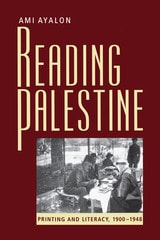
Reading Palestine
Printing and Literacy, 1900-1948By Ami Ayalon
University of Texas Press, 2004
Prior to the twentieth century, Arab society in Palestine was predominantly illiterate, with most social and political activities conducted through oral communication. There were no printing presses, no book or periodical production, and no written signs in public places. But a groundswell of change rapidly raised the region's literacy rates, a fascinating transformation explored for the first time in Reading Palestine.
Addressing an exciting aspect of Middle Eastern history as well as the power of the printed word itself, Reading Palestine describes how this hurried process intensified the role of literacy in every sphere of community life. Ami Ayalon examines Palestine's development of a modern educational system in conjunction with the emergence of a print industry, libraries and reading clubs, and the impact of print media on urban and rural populations. Drawn from extensive archival sources, official reports, autobiographies, and a rich trove of early Palestinian journalism, Reading Palestine provides crucial insight into the dynamic rise of literacy that revolutionized the way Palestinians navigated turbulent political waters.

Reading Piers Plowman and the Pilgrim's Progress
Reception and the Protestant ReaderBarbara A. Johnson
Southern Illinois University Press, 1992
Centering her discussion on two historical "ways of reading"—which she calls the Protestant and the lettered—Barbara A. Johnson traces the development of a Protestant readership as it is reflected in the reception of Langland’s Piers Plowman and Bunyan’s Pilgrim’s Progress.
Informed by reader-response and reception theory and literacy and cultural studies, Johnson’s ambitious examination of these two ostensibly literary texts charts the cultural roles they played in the centuries following their composition, roles far more important than their modern critical reputations can explain.
Johnson argues that much more evidence exists about how earlier readers read than has hitherto been acknowledged. The reception of Piers Plowman, for example, can be inferred from references to the work, the apparatus its Renaissance printer inserted in his editions, the marginal comments readers inscribed both in printed editions and in manuscripts, and the apocryphal "plowman" texts that constitute interpretations of Langland’s poem. She demonstrates by example that what is culturally transmitted has not been just the work itself; it includes vestiges of past readers’ encounters with the text that are traceable both in the way a text is presented as well as in the way that presentation is received.
Conditioned more by religious, historical, and economic forces than by literary concerns, Langland’s poem became a part of the reformist tradition that culminated in Bunyan’s Pilgrim’s Progress. By understanding this tradition, Bunyan’s place in it, and the way the reception of The Pilgrim’s Progress illustrates the beginning of a new, more realistic fictional tradition, Johnson concludes, we can begin to delineate a more accurate history of the ways literature and society intersect, a history of readers reading.
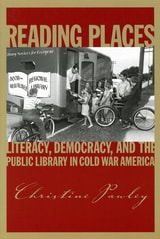
Reading Places
Literacy, Democracy, and the Public Library in Cold War AmericaChristine Pawley
University of Massachusetts Press, 2010
Central to the experiment were well-stocked bookmobiles that brought books to rural districts and the one-room schools that dotted the region. Three years after the project began, state officials and local librarians judged it an overwhelming success. Library circulation figures soared to two-and-a-half times their previous level. Over 90 percent of grade-school children in the rural schools used the bookmobile service, and their reading scores improved beyond expectation.
Despite these successes, however, local communities displayed deeply divided reactions. Some welcomed the book-mobiles and new library services wholeheartedly, valuing print and reading as essential to the exercise of democracy, and keen to widen educational opportunities for children growing up on hardscrabble farms where books and magazines were rare. Others feared the intrusion of govern- ment into their homes and communities, resented the tax increases that library services entailed, and complained about the subversive or immoral nature of some books.
Analyzing the history of tensions between various community groups, Pawley delineates the long-standing antagonisms arising from class, gender, and ethnic differences which contributed to a suspicion of official projects to expand education. Relating a seemingly small story of library policy, she teases out the complex interaction of reading, locality, and cultural difference. In so doing, she illuminates broader questions regarding libraries, literacy, and citizenship, reaching back to the nineteenth century and forward to the present day.
Reading Prisoners
Literature, Literacy, and the Transformation of American Punishment, 1700–1845Schorb, Jodi
Rutgers University Press, 2014
Reclaiming Catherine of Siena
Literacy, Literature, and the Signs of OthersJane Tylus
University of Chicago Press, 2009
Jane Tylus charts here the contested struggles of scholars over the centuries to situate Catherine in the history of Italian culture in early modernity. But she mainly focuses on Catherine’s works, calling attention to the interplay between orality and textuality in the letters and demonstrating why it was so important for Catherine to envision herself as a writer. Tylus argues for a reevalution of Catherine as not just a medieval saint, but one of the major figures at the birth of the Italian literary canon.
Reclaiming the Rural
Essays on Literacy, Rhetoric, and PedagogyEdited by Kim Donehower, Charlotte Hogg, and Eileen E. Schell
Southern Illinois University Press, 2012
In Reclaiming the Rural: Essays on Literacy, Rhetoric, and Pedagogy, editors Kim Donehower, Charlotte Hogg, and Eileen E. Schell bring together a diverse collection of essays that consider literacy, rhetoric, and pedagogy in the United States, Canada, and Mexico. The essays move beyond the typical arguments for preserving, abandoning, or modernizing by analyzing how rural communities sustain themselves through literate action. The contributors explore the rhetorics of water disputes in the western United States, the histories and influences of religious rhetorics in Mexico, agricultural and rural literacy curricula, the literacies of organizations such as 4-H and Academia de la Nueva Raza, and neoliberal rhetorics. Central to these examinations are the rural populations themselves, which include indigenous peoples in the rural United States, Canada, and Mexico, as well as those of European or other backgrounds.
The strength of the anthology lies in its multiple perspectives, various research sites, and the range of methodologies employed, including rhetorical analyses of economies and environments, media, and public spaces; classroom-based research; historical analysis and archival work; and qualitative research. The researchers engage the duality between the practices of everyday life in rural communities and the practices of reflecting on and making meaning.
Reclaiming the Rural reflects the continually changing, nuanced, context-dependent realities of rural life while acknowledging the complex histories, power struggles, and governmental actions that have affected and continue to affect the lives of rural citizens. This thought-provoking collection demonstrates the value in reclaiming the rural for scholarly and pedagogical analysis.
Reimagining Popular Notions of American Intellectualism
Literacy, Education, and ClassKelly Susan Bradbury
Southern Illinois University Press, 2016
Bradbury begins by tracing the origins and evolution of the narrow views of intellectualism that are common in the United States today. Then, applying a more inclusive and egalitarian definition of intellectualism, she examines the literacy and learning practices of three nonelite sites of adult public education in the United States: the nineteenth-century lyceum, a twentieth-century labor college, and a twenty-first-century GED writing workshop. Bradbury argues that together these three case studies teach us much about literacy, learning, and intellectualism in the United States over time and place. She concludes the book with a reflection on her own efforts to aid students in recognizing and resisting the rhetoric of anti-intellectualism that surrounds them and that influences their attitudes and actions.
Drawing on case studies as well as Bradbury’s own experiences with students, Reimagining Popular Notions of American Intellectualism demonstrates that Americans have engaged and do engage in the process and exercise of intellectual inquiry, contrary to what many people believe. Addressing a topic often overlooked by rhetoric, composition, and literacy studies scholars, it offers methods for helping students reimagine what it means to be intellectual in the twenty-first century.
Reimagining the Educated Citizen
Creole Pedagogies in the Transatlantic World, 1685-1896Petra Munro Hendry
University of Michigan Press, 2023
Winner of the 2023 American Educational Research Association (AERA) Division B: Curriculum Studies Outstanding Book Award
Reimagining the Educated Citizen contends that the constructs of public education and citizenship in the struggle to constitute a U.S. national identity are inseparable from the simultaneous emergence of transatlantic constructs of an educated citizen along transnational and transracial lines. The nineteenth century is commonly understood as the age of nationalism and nation formation in which the Anglo-Protestant Common School movement takes center stage in the production of the American democratic citizen. Ironically, the argument for public, Common Schools privileged whiteness instead of equality. This book suggests that an alternative vision of the relationship between education and citizenship emerged from a larger transatlantic history. Given shape by the movement of people, ideas, commodities, and practices across the Caribbean, Africa, Europe, the Gulf of Mexico and the Mississippi Valley, this radical egalitarian vision emerged at the crossroads of the Atlantic-colonial and antebellum Louisiana.
Relocating Authority
Japanese Americans Writing to Redress Mass IncarcerationMira Shimabukuro
University Press of Colorado, 2015
Relocating Authority examines the ways Japanese Americans have continually used writing to respond to the circumstances of their community’s mass imprisonment during World War II. Using both Nikkei cultural frameworks and community-specific history for methodological inspiration and guidance, Mira Shimabukuro shows how writing was used privately and publicly to individually survive and collectively resist the conditions of incarceration.
Examining a wide range of diverse texts and literacy practices such as diary entries, note-taking, manifestos, and multiple drafts of single documents, Relocating Authority draws upon community archives, visual histories, and Asian American history and theory to reveal the ways writing has served as a critical tool for incarcerees and their descendants. Incarcerees not only used writing to redress the “internment” in the moment but also created pieces of text that enabled and inspired further redress long after the camps had closed.
Relocating Authority highlights literacy’s enduring potential to participate in social change and assist an imprisoned people in relocating authority away from their captors and back to their community and themselves. It will be of great interest to students and scholars of ethnic and Asian American rhetorics, American studies, and anyone interested in the relationship between literacy and social justice.
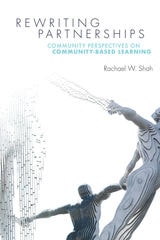
Rewriting Partnerships
Community Perspectives on Community-Based LearningRachael W. Shah
Utah State University Press, 2020
Winner of the IARSLCE 2021 Publication of the Year Award and the Coalition for Community Writing Outstanding Book Award.
Community members are rarely tapped for their insights on engaged teaching and research, but without these perspectives, it is difficult to create ethical and effective practices. Rewriting Partnerships calls for a radical reorientation to the knowledges of community partners. Emphasizing the voices of community members themselves—the adult literacy learners, secondary students, and youth activists who work with college students—the book introduces Critical Community-Based Epistemologies, a deeply practical approach to knowledge construction that centers the perspectives of marginalized participants.
Drawing on interviews with over eighty community members, Rewriting Partnerships features community knowledges in three common types of community-engaged learning: youth working with college students in a writing exchange program, nonprofit staff who serve as clients for student projects, and community members who work with graduate students. Interviewees from each type of partnership offer practical strategies for creating more ethical collaborations, including how programs are built, how projects are introduced to partners, and how graduate students are educated. The book also explores three approaches to partnership design that create space for community voices at the structural level: advisory boards, participatory evaluation, and community grading.
Immediately applicable to teachers, researchers, community partners, and administrators involved in community engagement, Rewriting Partnerships offers concrete strategies for creating more community-responsive partnerships at the classroom level as well as at the level of program and research design. But most provocatively, the book challenges common assumptions about who can create knowledge about community-based learning, demonstrating that community partners have the potential to contribute significantly to community engagement scholarship and program decision-making.
Rhetorical Delivery as Technological Discourse
A Cross-Historical StudyBen McCorkle
Southern Illinois University Press, 2012
According to Ben McCorkle, the rhetorical canon of delivery—traditionally seen as the aspect of oratory pertaining to vocal tone, inflection, and physical gesture—has undergone a period of renewal within the last few decades to include the array of typefaces, color palettes, graphics, and other design elements used to convey a message to a chosen audience. McCorkle posits that this redefinition, while a noteworthy moment of modern rhetorical theory, is just the latest instance in a historical pattern of interaction between rhetoric and technology. In Rhetorical
Delivery as Technological Discourse: A Cross-Historical Study, McCorkle explores the symbiotic relationship between delivery and technologies of writing and communication. Aiming to enhance historical understanding by demonstrating how changes in writing technology have altered our conception of delivery, McCorkle reveals the ways in which oratory and the tools of written expression have directly affected one another throughout the ages.
To make his argument, the author examines case studies from significant historical moments in the Western rhetorical tradition. Beginning with the ancient Greeks, McCorkle illustrates how the increasingly literate Greeks developed rhetorical theories intended for oratory that incorporated “writerly” tendencies, diminishing delivery’s once-prime status in the process. Also explored is the near-eradication of rhetorical delivery in the mid-fifteenth century—the period of transition from late manuscript to early print culture—and the implications of the burgeoning
print culture during the nineteenth century.
McCorkle then investigates the declining interest in delivery as technology designed to replace the human voice and gesture became prominent at the beginning of the 1900s. Situating scholarship on delivery within a broader postmodern structure, he moves on to a discussion of the characteristics of contemporary hypertextual and digital communication and its role in reviving the canon, while also anticipating the future of communication technologies, the likely shifts in attitude toward delivery, and the implications of both on the future of teaching rhetoric.
Rhetorical Delivery as Technological Discourse traces a long-view perspective of rhetorical history to present readers a productive reading of the volatile treatment of delivery alongside the parallel history of writing and communication technologies. This rereading will expand knowledge of the canon by not only offering the most thorough treatment of the history of rhetorical delivery available but also inviting conversation about the reciprocal impacts of rhetorical theory and written communication on each other throughout this history.
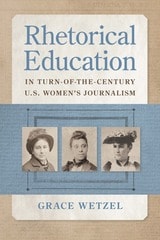
Rhetorical Education in Turn-of-the-Century U.S. Women's Journalism
Grace Wetzel, with a foreword by Shari J. Stenberg
Southern Illinois University Press, 2022
At the end of the nineteenth century, newspapers powerfully shaped the U.S. reading public, fostering widespread literacy development and facilitating rhetorical education. With new opportunities to engage audiences, female journalists repurposed the masculine tradition of journalistic writing by bringing together intimate forms of rhetoric and pedagogy to create innovative new dialogues. Rhetorical Education in Turn-of-the-Century U.S. Women’s Journalism illuminates the pedagogical contributions of three newspaperwomen to show how the field became a dynamic site of public participation, relationship building, education, and activism in the 1880s and 1890s.
Grace Wetzel introduces us to the work of Omaha correspondent Susette La Flesche Tibbles (Inshta Theamba), African American newspaper columnist Gertrude Bustill Mossell, and white middle-class reporter Winifred Black (“Annie Laurie”). Journalists by trade, these three writers made the mass-circulating newspaper their site of teaching and social action, inviting their audiences and communities—especially systematically marginalized voices—to speak, write, and teach alongside them.
Situating these journalists within their own specific writing contexts and personas, Wetzel reveals how Mossell promoted literacy learning and community investment among African American women through a reader-centered pedagogy; La Flesche modeled relational news research and reporting as a survivance practice while reporting for the Omaha Morning World-Herald at the time of the Wounded Knee Massacre; and Black inspired public writing and activism among children from different socioeconomic classes through her “Little Jim” story. The teachings of these figures serve as enduring examples of how we can engage in meaningful public literacy and ethical journalism.
Rhetorics of Literacy
The Cultivation of American Dialect PoetryNadia Nurhussein
The Ohio State University Press, 2013
Rural Literacies
Kim Donehower, Charlotte Hogg, and Eileen Schell
Southern Illinois University Press, 2006