50 books match the query 'Literature, Medieval' and 2 start with r
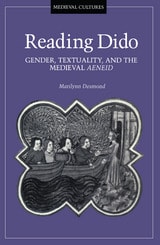
cover of Reading Dido: Gender, Textuality, and the Medieval Aeneid

Reading Dido

Gender, Textuality, and the Medieval Aeneid

Marilynn Desmond

University of Minnesota Press, 1994

Describes the variations in the figure of Dido as she emerges from ancient literary texts.

If we view the Aeneid—the poem of empire, conquest, and male hierarchy-as the West's quintessential canonical text and Latin primer, then the history of Virgil readership should tell us much about the concept of education in the West. In this book, Marilynn Desmond reveals how a constructed and mediated tradition of reading Virgil has conditioned various interpretations among readers responding to medieval cultural and literary texts. In particular, she shows how the story of Dido has been marginalized within canonical readings of the Aeneid. Reaching back to the Middle Ages and vernacular poetic readings of Dido, Desmond recovers an alternative Virgil from historical tradition and provides another paradigm for reading the Aeneid.

Desmond follows the figure of Dido as she emerges from ancient historical and literary texts (from Timaeus and Justin to Virgil and Ovid) and circulates in medieval textual cultures. Her study ranges from the pedagogical discourses of Latin textual traditions (including Servius, Augustine, Bernard Silvestris, and John of Salisbury) to the French and English vernacular cultures inscribed in the Roman d'Eneas, the Histoire ancienne jusqu'à César, and the work of Dante, Chaucer, Gavin Douglas, Caxton, and Christine de Pizan. The positions of all these readers point to the cultural specificity and historical contingency of all traditions of reading; thus, this book demonstrates how medieval traditions of reading Dido offer the modern reader a series of countertraditions that support feminist, antihomophobic, and postcolonial interpretive gestures.
[more]
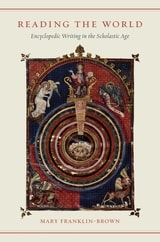
cover of Reading the World: Encyclopedic Writing in the Scholastic Age

Reading the World

Encyclopedic Writing in the Scholastic Age

Mary Franklin-Brown

University of Chicago Press, 2012

The thirteenth century saw such a proliferation of new encyclopedic texts that more than one scholar has called it the “century of the encyclopedias.” Variously referred to as a speculum, thesaurus, or imago mundi—the term encyclopedia was not commonly applied to such books until the eighteenth century—these texts were organized in such a way that a reader could easily locate a collection of authoritative statements on any given topic. Because they reproduced, rather than simply summarized, parts of prior texts, these compilations became libraries in miniature.
 
In this groundbreaking study, Mary Franklin-Brown examines writings in Latin, Catalan, and French that are connected to the encyclopedic movement: Vincent of Beauvais’s Speculum maius; Ramon Llull’s Libre de meravelles, Arbor scientiae, and Arbre de filosofia d’amor; and Jean de Meun’s continuation of the Roman de la Rose. Franklin-Brown analyzes the order of knowledge in these challenging texts, describing the wide-ranging interests, the textual practices—including commentary, compilation, and organization—and the diverse discourses that they absorb from preexisting classical, patristic, and medieval writing. She also demonstrates how these encyclopedias, like libraries, became “heterotopias” of knowledge—spaces where many possible ways of knowing are juxtaposed.
 
But Franklin-Brown’s study will not appeal only to historians: she argues that a revised understanding of late medievalism makes it possible to discern a close connection between scholasticism and contemporary imaginative literature. She shows how encyclopedists employed the same practices of figuration, narrative, and citation as poets and romanciers, while much of the difficulty of the imaginative writing of this period derives from a juxtaposition of heterogeneous discourses inspired by encyclopedias. 
 
With rich and innovative readings of texts both familiar and neglected, Reading the World reveals how the study of encyclopedism can illuminate both the intellectual work and the imaginative writing of the scholastic age.
[more]