85 books match the query 'Literature and history' and 5 start with r
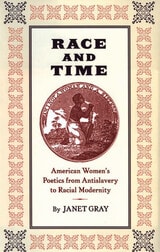
cover of Race and Time: American Women's Poetics from Antislavery to Racial Modernity

Race and Time

American Women's Poetics from Antislavery to Racial Modernity

Janet Gray

University of Iowa Press, 2004

Race and Time urges our attention to women’s poetry in considering the cultural history of race. Building on close readings of well known and less familiar poets—including Elizabeth Margaret Chandler, Sarah Louisa Forten, Hannah Flagg Gould, Frances Ellen Watkins Harper, Sarah Piatt, Mary Eliza Tucker Lambert, Sarah Josepha Hale, Eliza Follen, and Mary Mapes Dodge—Gray traces tensions in women’s literary culture from the era of abolitionism to the rise of the Plantation tradition. She devotes a chapter to children’s verse, arguing that racial stereotypes work as “nonsense” that masks conflicts in the construction of white childhood. A compilation of the poems cited, most of which are difficult to find elsewhere, is included as an appendix.

Gray clarifies the cultural roles women’s poetry played in the nineteenth-century United States and also reveals that these poems offer a fascinating, dynamic, and diverse field for students of social and cultural history. Gray’s readings provide a rich sense of the contexts in which this poetry is embedded and examine its aesthetic and political vitality in meticulous detail, linking careful explication of the texts with analysis of the history of poetry, canons, literacy, and literary authority.

Race and Time distinguishes itself from other critical studies not only through its searching, in-depth readings but also through its sustained attention to less known poets and its departure from a Dickinson-centered model. Most significantly, it offers a focus on race, demonstrating how changes in both the U.S. racial structure and women’s place in public culture set the terms for change in how women poets envisioned the relationship between poetry and social power.

Gray’s work makes contributions to several fields of study: poetry, U.S. literary history and American studies, women’s studies, African American studies and whiteness studies, children’s literature, and cultural studies. While placing the works of figures who have been treated elsewhere (e.g., Dickinson and Harper) into revealing new relationships, Race and Time does much to open interdisciplinary discussion of unfamiliar works.
[more]
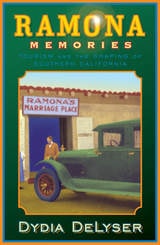
cover of Ramona Memories: Tourism and the Shaping of Southern California

Ramona Memories

Tourism and the Shaping of Southern California

Dydia DeLyser

University of Minnesota Press, 2005
The most important woman in the history of southern California never lived. The eponymous heroine of Helen Hunt Jackson's popular 1884 novel Ramona, a half-Indian beauty raised on a wealthy Mexican rancho, nonetheless left an indelible imprint on southern California's landscape. Within a year of its publication, landmarks identified with Ramona's fictional life - her birthplace, her home, the site of her wedding, and her grave - became important, even canonical parts of a visit to southern California. One could take the Ramona freeway to town, cook like Ramona, and smell like Ramona. The novel's romanticized version of California's Hispanic past also inspired films, songs, musical instruments, jewelry, clothes, beer, wine, canned goods, collectibles, and a play that still draws thirty thousand people annually. Although historians and other writers have acknowledged Ramona's importance in the shaping of southern California's regional identity, there has never been an in-depth study of the origins and evolution of the "Ramona Myth" itself - until now. In Ramona Memories, Dydia DeLyser traces the myth's emergence within the context of the late nineteenth- and early twentieth-century tourist industry. DeLyser explores the establishment of tourist attractions by fans of the novel. She details the stories of individual Ramona enthusiasts who, guided by numerous travel books and articles, wove the text of the novel and its lavishly described locations into their own lives, from pilgrimages to either of the two ranchos acclaimed as Ramona's home to Ramona-themed luncheons and hopeful honeymoon visits to the Wishing Well at her marriage place. Based on more than a decade of meticulous research, Ramona Memories reveals how a fiction - and the real places and products that it inspired - helped to make an idealized past visible, permeating southern California's social memory.
[more]
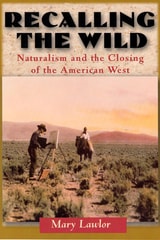
cover of Recalling the Wild: Naturalism and the Closing of the American West

Recalling the Wild

Naturalism and the Closing of the American West

Lawlor, Mary

Rutgers University Press, 2000

Ever since the first interactions between Europeans and Native Americans, the “West” has served as a site of complex geographical, social and cultural transformation. American literature is defined, in part, by the central symbols derived from these points of contact. By the end of the nineteenth century, the Western frontier was declared “closed,” a demise solidified by Frederick Jackson Turner’s influential essay “The Significance of the Frontier in American History (1893). At the same time, “naturalism” was popularized by the writings of Frank Norris, Stephen Crane, Jack London, Willa Cather, and the photographs of Edward Curtis. Though very different artists, they were united by their common attraction to the mythic American West.

As she investigates the interactions of representations of the West, Lawlor effortlessly melds literary studies, American studies, and history. She traces the cultural conception of the American West through its incarnations in the “westernism” of Daniel Boone and James Fenimore Cooper and the romanticism of the expansive frontier they helped formulate. Simultaneously, however, the influence of evolutionism and the styles of French naturalism began to challenge this romantic idiom. This naturalistic discourse constructed the West as a strictly material place, picturing a limited and often limiting geography that portrayed regional identity as the product of material “forces” rather than of individualistic enterprise.

With subtle, probing language, Lawlor explains how literary and artistic devices helped shape the idea of the American West and the changing landscape of the continent at the turn of the last century.
[more]
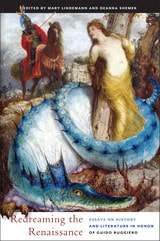
cover of Redreaming the Renaissance: Essays on History and Literature in Honor of Guido Ruggiero

Redreaming the Renaissance

Essays on History and Literature in Honor of Guido Ruggiero

Mary Lindemann

University of Delaware Press, 2024
Redreaming the Renaissance seeks to remedy the dearth of conversations between scholars of history and literary studies by building on the pathbreaking work of Guido Ruggiero to explore the cross-fertilization between these two disciplines, using the textual world of the Italian Renaissance as proving ground. In this volume, these disciplines blur, as they did for early moderns, who did not always distinguish between the historical and literary significance of the texts they read and produced. Literature here is broadly conceived to include not only belles lettres, but also other forms of artful writing that flourished in the period, including philosophical writings on dreams and prophecy; life-writing; religious debates; menu descriptions and other food writing; diaries, news reports, ballads, and protest songs; and scientific discussions. The twelve essays in this collection examine the role that the volume’s dedicatee has played in bringing the disciplines of history and literary studies into provocative conversation, as well as the methodology needed to sustain and enrich this conversation.
[more]
cover of Revisionary Interventions into the Americanist Canon

Revisionary Interventions into the Americanist Canon

Donald E. Pease

Duke University Press, 1994

Throughout the era of the Cold War a consensus reigned as to what constituted the great works of American literature. Yet as scholars have increasingly shown, and as this volume unmistakably demonstrates, that consensus was built upon the repression of the voices and historical contexts of subordinated social groups as well as literary works themselves, works both outside and within the traditional canon. This book is an effort to recover those lost voices. Engaging New Historicist, neo-Marxist, poststructuralist, and other literary practices, this volume marks important shifts in the organizing principles and self-understanding of the field of American Studies.
Originally published as a special issue of boundary 2, the essays gathered here discuss writers as diverse as Kate Chopin, Frederick Douglass, Emerson, Melville, W. D. Howells, Henry James, W. E. B. DuBois, and Mark Twain, plus the historical figure John Brown. Two major sections devoted to the theory of romance and to cultural-historical analyses emphasize the political perspective of "New Americanist" literary and cultural study.

Contributors. William E. Cain, Wai-chee Dimock, Howard Horwitz, Gregory S. Jay, Steven Mailloux, John McWilliams, Susan Mizruchi, Donald E. Pease, Ivy Schweitzer, Priscilla Wald, Michael Warner, Robert Weimann

[more]