Results by title
57 books match the query 'Literature and science' and 4 start with r
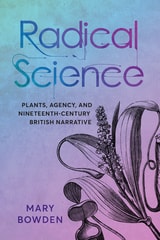
Radical Science
Plants, Agency, and Nineteenth-Century British NarrativeMary Bowden
The Ohio State University Press, 2026
Can plants move? Can they think? Can they act? In Radical Science, Mary Bowden shows that debates about plants’ capabilities are not new but can be traced to the nineteenth century, where they moved from scientific inquiries to popular articles and literary fiction. Examining the work of nineteenth-century physiological botanists, Bowden expands beyond Charles Darwin’s work in the field to uncover the full story of these debates and the impacts they had on literature, culture, and people. While many have interpreted the frequent comparisons between plants and people in nineteenth-century literature to be exemplary of aesthetic values or sexual symbolism, Bowden maintains that comparisons between plants and women, members of the working class, and people of color reiterate botanical debates about how to recognize agency in beings that are assumed to be passive. Studying the scientific texts of Darwin and Maria Elizabetha Jacson alongside social problem novels by Elizabeth Gaskell and Charles Kingsley and early science fiction by H. G. Wells, Radical Science foregrounds the connection between science and literature and ultimately suggests that we look to the propositions of nineteenth-century physiological botany to find more sustaining models of social and environmental relationship.
[more]
Rethinking Reality
Lucretius and the Textualization of NatureDuncan F. Kennedy
University of Michigan Press, 2002
How deeply into the structure of physical reality do the effects of our way of representing it reach? To what extent do constructivist accounts of scientific theorizing involve realist assumptions, and vice versa? This book provides a lucid and concise introduction to contemporary debates, taking as its theme the question of the relationship of representation and reality. It treats in an attractive and accessible way the historical, philosophical, and literary aspects of this question. In particular, it explores how the present relates to and configures claims to scientific knowledge from the past, taking as its main case study On the Nature of Things (De Rerum Natura), the poem on physics written by the Roman poet Lucretius in the 50s B.C.E.
The book engages in a sustained argument about realist assumptions in scientific and other discourses through detailed analysis and discussion of some of the most important recent contributions to this debate. Engaging sympathetically but not uncritically with constructivist accounts of scientific knowledge, the book takes up a sustained critique of recent contributions to that debate, including those of Ian Hacking, Evelyn Fox Keller, Bruno Latour, and Hans-Jörg Rheinberger. What are the implications of regarding such knowledge as "discovered" or "invented"? How is the rhetoric of such claims to be identified and the pretentions of those claims assessed?In what ways can realist and constructivist approaches be reconciled? How do these considerations affect the way we read scientific texts from the past and regard them historically?
What emerges is a fresh and challenging assessment of the role of time and temporal perspective in assessing claims to knowledge in scientific thought and of the importance of textuality to the history of knowledge. A wide variety of readers, from classicists and intellectual historians to epistemologists of science, will enjoy and learn from Rethinking Reality.
Duncan Kennedy is Reader in Latin Literature and the Theory of Criticism, University of Bristol. He is also the author of The Arts of Love: Five Studies in the Discourse of Roman Love Elegy.
[more]
Rhetoric, Science, and Magic in Seventeenth-century England
Ryan J. Stark
Catholic University of America Press, 2009
Ryan J. Stark presents a spiritually sensitive, interdisciplinary, and original discussion of early modern English rhetoric. He shows specifically how experimental philosophers attempted to disenchant language
[more]
Robert Frost and the Challenge of Darwin
Robert Faggen
University of Michigan Press, 2001
Robert Frost and the Challenge of Darwin gives us a new and compelling portrait of the poet-thinker as a modern Lucretius--moved to examine the questions raised by Darwin, and willing to challenge his readers with the emerging scientific notions of what it meant to be human.
Combining both intellectual history and detailed analysis of Frost's poems, Robert Faggen shows how Frost's reading of Darwin reflected the significance of science in American culture from Emerson and Thoreau, through James and pragmatism. He provides fresh and provocative readings of many of Frost's shorter lyrics and longer pastoral narratives as they illustrate the impact of Darwinian thought on the concept of nature, with particular exploration of man's relationship to other creatures, the conditions of human equality and racial conflict, the impact of gender and sexual differences, and the survival of religion.
The book shows that Frost was neither a pessimist lamenting the uncertainties of the Darwinian worldview, nor a humanist opposing its power. Faggen draws on Frost's unpublished notebooks to reveal a complex thinker who willingly engaged with the difficult moral and epistemological implications of natural science, and showed their consonance with myths and traditions stretching back to Milton, Lucretius, and the Old Testament. Frost emerges as a thinker for whom poetry was not only artistic expression, but also a forum for the trial of ideas and their impact on humanity.
Robert Frost and the Challenge of Darwin provides a deeper understanding not only of Frost and modern poetry, but of the meaning of Darwin in the modern world, the complex interrelations of literature and science, and the history of American thought.
"A forceful, appealing study of the Frost-Darwin relation, which has gone little noted by previous scholars, and a fresh explanation of Frost's ambivalent relation to modernism, which he scorned but also influenced" --William Howarth, Princeton University
Robert Faggen is Associate Professor of Literature, Claremont McKenna College and Adjunct Associate Professor, Claremont Graduate School.
[more]