Results by title
65 books match the query 'Literature and the war' and 4 start with r
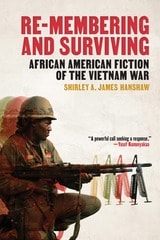
Re-Membering and Surviving
African American Fiction of the Vietnam WarShirley A. James Hanshaw
Michigan State University Press, 2020
The first book-length critical study of the black experience in the Vietnam War and its aftermath, this text interrogates the meaning of heroism based on models from African and African American expressive culture. It focuses on four novels: Captain Blackman (1972) by John A. Williams, Tragic Magic (1978) by Wesley Brown, Coming Home (1971) by George Davis, and De Mojo Blues (1985) by A. R. Flowers. Discussions of the novels are framed within the historical context of all wars prior to Vietnam in which Black Americans fought. The success or failure of the hero on his identity quest is predicated upon the extent to which he can reconnect with African or African American cultural memory. He is engaged therefore in “re-membering,” a term laden with the specificity of race that implies a cultural history comprised of African retentions and an interdependent relationship with the community for survival. The reader will find that a common history of racism and exploitation that African Americans and Vietnamese share sometimes results in the hero’s empathy with and compassion for the so-called enemy, a unique contribution of the black novelist to American war literature.
[more]
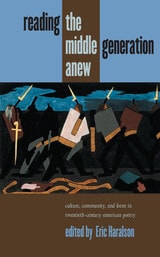
Reading the Middle Generation Anew
Culture, Community, and Form in Twentieth-Century American PoetryEric Haralson
University of Iowa Press, 2006
Ten original essays by advanced scholars and well-published poets address the middle generation of American poets, including the familiar—Robert Lowell, Elizabeth Bishop, Randall Jarrell, and John Berryman—and various important contemporaries: Delmore Schwartz, Theodore Roethke, Robert Hayden, and Lorine Niedecker. This was a famously troubled cohort of writers, for reasons both personal and cultural, and collectively their poems give us powerful, moving insights into American social life in the transforming decades of the 1940s through the 1960s.
In addition to having worked during the broad middle of the last century, these poets constitute the center of twentieth-century American poetry in the larger sense, refuting invidious connotations of “middle” as coming after the great moderns and being superseded by a proliferating postmodern experimentation. This middle generation mediates the so-called American century and its prodigious body of poetry, even as it complicates historical and aesthetic categorizations.
Taking diverse formal and thematic angles on these poets—deconstructionist, biographical-historical, and more formalist accounts—this book re-examines their between-ness and ambivalence: their various positionings and repositionings in aesthetic, political, and personal matters. The essays study the interplay between these writers and such shifting formations as religious discourse, consumerism, militarism and war, the ideology of America as “nature’s nation,” and U.S. race relations and ethnic conflicts. Reading the Middle Generation Anew also shows the legacy of the middle generation, the ways in which their lives and writings continue to be a shaping force in American poetry. This fresh and invigorating collection will be of great interest to literary scholars and poets.
[more]
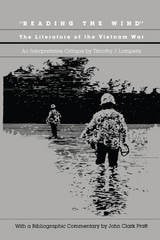
Reading the Wind
The Literature of the Vietnam WarTimothy J. Lomperis
Duke University Press, 1987
The decade following the American defeat in Vietnam has been filled with doubts about American politics and values, confusion over the lessons of the war, and anger about the physical and psychological suffering that occurred during the war as well as thereafter. In the years since the U.S. withdrawal, our need to make sense of Vietnam has prompted an outpouring of thinking and writing, from scholarly reappraisals of American foreign policy to highly personal accounts of participants. On the tenth anniversary of the final U. S. withdrawal, the Asia Society sponsored a conference on the Vietnam experience in American literature at which leading writers, critics, publishers, commentators, and academics wrestled with this phenomenon. Drawing on the synergy of this conference, Timothy J. Lomperis has produced an original work that focuses on the growing body of literature—including novels, personal accounts, and oral histories—which describes the experiences of American soldiers in Vietnam as well as the experience of veterans upon their return home.
[more]
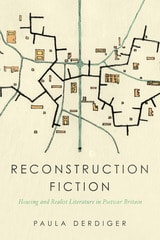
Reconstruction Fiction
Housing and Realist Literature in Postwar BritainPaula Derdiger
The Ohio State University Press, 2020
Reconstruction Fiction: Housing and Realist Literature in Postwar Britain by Paula Derdiger assesses the impact of World War II and the welfare state on literary fiction by focusing on one of the defining issues of the postwar period: housing. Through compelling close readings and lively historical and cultural analysis, Derdiger argues that literary realism was a necessary, generative response to the war and welfare state since they impacted the built environment and landscape. Wartime decimation of buildings and streets called for reconstruction, and reconstruction called not just for bricks and mortar, architectural drawings, town plans, preservation schemes, and new policies but also for fiction that invited particular ways of inhabiting an environment that had been irrevocably changed. Derdiger argues that fiction, like actual buildings, creates a sheltered space for the mediation between individual subjects and the social and geographical environments that they encounter. Realist fiction, specifically, insists that such mediation is possible and that it is socially valuable. Covering writers spanning various social positions and aesthetic tendencies—including Elizabeth Bowen, Graham Greene, Patrick Hamilton, Doris Lessing, Colin MacInnes, and Elizabeth Taylor—Derdiger shows how these authors responded to the war with realistic technique, investing in external conditions just as much as or more than their characters’ interior lives. In doing so, their reconstruction fiction helped to shape postwar life.
[more]