Results by title
99 books match the query 'Local' and 4 start with r
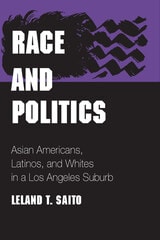
Race and Politics
Asian Americans, Latinos, and Whites in a Los Angeles SuburbLeland T. Saito. Foreword by Roger Daniels
University of Illinois Press, 1998
Located a mere fifteen minutes from Los Angeles, the San Gabriel Valley is an incubator for California's new ethnic politics. Here, Latinos and Asian Americans are the dominant groups. Politics are Latino-dominated, while a large infusion of Chinese immigrants and capital has made the San Gabriel Valley the center of the nation's largest Chinese ethnic economy. The white population, meanwhile, has dropped from an overwhelming majority in 1970 to a minority in 1990.
Leland T. Saito presents an insider's view of the political, economic, and cultural implications of this ethnic mix. He examines how diverse residents of the region have worked to overcome their initial antagonisms and develop new, more effective political alliances.
Tracing grassroots political organization along racial and ethnic lines, Race and Politics focuses on the construction of new identities in general and the panethnic affiliation "Asian American" in particular.
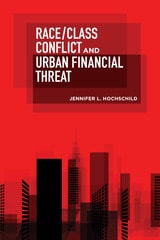
Race/Class Conflict and Urban Financial Threat
Jennifer L. Hochschild
Russell Sage Foundation, 2024
Hochschild investigates the root causes of disputes in the arenas of policing, development, schooling, and budgeting. She finds that race and class are central to the Stop-Question-Frisk policing policy in New York City and the development of Atlanta’s Beltline. New York’s Stop-Question-Frisk policy was intended to fight crime and keep all New Yorkers safe. In practice, however, young Black and Latino men in low-income neighborhoods were disproportionately stopped by a predominantly White police force. The goal of the Atlanta Beltline, a redevelopment project that includes public parks, new housing, commercial development, and a robust public transit system, is to expand access around the city and keep working-class residents in the city by constructing affordable housing. Instead, the construction completed thus far has encouraged gentrification and displacement of poor, disproportionately Black residents, and has increased the wealth and power of both Black and White city elites.
However, Hochschild finds that race and class inequality are not central to all urban policy disputes. When investigating the issues of charter schools in Los Angeles and Chicago’s pension system she identifies a third driver: financial threat that feels existential to the policy and political actors. In Los Angeles, there is a battle between traditional public schools and independent charter schools. Increasingly, families with sufficient resources are moving out of L.A. to areas with better school districts. Traditional public schools and charter schools must fight for the remaining students and the funding that comes with them. There are not enough students to teach and not enough money to teach them. The school district risks school closures, layoffs, and pension deficits; in this context, race/class conflict fades into the background.
Chicago’s public sector pension debt is at least three times as large as the city’s annual budget and continues to grow. Policy actors agree that the pension system needs to be stably funded. Yet city leaders, fearful of upsetting constituents and jeopardizing their political careers, fail to implement policies that would do so. Meaningful policy change to rectify the pension deficit continues to get kicked down the line for future policy actors to address. In this context also, race/class conflict fades into the background.
Race/Class Conflict and Urban Financial Threat is a compelling examination of the role that race, class, and political and fiscal threat play in shaping urban policy.
Readings in Arkansas Politics and Government
Kim U. Hoffman
University of Arkansas Press, 2020
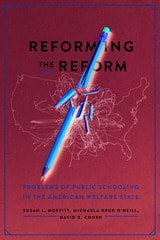
Reforming the Reform
Problems of Public Schooling in the American Welfare StateSusan L. Moffitt, Michaela Krug O'Neill, and David K. Cohen
University of Chicago Press, 2023
School reform is almost always born out of big dreams and well-meaning desires to change the status quo. But between lofty reform legislation and the students whose education is at stake, there are numerous additional policies and policymakers who determine how reforms operate. Even in the best cases, school reform initiatives can perpetuate problems created by earlier reforms or existing injustices, all while introducing new complications. In Reforming the Reform, political scientist Susan L. Moffitt, education policy scholar Michaela Krug O’Neill, and the late policy and education scholar David K. Cohen take on a wide-ranging examination of the many intricacies of school reform.
With a particular focus on policymakers in the spaces between legislation and implementation, such as the countless school superintendents and district leaders tasked with developing new policies in the unique context of their district or schools, the authors identify common problems that arise when trying to operationalize ambitious reform ideas. Their research draws on more than 250 interviews with administrators in Tennessee and California (chosen as contrasts for their different political makeup and centralization of the education system) and is presented here alongside survey data from across the United States as well as archival data to demonstrate how public schools shoulder enormous responsibilities for the American social safety net. They provide a general explanation for problems facing social policy reforms in federalist systems (including healthcare) and offer pathways forward for education policy in particular.